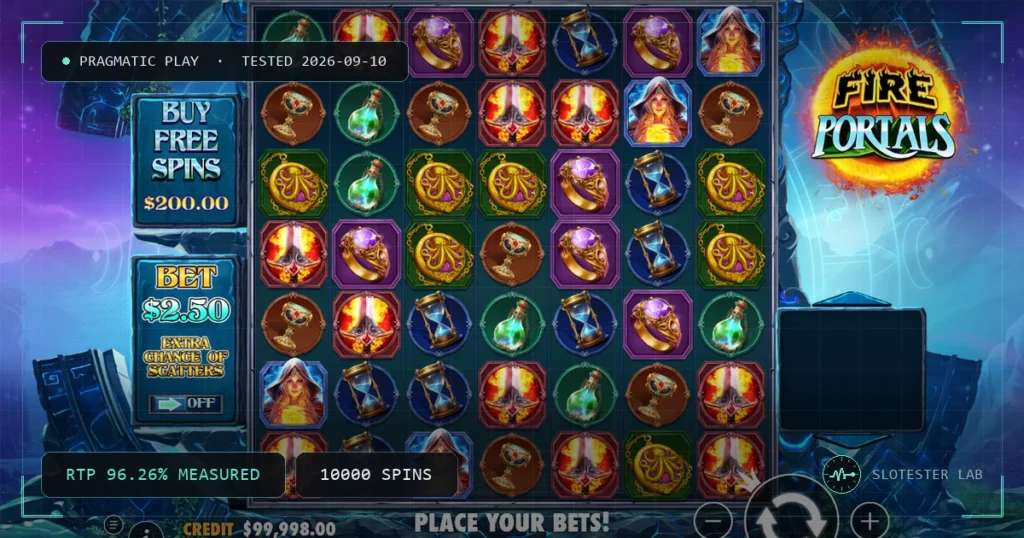
Pragmatic Play · 2024 · tested 2026-09-10
Fire Portals
Merged portals never rewrite a win already paid in the Fire Portals demo: 477 mergers were logged, and 45 of 50 bought free spins rounds finished below their USD 200 price.
- RTP measured / declared 96.3% 96.06%
- Hit frequency 25%
- Max win · no bonus 366x
- Bonus buy · mean result 100x · 0.57x
- Free spins, natural 31 / 10,000
- Bonus frequency 3.1 bHz
In numbers: measured RTP 96.3% against 96.06% declared over 10,000 logged rounds; 25.0% of rounds paid; a natural bonus landed once per 323 rounds (31 in total) and a bonus round paid a median 59.4x the stake, mean 81.1x, trigger spin included; 50 bonus buys at 100x returned 0.57x of their price on average, 90% of them below the price; the biggest round paid 365.9x; the longest dry run was 32 spins.
Test card
10,000 spins · USD 2.00 bet · every request logged| Spins | 10,000 |
| Bet | USD 2.00 |
| RTP declared | 96.06% |
| RTP measured | 96.26% (approximate 95% CI 79.7–112.8) |
| Hit frequency | 25% · every 4.01 |
| Dead streak max / avg | 32 / 3.98 |
| Median hit | 0.90x |
| Max win (no bonus round) | 365.9x · round 990 |
| Free spins, natural | 31 · 3.1 bHz · every 322.6 spins · mean bonus round payout 81.1x stake |
| Balance start → end | 100,000 → 99,253 |
each run keeps its own spin log, CSV and raw server journal with checksums; the figures on this card combine all runs
Play Fire Portals demo
PRAGMATIC PLAY · official demo · same math as real play United States
Fire Portals available at Cafe Casino
United States
Fire Portals available at Cafe Casino
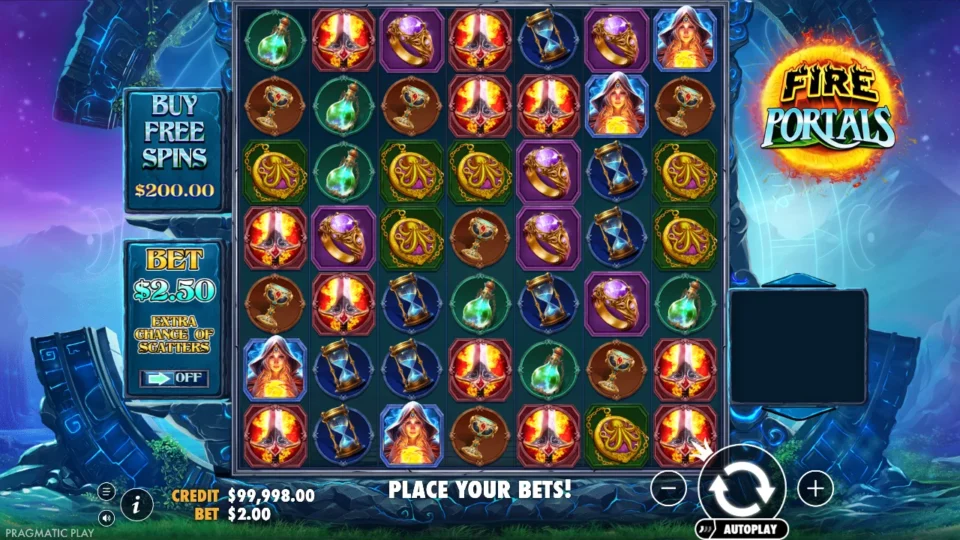
Same reels, real payouts
Cafe Casino runs the same Fire Portals with the same math and adds a welcome bonus for players from the United States:
300% up to $2,000 + 150 FS 18+ · T&Cs apply · the demo stays free
Bonus buy lab
50 buys × 100x · USD 200 eachmean 0.57x · median 0.314× price (USD 62.70) · 45 of 50 below price · best 5.34x · worst 0.03x
| Spins per bonus (avg / min–max) | 10.1 / 10–12 |
| Retriggered | 0.0% |
| Bonuses that paid nothing | 0% |
A retrigger requires another qualifying book-scatter event during free spins. A twelve-spin starting award is not an extension; none of the 50 purchases retriggered.
- Spent
- USD 10,00050 × USD 200
- Returned
- USD 5,71957.19% · approximate 95% CI 32–82%
- Net
- −USD 4,281−21.4 buys
- Break-even or better
- 5 / 5010%
- Paid 2× price or more
- 2 / 504%
- Price in base spins
- 100natural trigger every ~323 spins
One ticket equals 100 ordinary stakes. Natural bonuses occurred once per 323 ordinary rounds in this sample. Stakes multiplied by this interval measure gross wagering, not the net cost of obtaining a bonus. Purchase returns above include the complete purchased round and are divided by the ticket price.
Risk profile
how much bankroll this run needed| 50 bets | bust at spin 71 |
| 100 bets | bust at spin 155 |
| 200 bets | bust at spin 301 |
One run, one bet size. A different session can bust earlier or never; treat this as a measured example, not a rule.
How it plays
7 rules screens from the game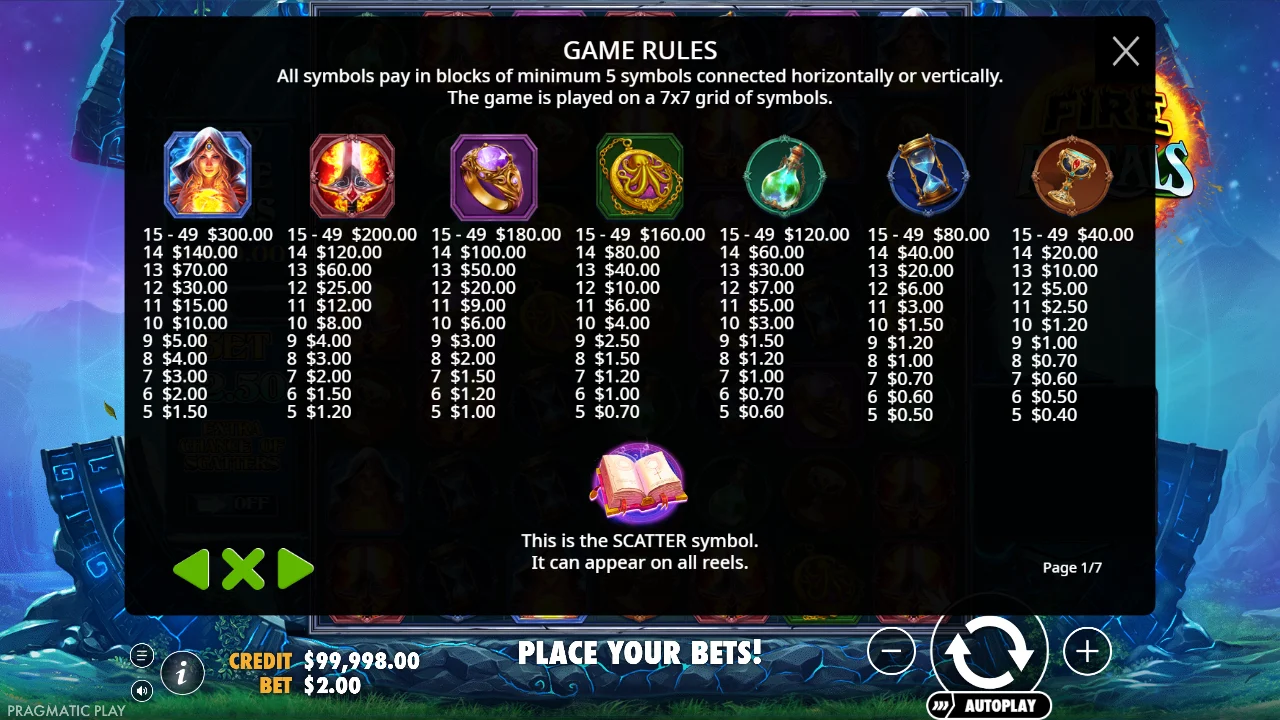
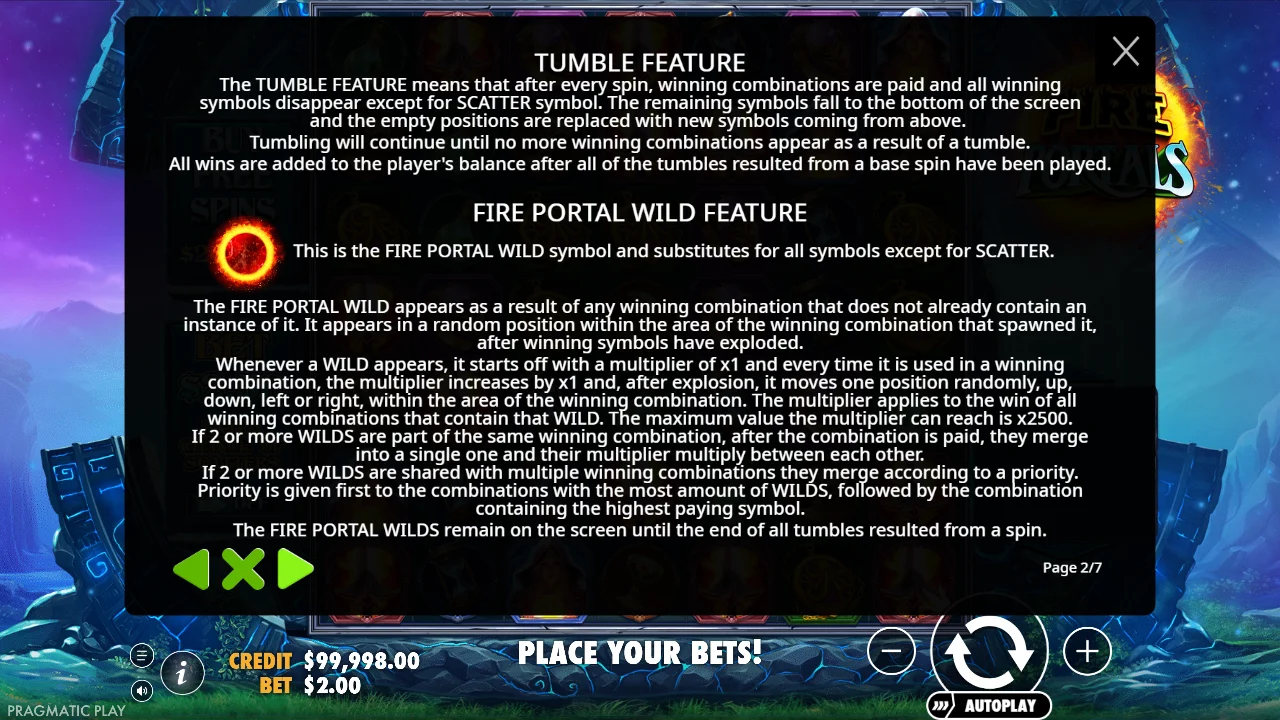
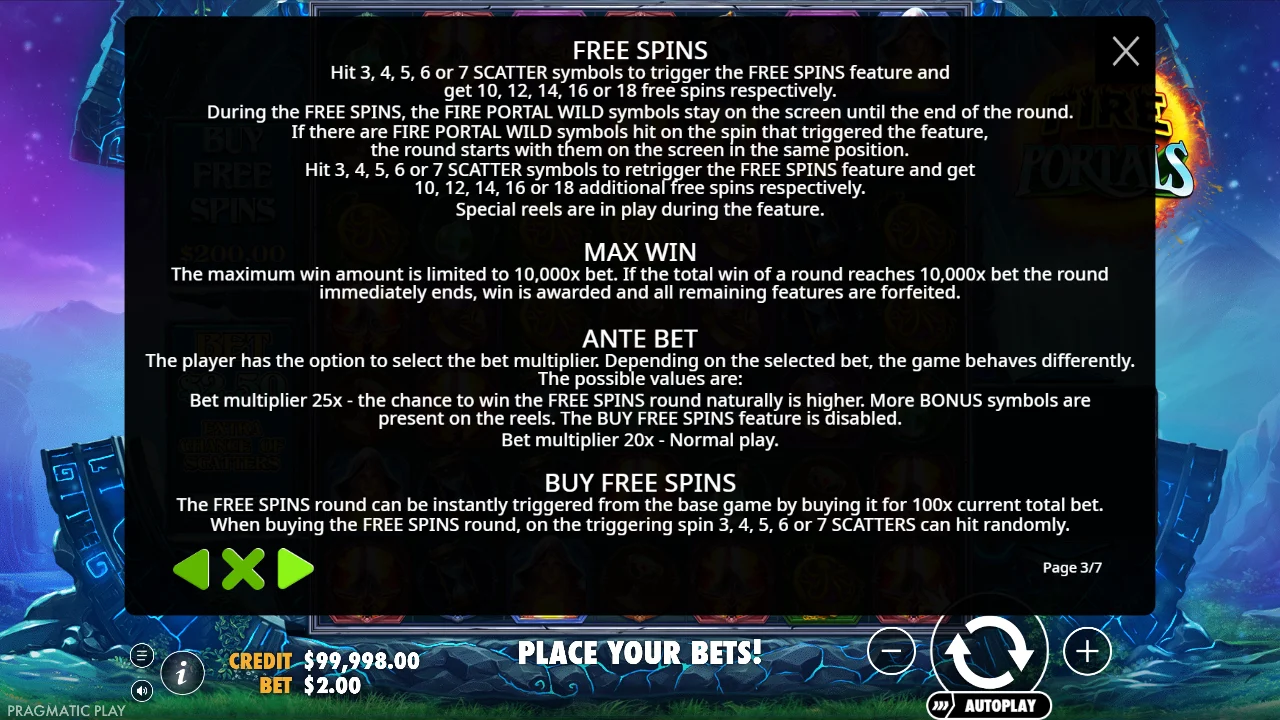
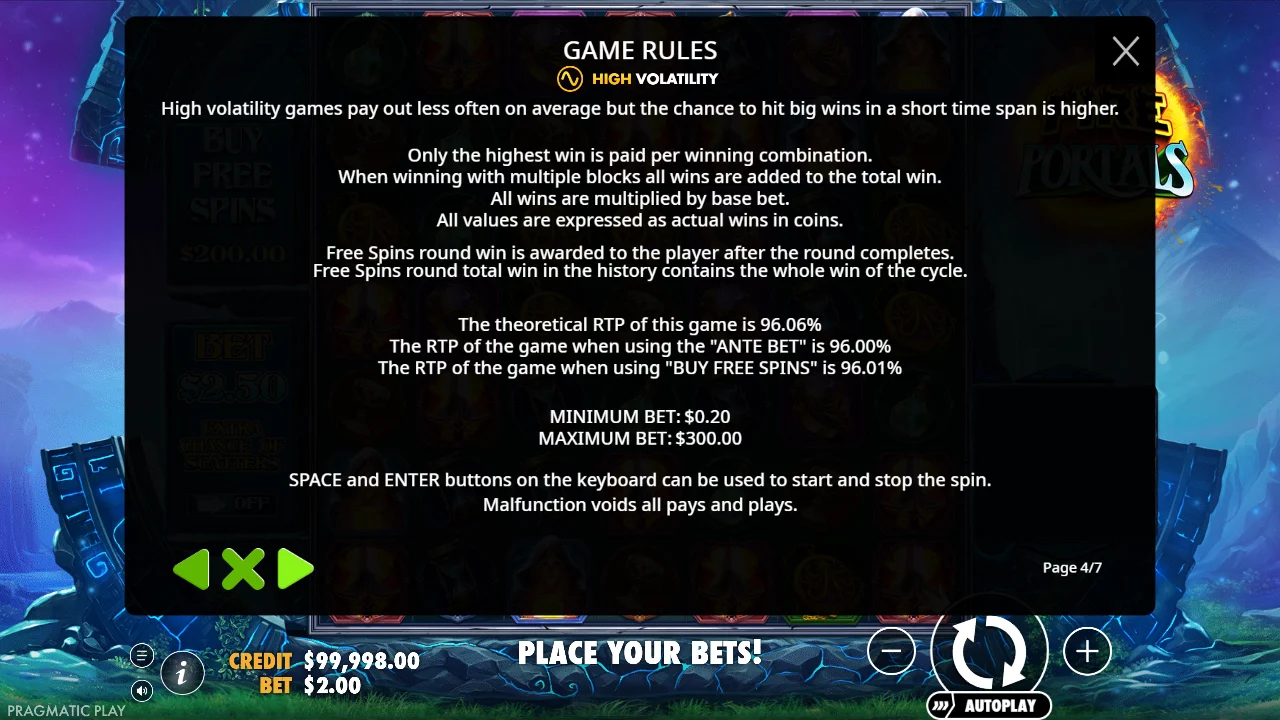
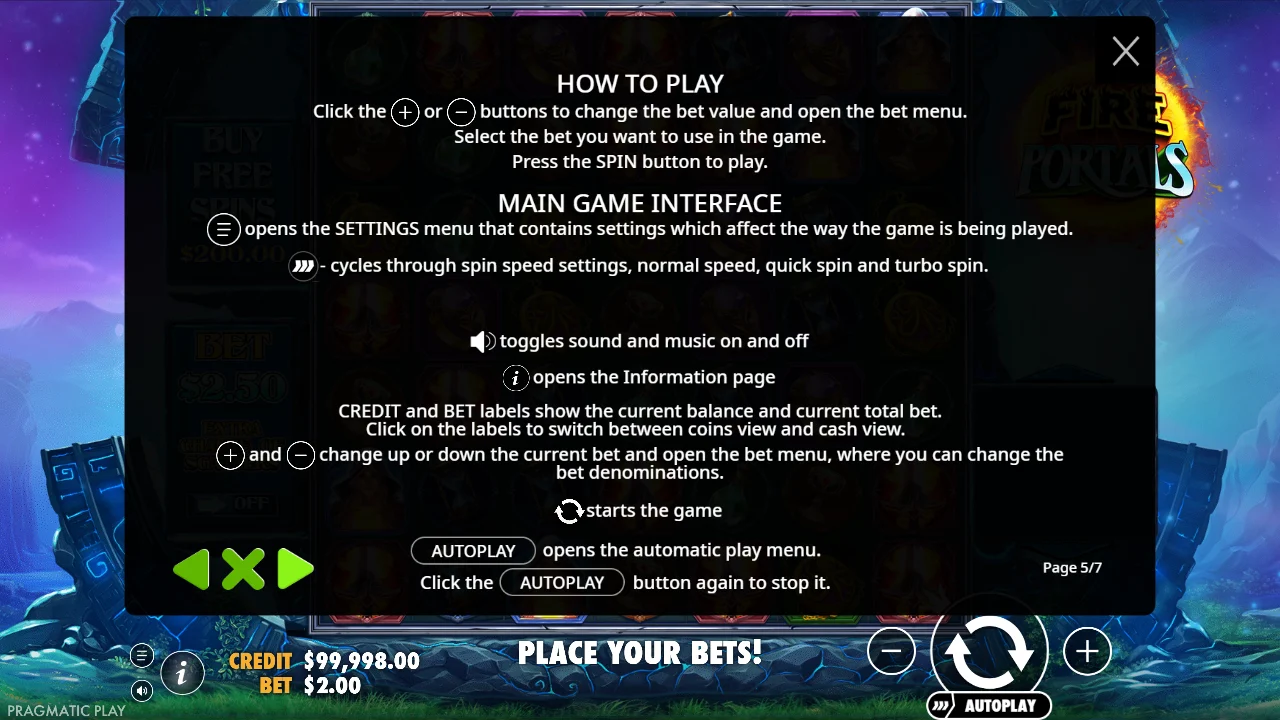
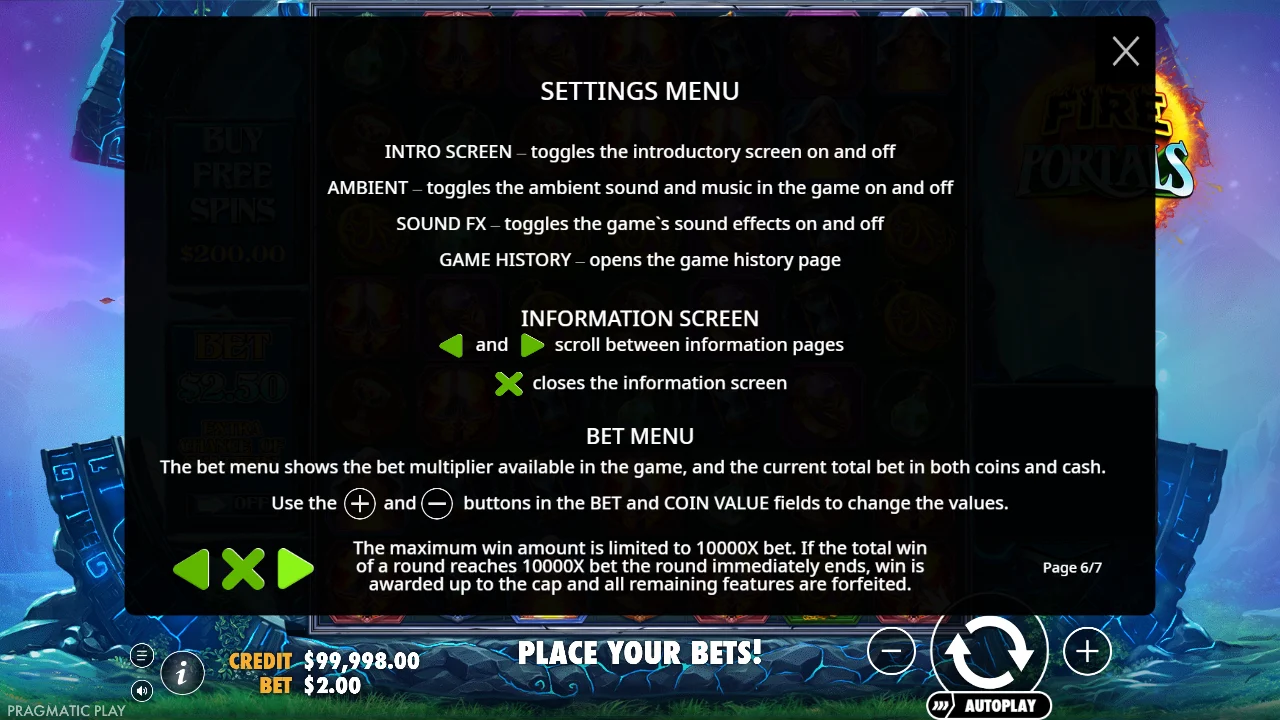
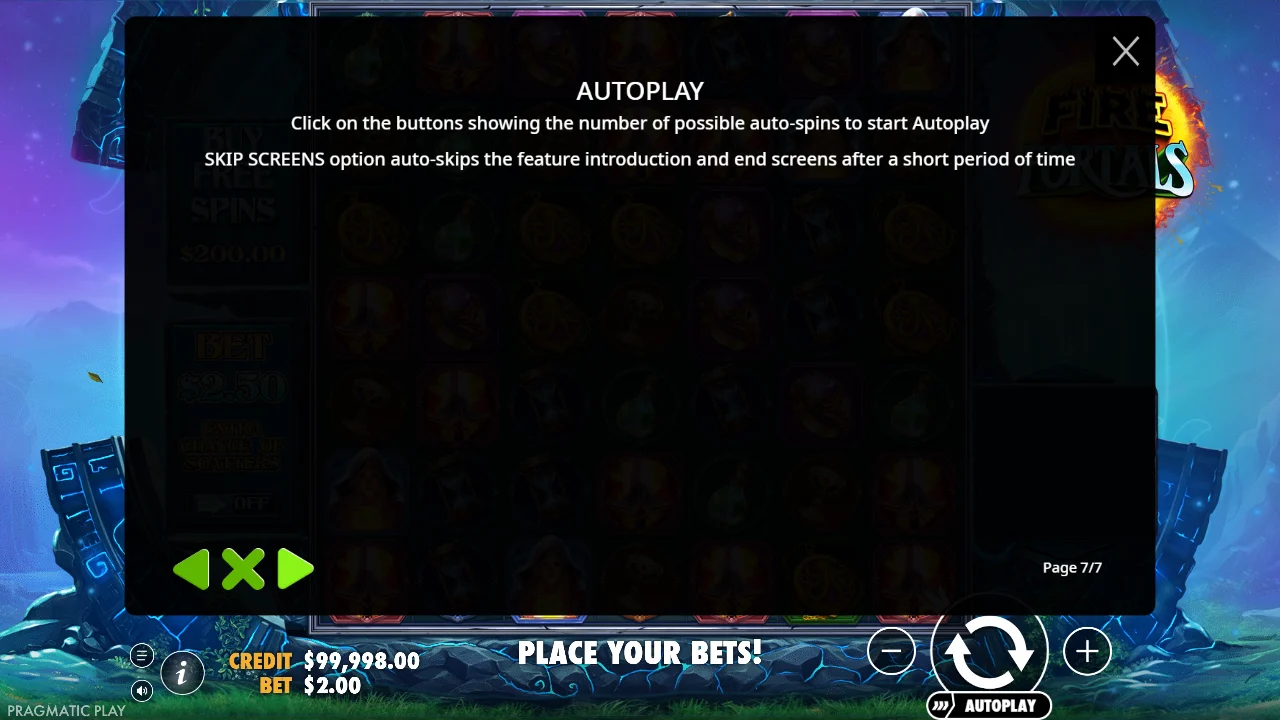
Fire Portals pays connected blocks on a seven-by-seven board. At least five identical symbols must touch through their horizontal or vertical edges; a diagonal meeting does not join two groups. Winning symbols disappear, replacements occupy the empty cells and any resulting blocks are paid before the round closes. The book is the scatter and does not disappear with an ordinary winning block.
A winning block with no portal creates one in its area after the symbols explode. This wild substitutes for paying symbols and begins at 1x. Its value contributes to any winning block using that position, then increases by one for each winning combination that used it. After the explosion it can move one position within the winning area, staying through the remaining tumbles of that paid spin.
When a block contains several portals, the payout uses their current combined values. The later merger is a separate step: after the win is paid, the updated portal values multiply together to form one wild. Purchase 4 shows this split clearly: 1 plus 322 gave a 323x payout factor, while the updated values of 2 and 323 formed a 646x portal. If competing combinations share wilds, the merger gives priority to the group containing more wilds, then to the higher-paying symbol; no portal can exceed 2,500x.
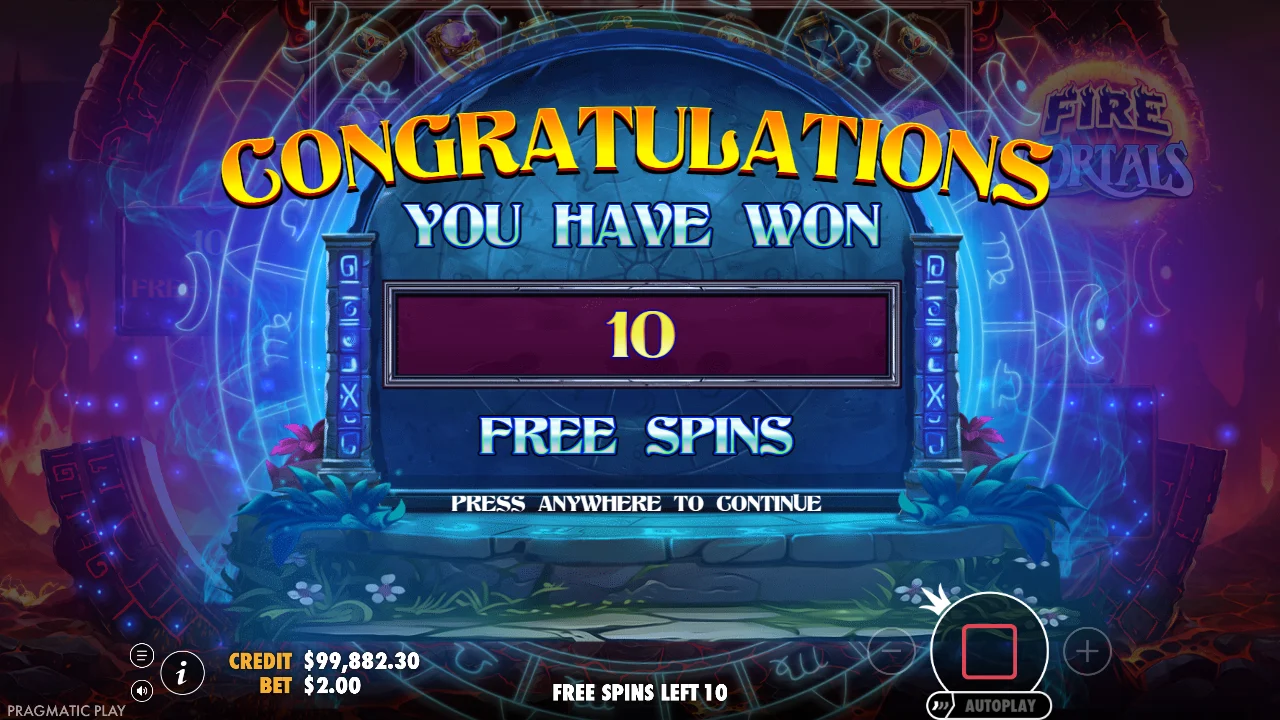
The books open free spins with three or more scatters. Three, four, five, six and seven award ten, twelve, fourteen, sixteen and eighteen spins respectively. The same scatter counts add those amounts again when they land during the feature. Existing portals from the triggering spin carry into the bonus, where portals remain across spins until the feature finishes.
At USD 2 per ordinary spin, the direct-entry button asks for USD 200, and the bought trigger can land three to seven books, so a longer opening award is possible without a retrigger. Ante raises the ordinary stake and adds bonus symbols to the reels, with purchases then unavailable; both statistical series used the ordinary USD 2 setting with Ante off. Marked as high volatility, this build allows stakes from USD 0.20 up to USD 300 including Ante, with theoretical returns of 96.06% for ordinary play, 96.00% with Ante and 96.01% for purchases. The round stops on reaching its win ceiling, 10,000x at the tested setting, cancelling unused features.
 Cluster pays
 Cascading reels
 Wild symbol
 Multiplier
 Scatter symbol
 Free spins
 Retrigger
 Bonus buy
 Extra bet
On narrow screens, swipe or use arrow keys to view all payouts.
Bet range USD 0.20 – 300 per spin · payouts read from the game's paytable at bet USD 2.00
Gallery
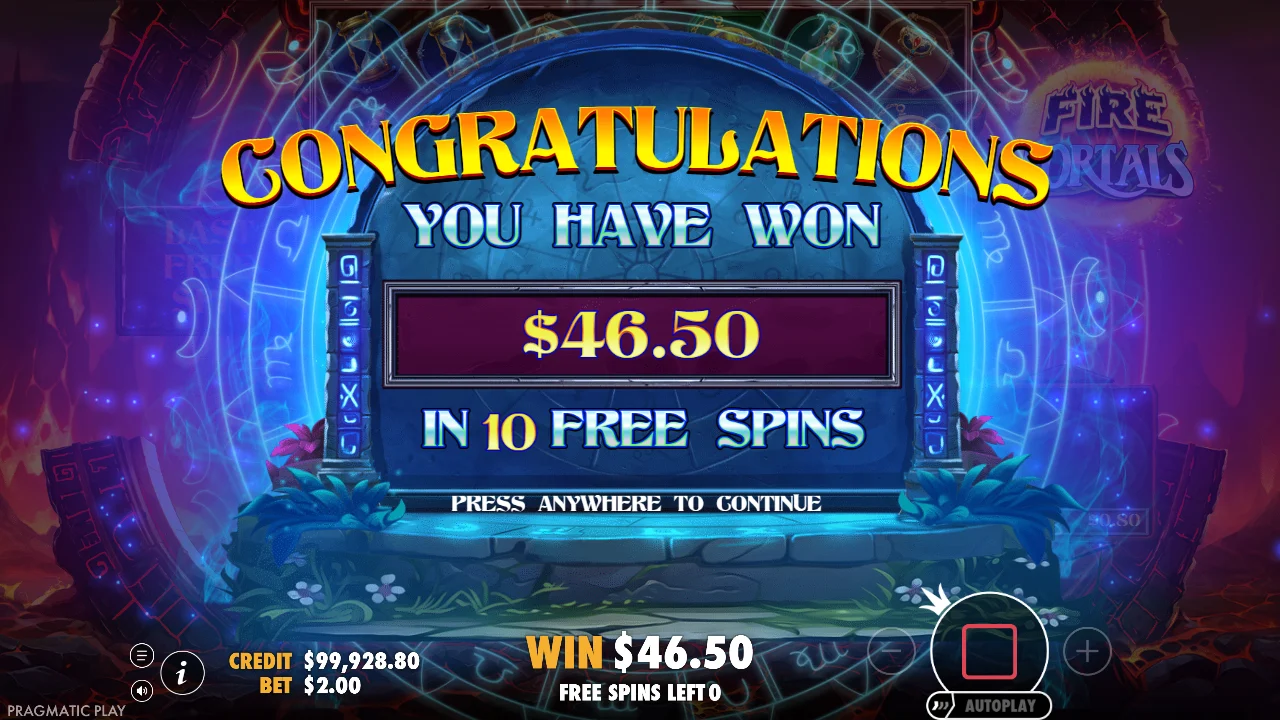
6 frames from the demo session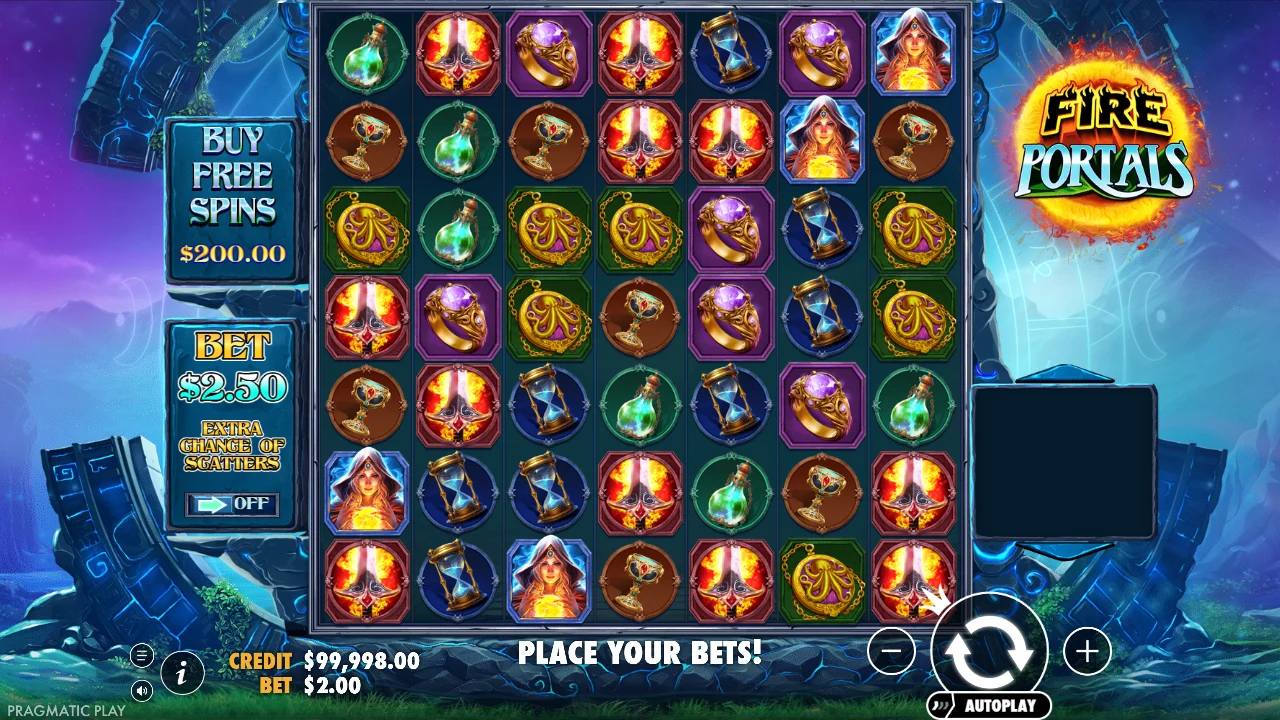
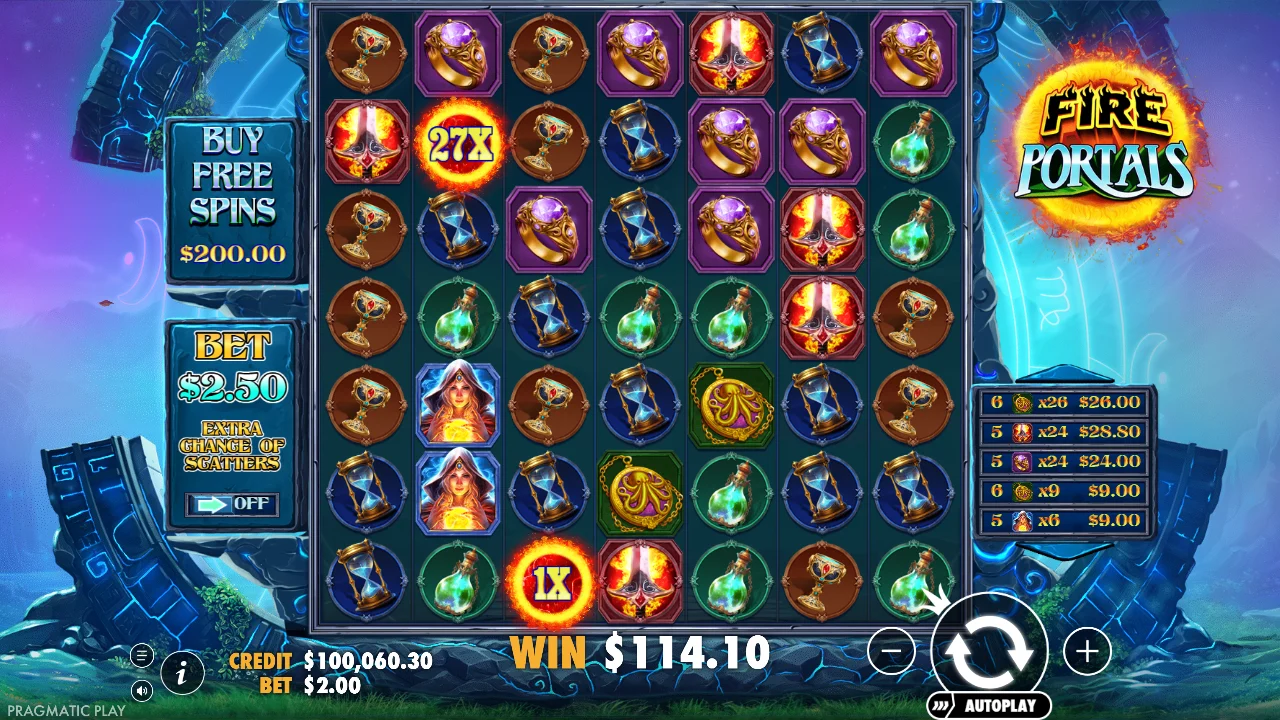
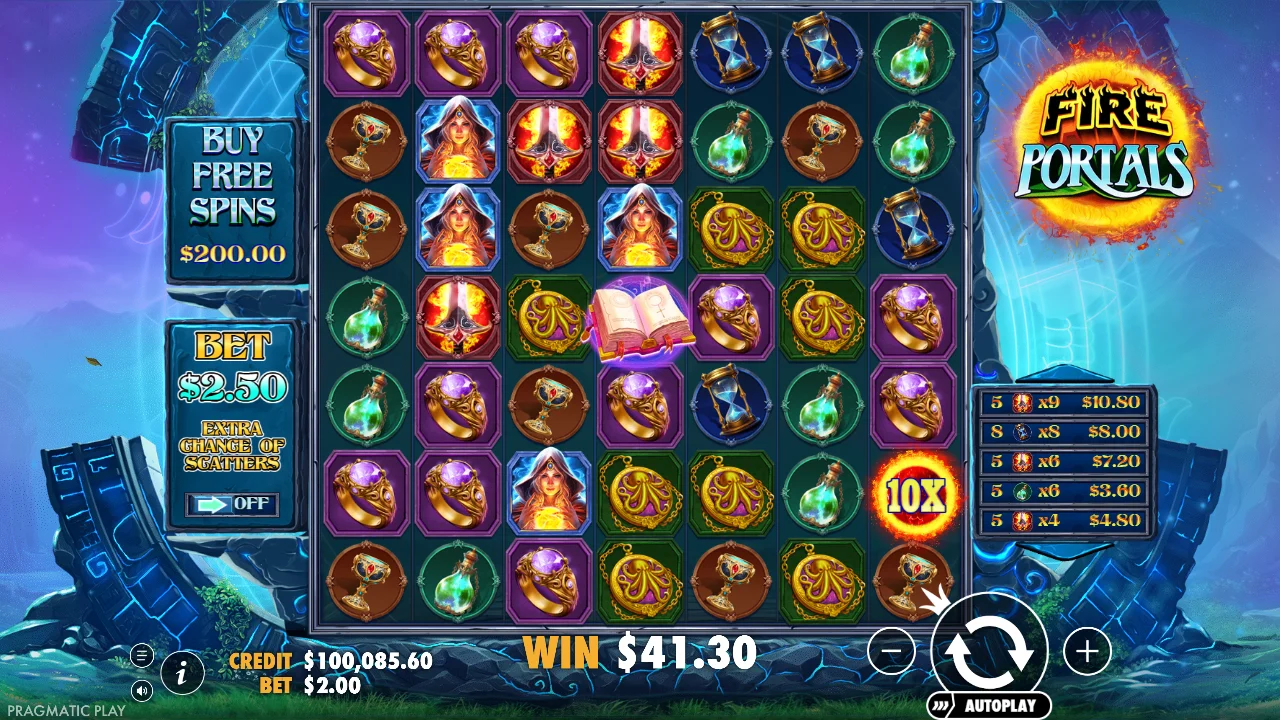
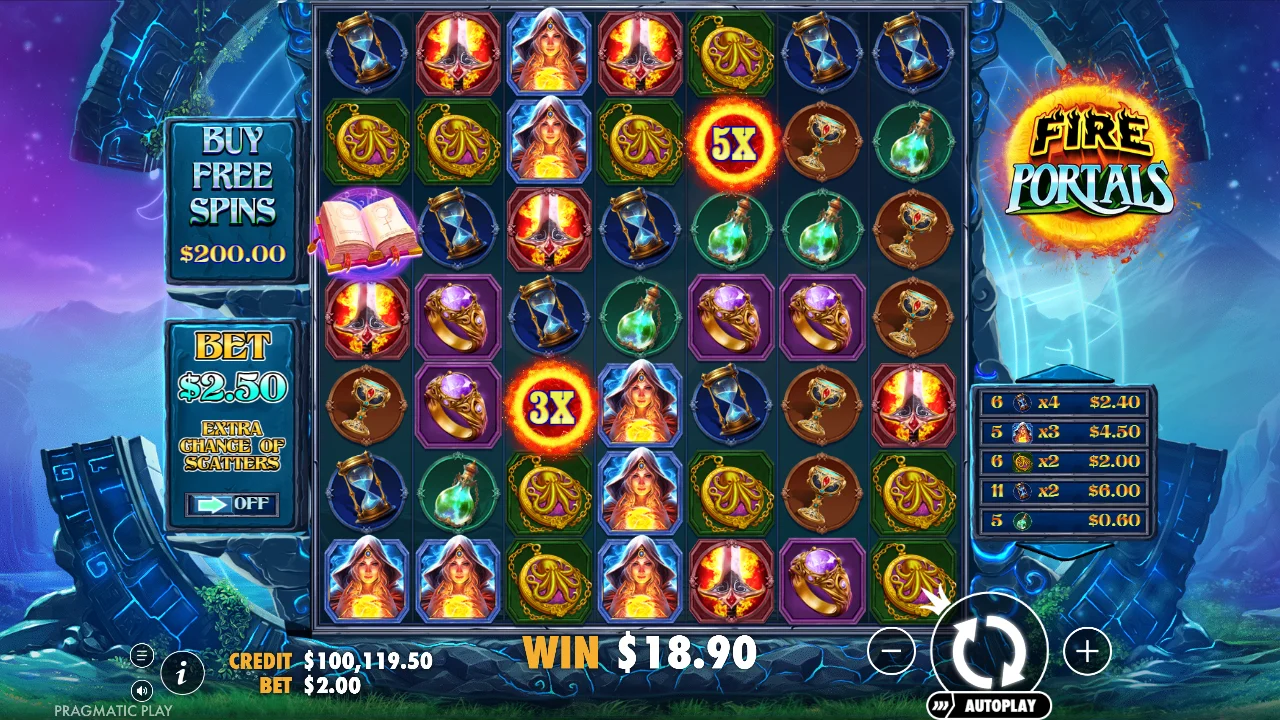
Verdict
The merger pays the next winPurchase 10 finished with a 1,768x portal still on the board. Two clusters had just paid USD 663, bringing the feature total to USD 759.80, before the updated portal values merged. Every subsequent response through the end of the feature paid zero. The largest merged portal in the test therefore contributed nothing after it was created.
Two entries dominated the purchase ledger: number 4 paid USD 1,068.10 and number 10 paid USD 759.80. Only three other purchases covered the USD 200 cost. Against a USD 62.70 median, the smallest payment was USD 6 on purchase 12. None of the fifty features retriggered; longer starts came from their initial scatter awards.
Ordinary play produced the test's largest stake multiple without free spins: round 990 returned USD 731.80, or 365.9x, over twelve steps. The complete 10,000-round sample returned 96.26%, close to its 96.06% setting, within an approximate 95% band of 79.70% to 112.83%. The first natural feature did not arrive until round 377.
The balance eventually finished USD 747.30 below its start, after a peak-to-trough decline of 990.7 stakes. There were 1,364 rounds between the bonuses on 2260 and 3625, despite ordinary clusters paying within that gap. Fire Portals offers an unusually visible multiplier calculation to study; the purchase ledger also shows how little that growing machinery sometimes returned for its entry price.
- The current payout and the later merged multiplier can be checked separately in the saved responses
- The largest ordinary-play round reached 365.9x without waiting for a bonus
- Existing portals carry from the triggering spin into free spins
- Forty-five purchases left part of their USD 200 cost unrecovered
- No purchased feature earned a retrigger in this fifty-entry sample
- A near-profile measured RTP still came with a 990.7-stake drawdown
Test record
10,000 rounds · 50 buys · open data · closed rigOne test run so far: a single session of the base game plus a separate series of bonus purchases on the official demo server, every request and response logged. When the game is tested again, the new run is added here and the figures on this page combine all runs into one sample.
- 10,000rounds logged
- 25%rounds that paid
- 366xbiggest round
- 1 / 323natural bonus rate
- 0.57xmean of 50 buys
- 32longest dry streak
01run Run 012026-09-10 measured return96.26%+0.2 pts vs declared
- 95% band
- 79.7–112.8%
- rounds that paid
- 25%
- biggest round
- 366x · round 990
- longest dry streak
- 32
- natural bonuses
- 31 · one per 323 rounds
- bonus buys
- mean 0.57x · median 0.314x · 90% below price
- balance start → end
- 100,000 → 99,253
- deepest drawdown
- 991x
10000 base-game spins at a fixed USD 2.0 bet; 50 bonus buys at 200.0 each (100.0x) on the official Pragmatic Play demo server (jurisdiction 99, RTP profile 96.06%); every request and response logged; test run 2026-09-10.
The test rig plays the official demo build over the network and records every server round: bet, win, intermediate steps (cascades, respins), free spins, collect. Screenshots and video were captured in a separate browser session and are not part of the statistical samples. The text was read against the log by an editor before publication. How we test →
FAQ
5 questions · answered from the logDo merged portal values change the win already paid?
No. A winning cluster is settled with the portal values that contributed to it. The wilds then grow and merge, creating a factor for later combinations. The rules example above follows both stages of purchase 4; purchase 10 shows the other possibility, where a large new portal remained unused until the feature ended.
Can a portal help more than one symbol group at once?
Yes. Its value applies to each qualifying group that contains it. That also means it can gain more than one increment during a tumble. When shared portals could merge through different groups, the rules first favour the group with more wilds, then the higher-paying symbol; no portal can exceed 2,500x.
Will buying free spins preserve the portals from my previous spin?
No. Portals persist through a paid round and carry into a feature triggered within that round, but an ordinary round that has ended does not leave its portals waiting for a later purchase. A USD 200 purchase has its own trigger and subsequent board.
Does a twelve-spin purchase mean the bonus retriggered?
No. Four books can award 12 spins at the start, while a retrigger requires another qualifying scatter event during the feature. The initial awards were checked on their own; none of these 50 purchases retriggered.
Was the 57.19% purchase return the game's advertised RTP?
No. It was the measured result of spending USD 10,000 on fifty USD 200 entries and receiving USD 5,719. The captured rules set the purchase profile at 96.01%. Fifty results, including a USD 6 low and a USD 1,068.10 high, give a limited sample of that profile.
Also tested
4 more slots on the same rig-
 Rich Wilde and the Amulet of Dead
Play'n GO · 10,000 spins
2026-10-15
RTP
84.1% 96.3%
hit38%
max160x
buy—
Rich Wilde and the Amulet of Dead
Play'n GO · 10,000 spins
2026-10-15
RTP
84.1% 96.3%
hit38%
max160x
buy—
-
 Big Bad Wolf MEGAWAYS
Quickspin · 20,000 spins
2026-09-27
RTP
88.1% 96.1%
hit37%
max227x
buy0.98x
Big Bad Wolf MEGAWAYS
Quickspin · 20,000 spins
2026-09-27
RTP
88.1% 96.1%
hit37%
max227x
buy0.98x
-
 The Dog House Dog Or Alive
Pragmatic Play · 10,000 spins
2026-09-10
RTP
99.3% 96.5%
hit16%
max113x
buy0.94x
The Dog House Dog Or Alive
Pragmatic Play · 10,000 spins
2026-09-10
RTP
99.3% 96.5%
hit16%
max113x
buy0.94x
-
 Big Bass Splash
Pragmatic Play · 20,000 spins
2026-09-10
RTP
90.2% 96.7%
hit14%
max201x
buy0.64x
Big Bass Splash
Pragmatic Play · 20,000 spins
2026-09-10
RTP
90.2% 96.7%
hit14%
max201x
buy0.64x
Field notes
0 notes