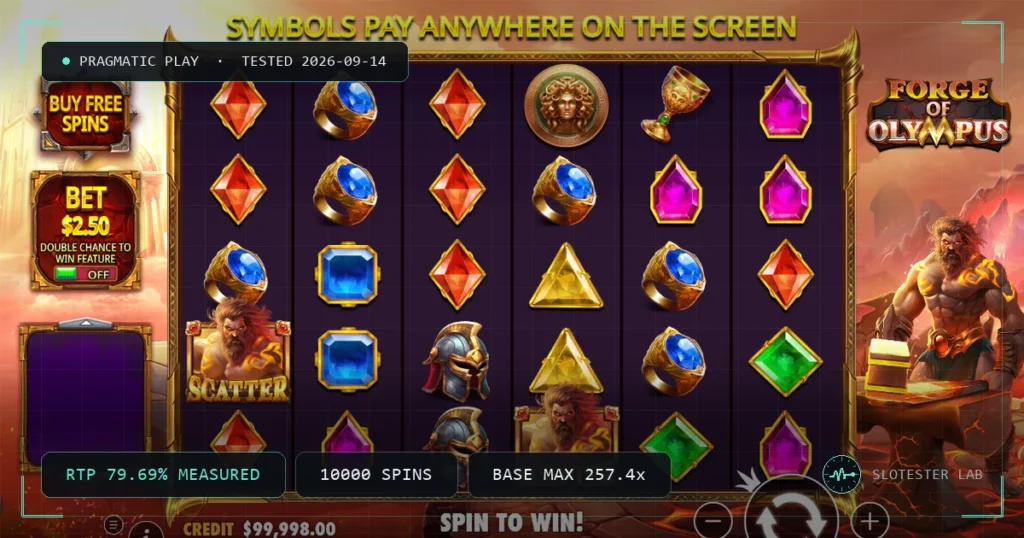
Pragmatic Play · 2023 · tested 2026-09-14
Forge of Olympus
A free spin paid zero yet raised the bonus level in round 493: this Forge of Olympus demo review follows the sixth hammer and the money it left unchanged.
The ninth free spin of round 493 collected the sixth hammer and reached level 2 without paying. The complete round's running total stayed at USD 19.40.
measured over 10,000 spins · 50 buys
Is Forge of Olympus worth playing?
quick answerA hammer can advance Forge of Olympus's bonus meter even when its spin produces no symbol payout. Round 493 demonstrated this at its sixth collected hammer: level 2 opened while the accumulated round payout remained USD 19.40. Across the separate purchase sample, the median complete payout was USD 77.70, or 0.3885x the USD 200 entry price.
Test card
10,000 spins · USD 2.00 bet · every request logged| Spins | 10,000 |
| Bet | USD 2.00 |
| RTP declared | 96.25% |
| RTP measured | 79.69% (approximate 95% CI 69.4–90.0) |
| Hit frequency | 25% · every 4.04 |
| Dead streak max / avg | 24 / 3.97 |
| Median hit | 1.15x |
| Max win (base game) | 257.4x · spin 9076 |
| Free spins, natural | 23 · every 434.8 spins · mean FS-only payout 48.5x stake |
| Balance start → end | 100,000 → 95,938 |
Play Forge of Olympus demo
same math as real play · demo balance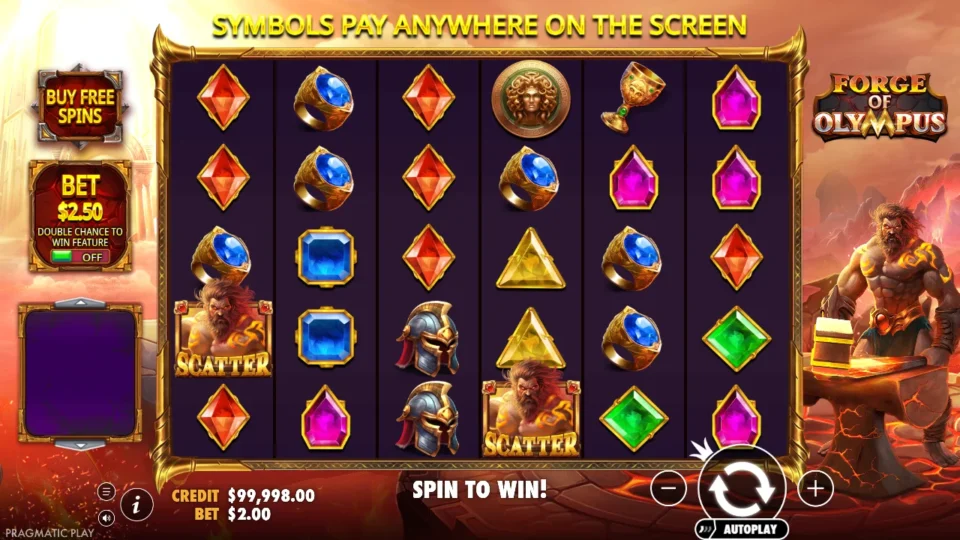
Bonus buy lab
50 buys × 100x · USD 200 eachmean 0.77x · median 0.3885× price (USD 77.70) · 30 of 50 below price · best 3.65x · worst 0.07x
| Spins per bonus (avg / min–max) | 16.9 / 10–30 |
| Retriggered | 28% |
| Bonuses that paid nothing | 0% |
At least three scatters within an active feature award five additional spins. Fourteen of fifty purchases received such additions; ten, fifteen or twenty spins granted at entry are initial awards.
- Spent
- USD 10,00050 × USD 200
- Returned
- USD 7,668.2076.68% · approximate 95% CI 57–97%
- Net
- −USD 2,331.80−11.7 buys
- Break-even or better
- 20 / 5040%
- Paid 2× price or more
- 2 / 504%
- Price in base spins
- 100natural trigger every ~435 spins
One ticket equals 100 ordinary stakes. Natural bonuses occurred once per 435 paid rounds in this sample. Stakes multiplied by this interval measure gross wagering, not the net cost of obtaining a bonus. Purchase returns above include the complete purchased round and are divided by the ticket price.
Risk profile
how much bankroll this run needed| 50 bets | bust at spin 131 |
| 100 bets | bust at spin 273 |
| 200 bets | bust at spin 779 |
One run, one bet size. A different session can bust earlier or never; treat this as a measured example, not a rule.
How it plays
8 rules screens from the game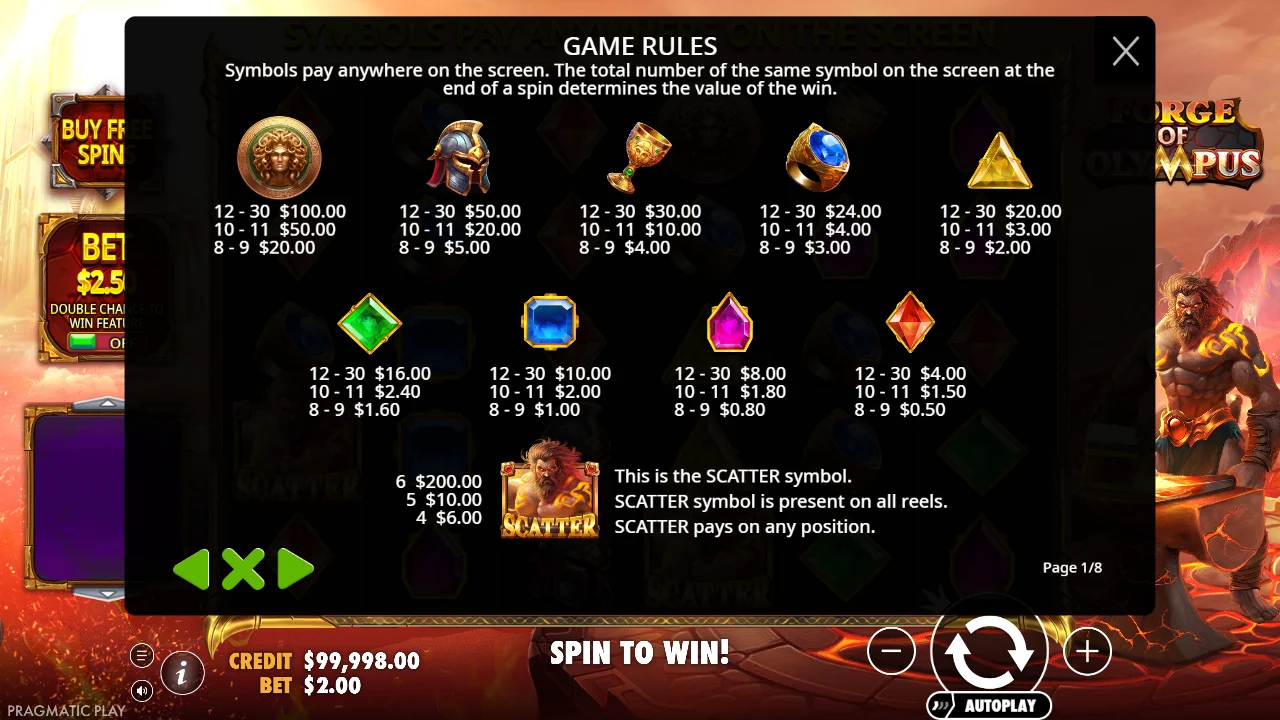
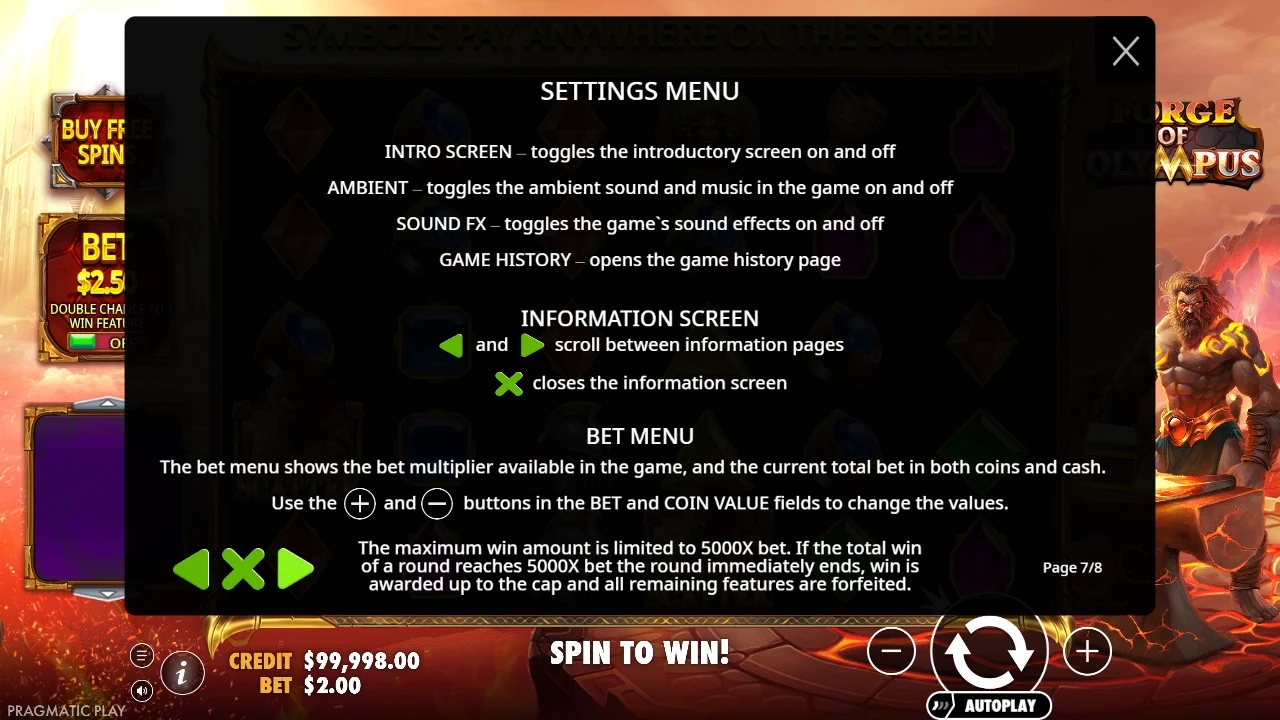
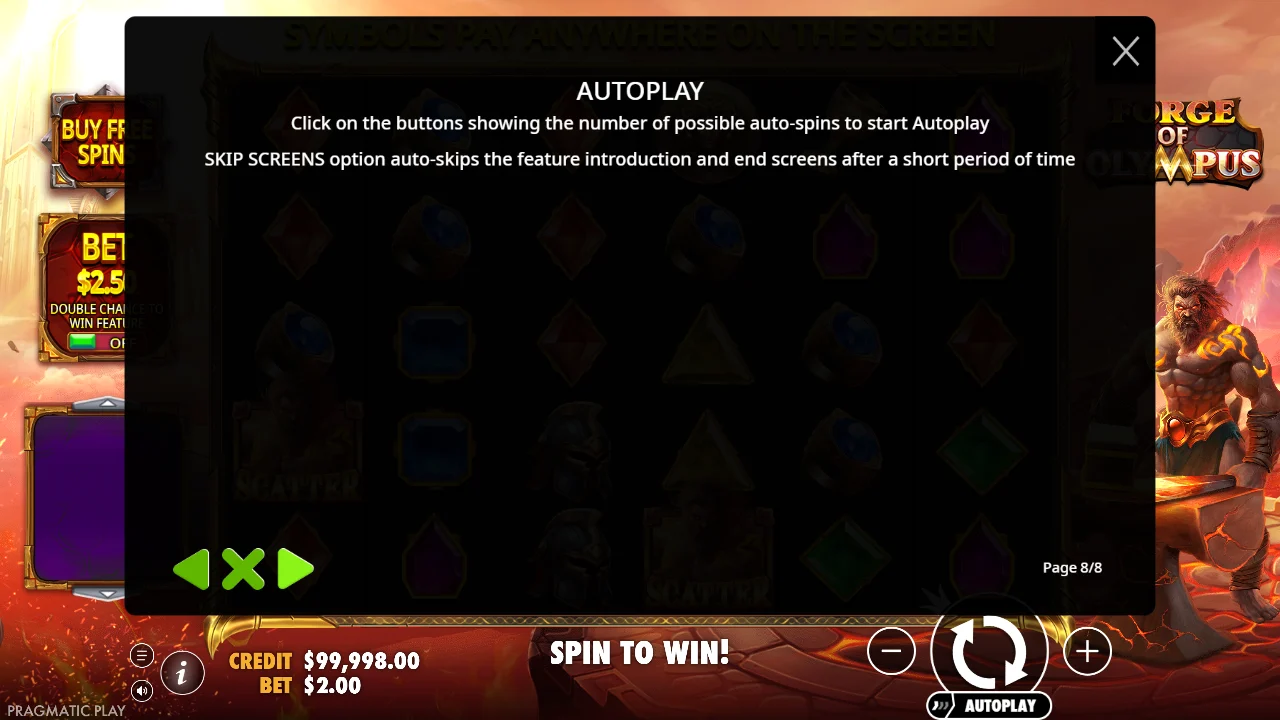
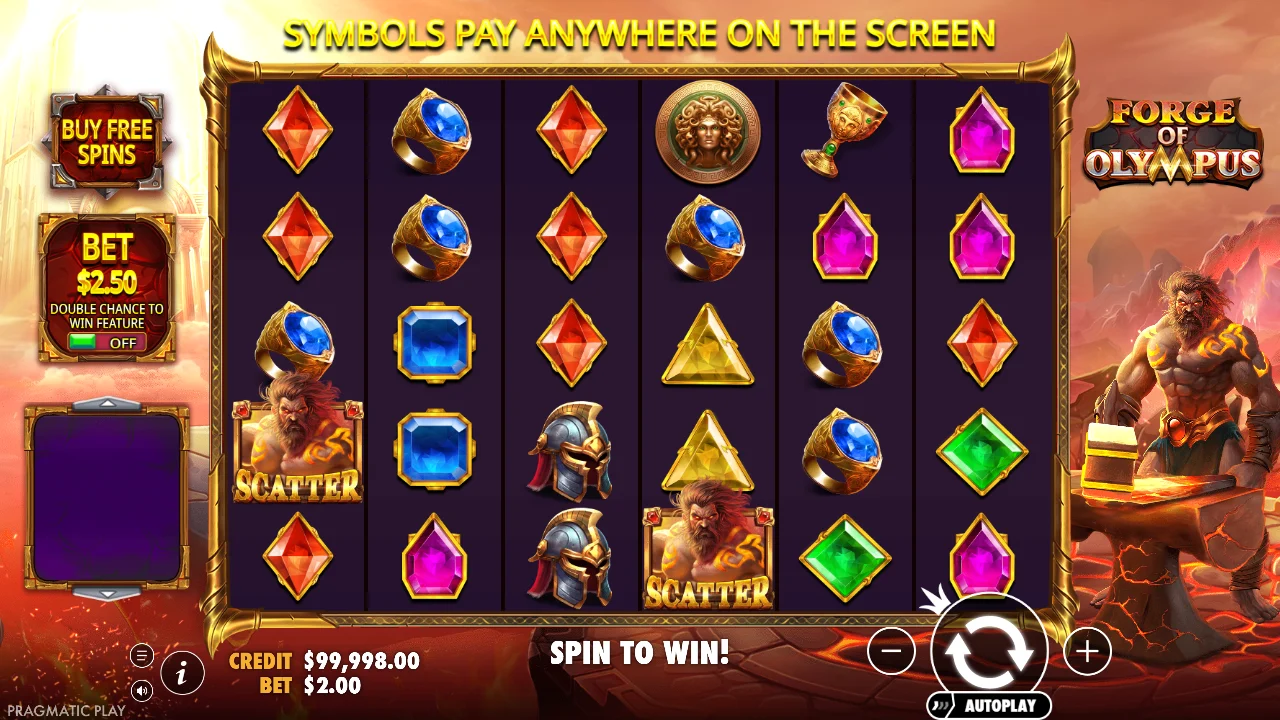
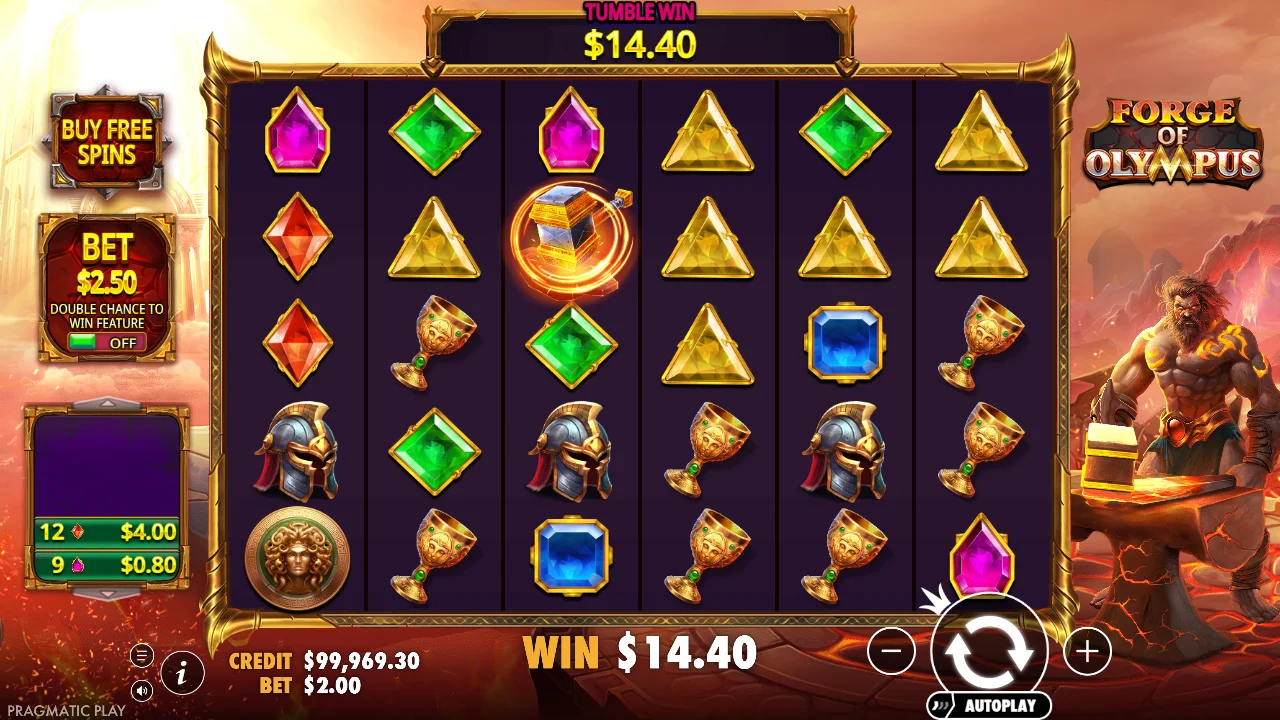
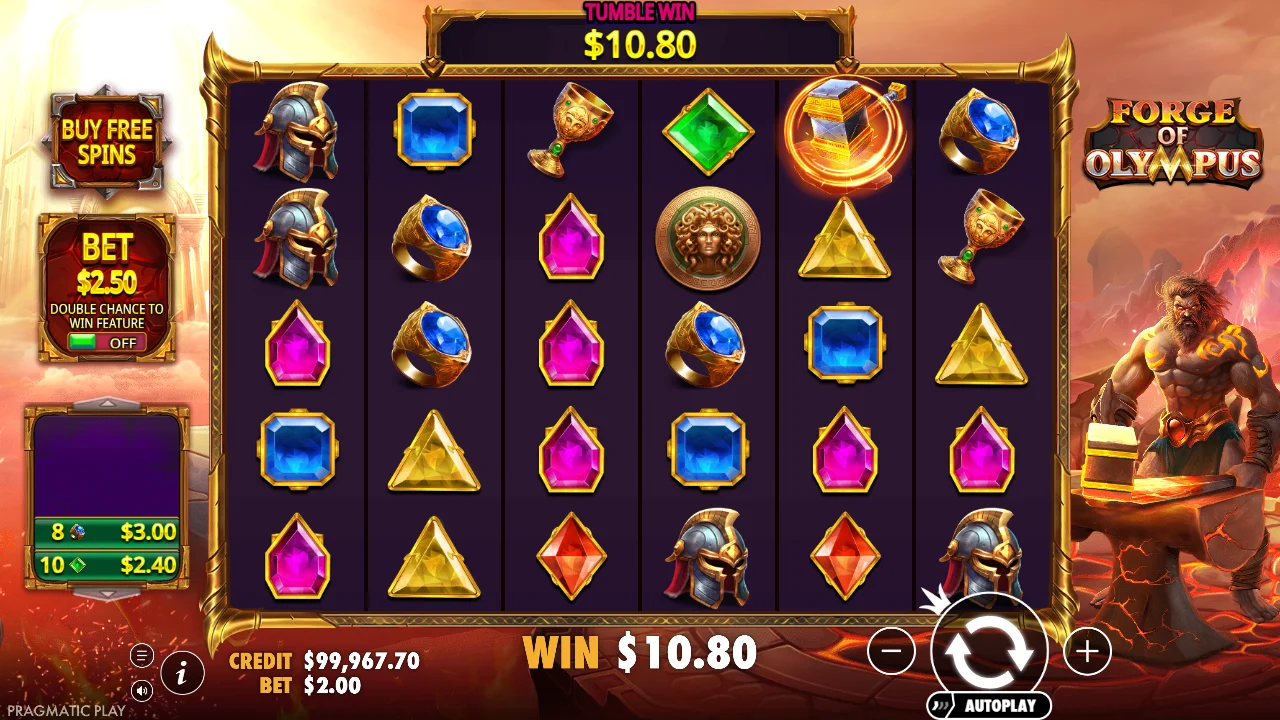
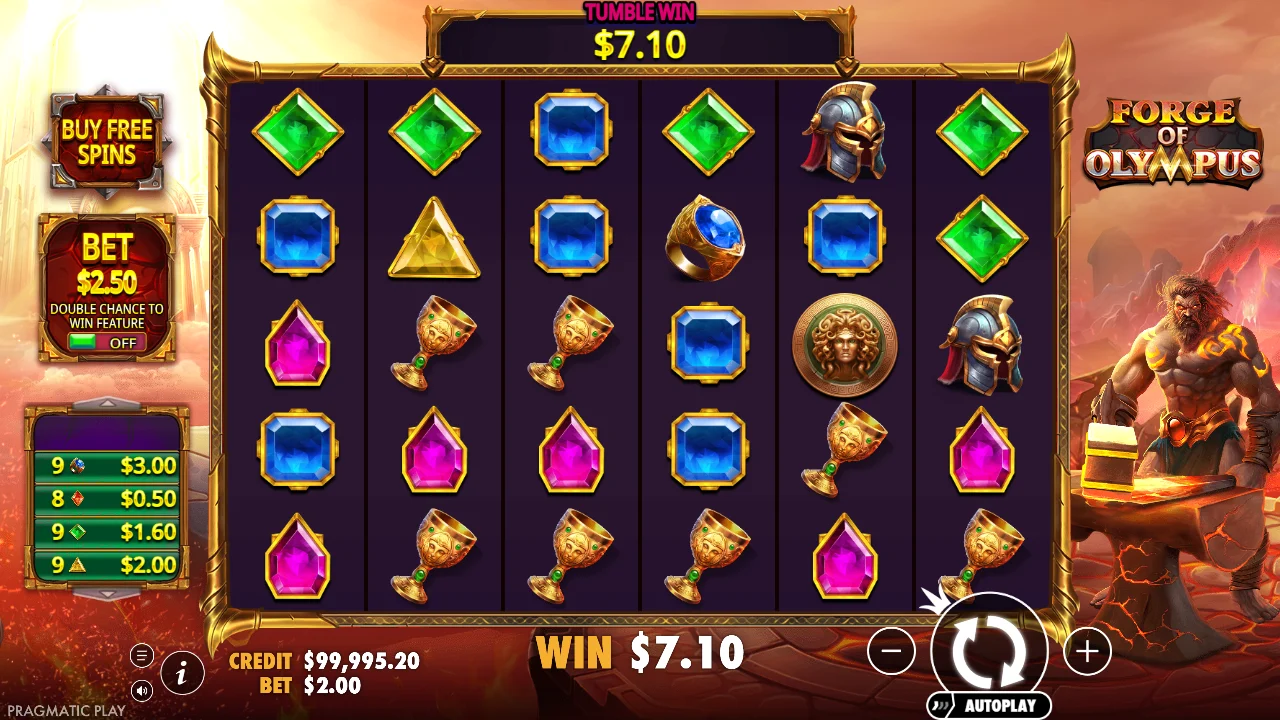
Forge of Olympus uses a 6-by-5 field with payments determined by matching-symbol counts, beginning at eight; there are no fixed paylines. A paid combination disappears, allowing the board to produce further awards in the same tumble sequence. The gold medallion pays 50x the ordinary stake at twelve or more, while four, five or six scatters have their own cash awards.
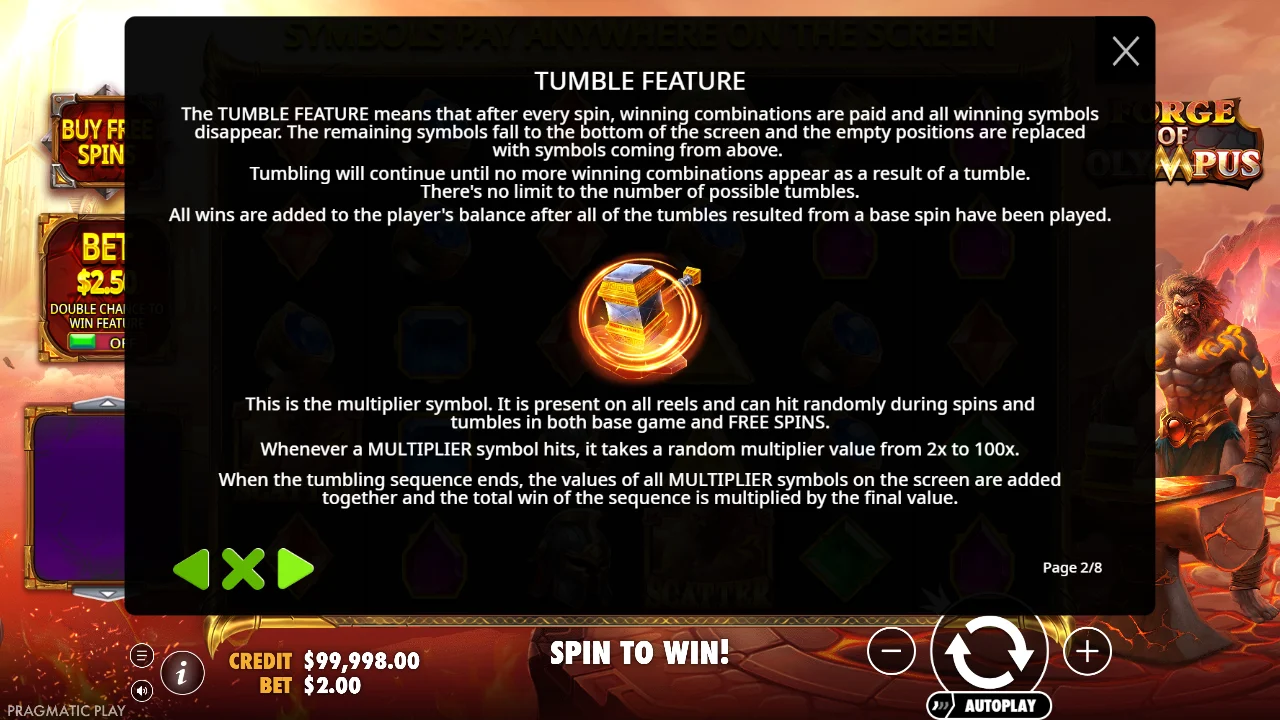
Hammers carry values between 2x and 100x in ordinary play. Their values are added when the tumble sequence finishes, and the resulting multiplier applies to that sequence's combined payout. Round 9076 illustrates the calculation: USD 9.90 of symbol awards met 50x and 2x hammers, producing USD 514.80 altogether. A hammer with no underlying cash award cannot create a payout by multiplication.
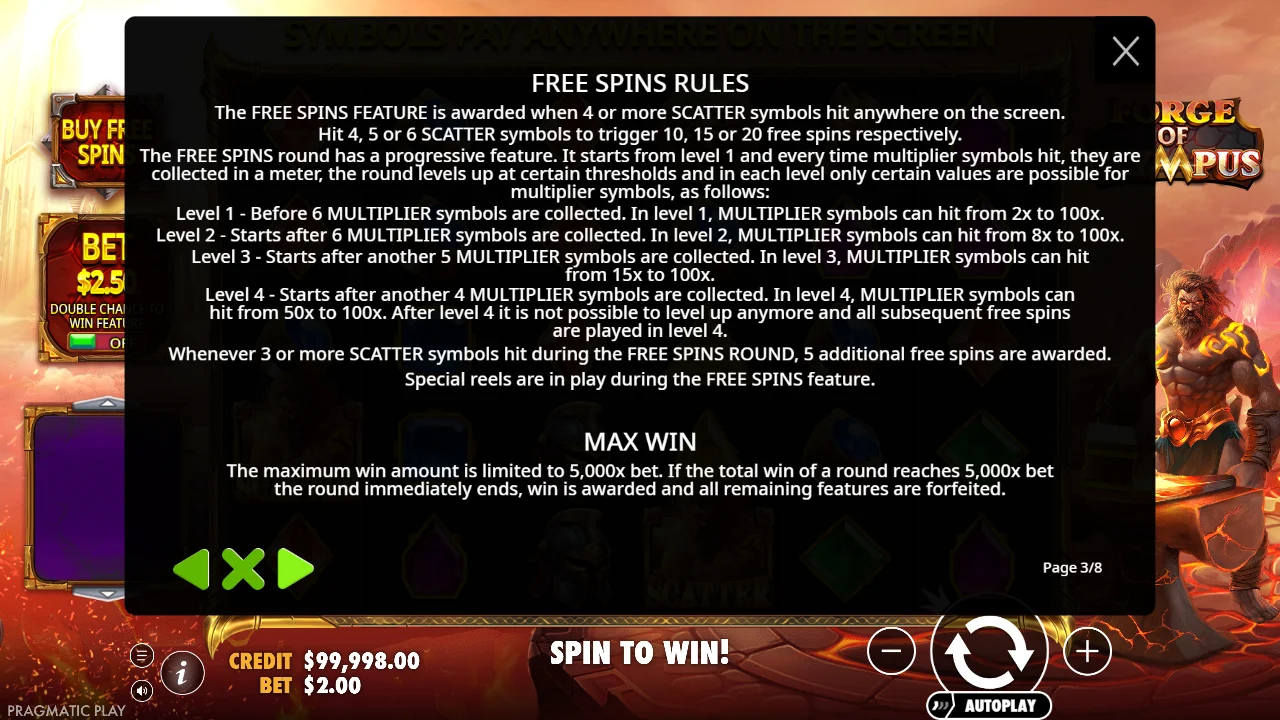
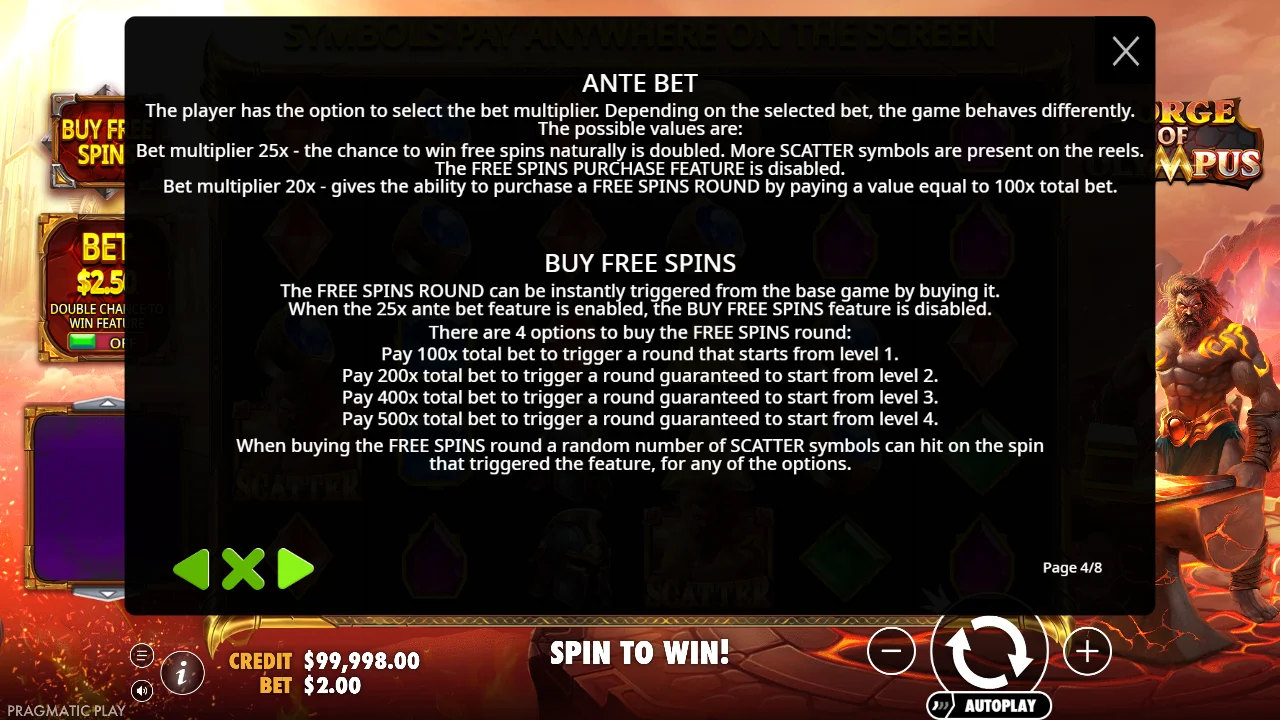
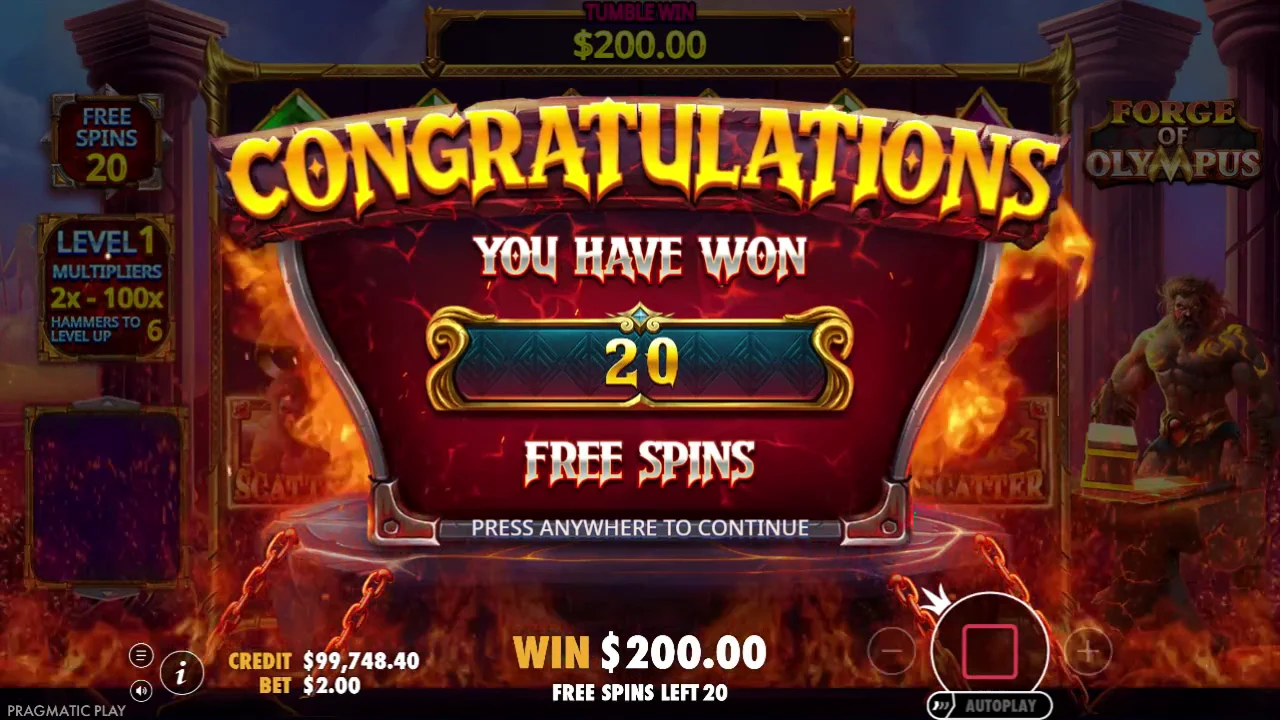
Initial free spins number 10, 15 or 20 for four, five or six scatters respectively; landing at least three scatters during the feature adds five. The bonus starts at level 1, then reaches levels 2, 3 and 4 after collecting six, eleven and fifteen hammers in total. Those levels raise the minimum hammer value from 2x to 8x, 15x and 50x, while the upper value remains 100x. Buying a start at those respective levels costs 100x, 200x, 400x or 500x the ordinary stake; this test used only the 100x option.
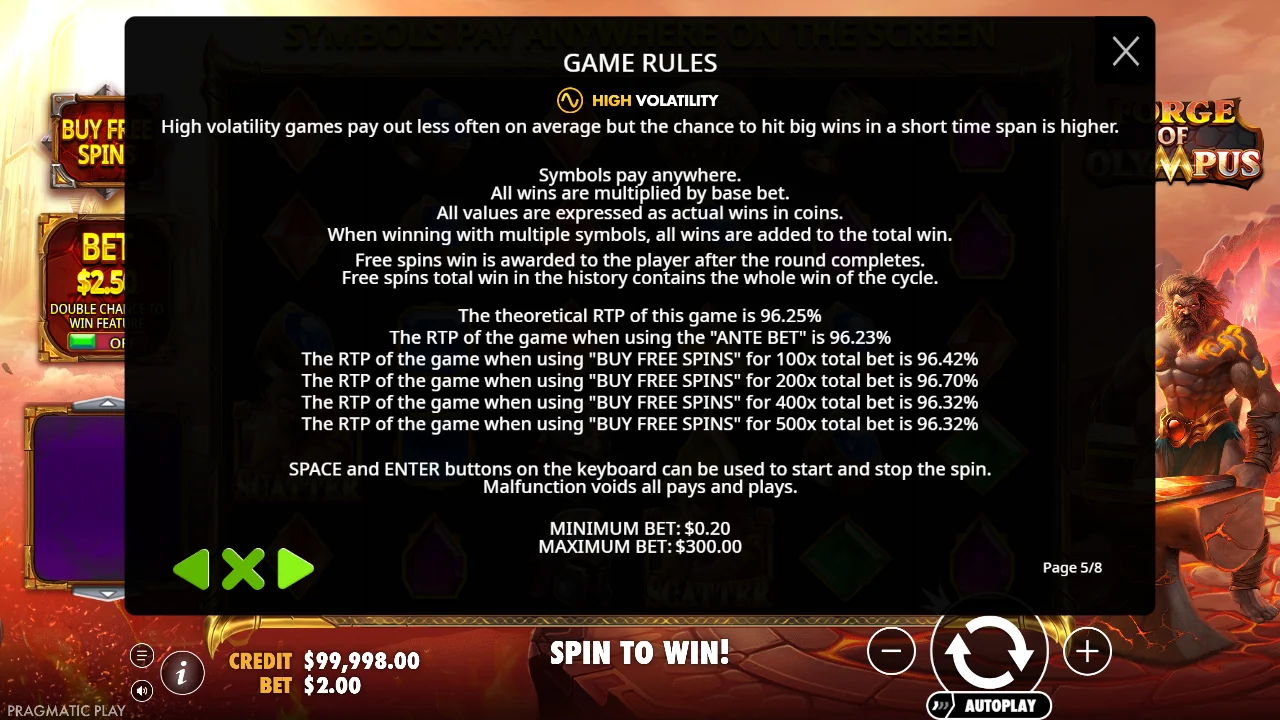
Ante uses 25 stake credits instead of 20 for twice the regular chance of triggering free spins; purchase access uses the 20-credit setting. Theoretical RTP is 96.25% for regular play, 96.23% with Ante and 96.42% for the tested level-1 purchase. The captured rules classify volatility as high, show USD 0.20 to 300 stakes and set a 5,000x round ceiling. All dollar amounts in the demo are virtual credits.
 Free spins
 Retrigger
 Scatter symbol
 Multiplier
 Cascading reels
 Bonus buy
Bet range USD 0.20 – 300 per spin · payouts read from the game's paytable at bet USD 2.00
Gallery
7 frames from the test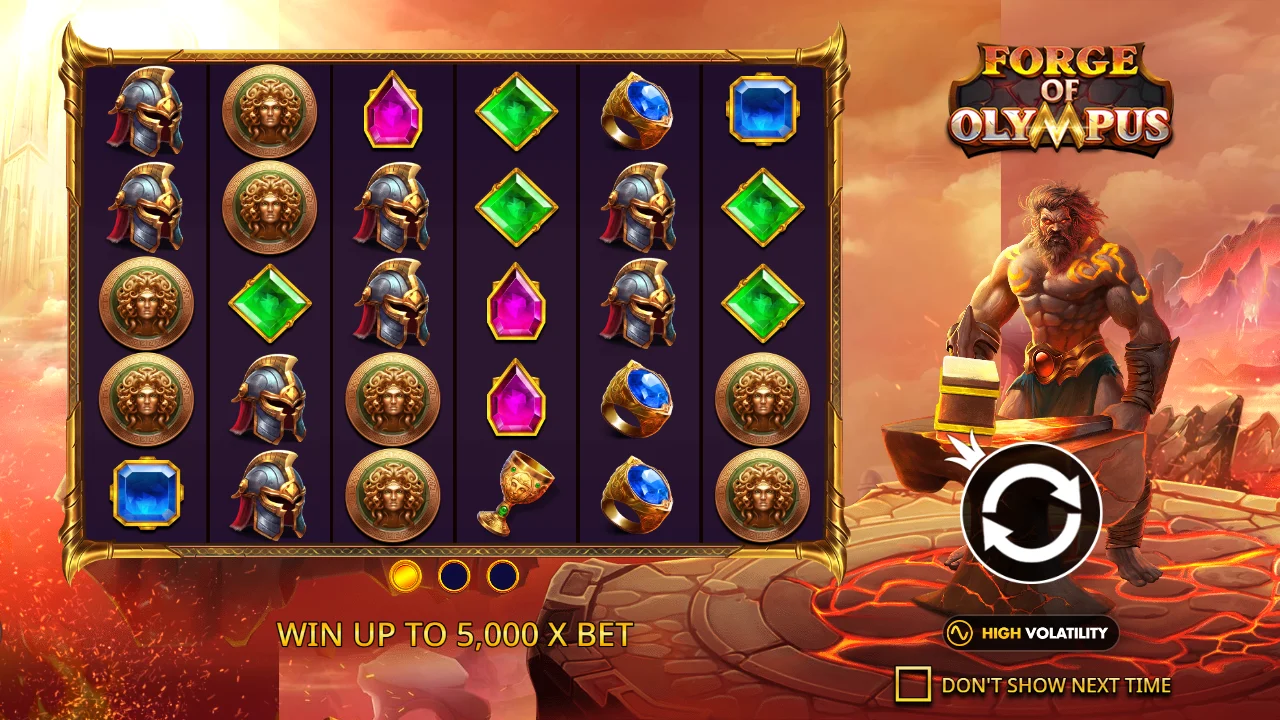
Verdict
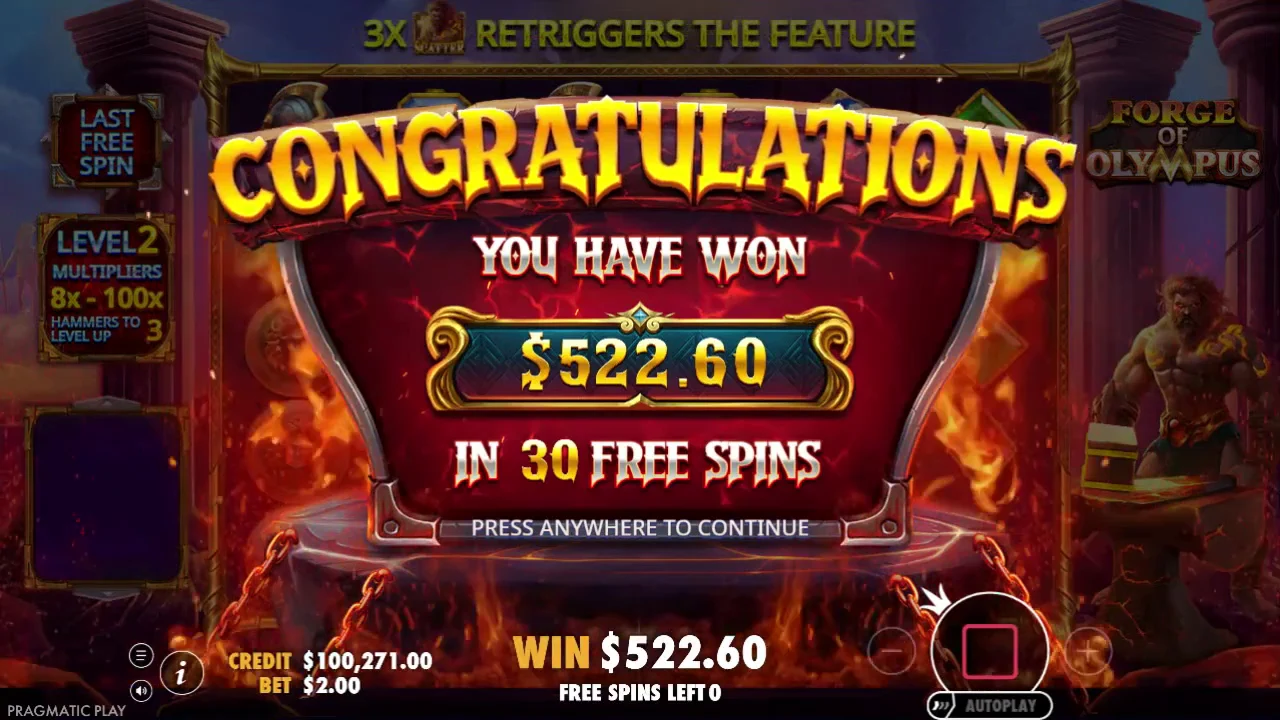
Hammer progress and cash move on separate countersA level change need not mean money has been won. In natural round 493, the first eight free spins had added USD 8.60 to the USD 10.80 entry payout, with five hammers collected. Free spin nine showed a 25x hammer on a non-paying board: the meter reached six and moved to level 2, but the USD 19.40 running payout did not change. The completed round eventually returned USD 102, comprising USD 91.20 from free spins and the USD 10.80 entry.
Entry payouts also matter when reading the purchase results. The 50 purchases cost USD 200 apiece and paid USD 7,668.20 altogether, of which USD 3,670 came from the entry scatters and USD 3,998.20 from the subsequent free spins. The full-payout mean was 0.76682x the ticket price and the median 0.3885x, equivalent to USD 77.70; thirty tickets failed to cover USD 200. These figures describe the tested level-1 option, without measuring the three dearer entries.
Among 10,000 paid rounds, 23 opened natural features; their FS-only awards supplied 14.00% of the series' total payout. Hammer multipliers also operated outside those features: round 9076 converted USD 9.90 into USD 514.80 through a combined 52x. Round 493 exposes the other side of that mechanism: a collected hammer may improve the bonus level while adding nothing to the current cash total.
- The level meter records hammer collection even on zero-paying free spins, as round 493 confirms.
- Hammers can multiply an entire ordinary tumble sequence: round 9076 returned 257.4x the stake without entering free spins.
- The four purchase prices identify the starting bonus level before entry.
- Only twenty purchases covered their USD 200 charge; the other thirty settled below it.
- The gap between natural triggers at rounds 1449 and 3137 contained 1,687 non-triggering paid rounds.
- Even a 100x hammer added no money when round 6879 had no symbol award to multiply.
- Four paying screens in ordinary round 9076 accumulated USD 2, 4.60, 1.50 and 1.80 before the combined 52x hammer multiplier was applied.
- A 100x hammer appeared in ordinary round 6879 without a paying symbol group, leaving that round at zero.
- The strongest complete natural round was 1449 at USD 543.40: USD 537.40 from free spins plus USD 6 on entry.
- Purchase 24 returned USD 730, or 3.65x its USD 200 price, after twenty starting spins and a later five-spin addition.
- Later scatters added five spins on fourteen purchased tickets; an award already present at entry was excluded from that count.
Method & data
open data · closed rig10000 ordinary paid rounds, including naturally triggered features, at a fixed USD 2.0 bet; 50 bonus buys at 200.0 each (100.0x) on the official Pragmatic Play demo server (jurisdiction 99, RTP profile 96.25%); every request and response logged; test run 2026-09-14.
The test rig recorded every round on the official demo server. Screenshots and video were captured in a separate browser session and are not part of the statistical samples. This release has completed automated data, content and page checks; human editorial review is pending. How we test →
| 2026-09-14 | 10,000 spins · RTP 79.7% |
FAQ
7 questions · answered from the logCan a losing Forge of Olympus free spin raise the bonus level?
Yes. During natural round 493, free spin nine collected a 25x hammer without a symbol payout. It was the sixth hammer of the feature, so level 2 opened, yet the running complete-round payout remained USD 19.40. Hammer collection and cash settlement are separate operations.
Are Forge of Olympus hammers added together or multiplied?
At the closing tumble, the displayed hammer values are added. Round 9076 combined 50x and 2x hammers into 52x, then applied that figure to USD 9.90 of accumulated symbol awards. The complete ordinary round paid USD 514.80; multiplying 50 by 2 would not reproduce the logged result.
Why was sample RTP 79.69% when the build says 96.25%?
Ordinary play returned USD 15,938.10 against USD 20,000 in stakes, giving this 10,000-round sample an RTP of 79.69%. The build declares 96.25% theoretical RTP. Its approximate 95% CI is 69.35 to 90.03%, using a normal approximation for uncertainty in the mean, rather than a forecast interval for another session.
Is a higher starting bonus level worth its price?
This dataset covers fifty level-1 entries at 100x the ordinary stake, with a USD 77.70 median payout on a USD 200 purchase: 0.3885x its price. Levels 2, 3 and 4 cost 200x, 400x and 500x respectively. No purchase sample was collected for those options, so these results cannot establish their relative value.
Does the purchase payout include the triggering scatters?
Yes. Across fifty purchased rounds, entry scatters paid USD 3,670 and the free spins paid USD 3,998.20, giving USD 7,668.20 combined. Purchase 24, for example, returned USD 200 on entry and USD 530 from free spins. Its complete USD 730 payout was 3.65x the price.
What spacing separated natural bonus entries in this test?
There were 23 triggers in the 10,000 ordinary rounds, equivalent to one entry per 434.78 paid rounds in this sample. Between triggers 1449 and 3137, 1,687 paid rounds produced no feature. A trigger interval measures frequency; stake multiplied by that interval is gross wagering before accounting for ordinary payouts.
Do twenty starting free spins count as a retrigger?
No. Six entry scatters grant twenty spins immediately, whereas three or more scatters during the feature add five later. Purchase 24 started with twenty, received one five-spin addition and finished with twenty-five. Fourteen of fifty purchased features had at least one such later addition.
Also tested
4 more slots on the same rig-
 Candy Blitz
Pragmatic Play · 2026-09-14 · 10,000 spins
RTP
96.1 → 91.1%
hit23%
max214x
buy1.06x
Candy Blitz
Pragmatic Play · 2026-09-14 · 10,000 spins
RTP
96.1 → 91.1%
hit23%
max214x
buy1.06x
-
 5 Lions Megaways
Pragmatic Play · 2026-09-10 · 10,000 spins
RTP
96.5 → 94.8%
hit29%
max450x
buy1.01x
5 Lions Megaways
Pragmatic Play · 2026-09-10 · 10,000 spins
RTP
96.5 → 94.8%
hit29%
max450x
buy1.01x
-
 Wisdom of Athena
Pragmatic Play · 2026-09-07 · 10,000 spins
RTP
96.1 → 95.2%
hit27%
max245x
buy0.61x
Wisdom of Athena
Pragmatic Play · 2026-09-07 · 10,000 spins
RTP
96.1 → 95.2%
hit27%
max245x
buy0.61x
-
 Gates of Olympus
Pragmatic Play · 2026-09-03 · 10,000 spins
RTP
96.5 → 80.2%
hit29%
max221x
buy0.77x
Gates of Olympus
Pragmatic Play · 2026-09-03 · 10,000 spins
RTP
96.5 → 80.2%
hit29%
max221x
buy0.77x
Field notes
0 notes