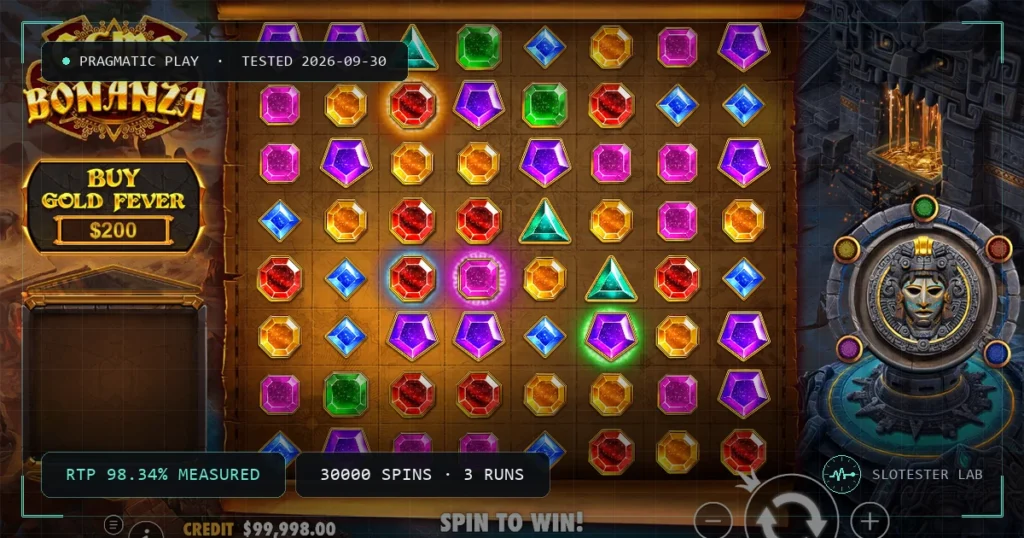
Pragmatic Play · 2020 · tested 2026-09-30
Gems Bonanza
With no free spins on its 8x8 cluster grid, Gems Bonanza took the first demo run's top payout from an ordinary spin, a 284x tumble chain on round 8167 that ran 32 tumbles.
- RTP measured / declared 98.3% 96.55%
- Hit frequency 32%
- Max win · no bonus 2,246x
- Bonus buy · mean result 100x · 0.89x
- Free spins, natural 0 / 30,000
In numbers: measured RTP 98.3% against 96.55% declared over 30,000 logged rounds in 3 runs; 32.2% of rounds paid; no natural bonus landed; 150 bonus buys at 100x returned 0.89x of their price on average, 64% of them below the price; the biggest round paid 2,246.4x; the longest dry run was 28 spins.
Test card
30,000 spins · USD 2.00 bet · every request logged| Spins | 30,000 · 3 runs |
| Bet | USD 2.00 |
| RTP declared | 96.55% |
| RTP measured | 98.34% (approximate 95% CI 80.5–116.2) |
| Hit frequency | 32% · every 3.1 |
| Dead streak max / avg | 28 / 3.08 |
| Median hit | 0.35x |
| Max win (no bonus round) | 2,246.4x · run 3, round 7062 |
| Free spins, natural | 0 |
| Balance start → end | 100,000 → 99,007 |
- 012026-09-0710,000 rounds · 50 buysfiles & checksums ↓92.51%RTP5 files · SHA-256 ↓
- 022026-09-2710,000 rounds · 50 buysfiles & checksums ↓81.14%RTP5 files · SHA-256 ↓
- 032026-09-3010,000 rounds · 50 buysfiles & checksums ↓121.39%RTP5 files · SHA-256 ↓
each run keeps its own spin log, CSV and raw server journal with checksums; the figures on this card combine all runs
Play Gems Bonanza demo
PRAGMATIC PLAY · official demo · same math as real play United States
Gems Bonanza available at Cafe Casino
United States
Gems Bonanza available at Cafe Casino
Same reels, real payouts
Cafe Casino runs the same Gems Bonanza with the same math and adds a welcome bonus for players from the United States:
300% up to $2,000 + 150 FS 18+ · T&Cs apply · the demo stays free
Bonus buy lab
150 buys × 100x · USD 200 eachmean 0.89x · median 0.495× price (USD 98.95) · 96 of 150 below price · best 4.44x · worst 0.07x
- Spent
- USD 30,000150 × USD 200
- Returned
- USD 26,585.2088.62% · approximate 95% CI 74–103%
- Net
- −USD 3,414.80−17.1 buys
- Break-even or better
- 54 / 15036%
- Paid 2× price or more
- 17 / 15011%
- Price in base spins
- 100no natural trigger in 30,000 spins
One buy costs 100 base spins; no natural bonus appeared in 30,000 spins, so buying was the only way into the feature during this run. Bought bonuses averaged 89x of the bet.
Risk profile
how much bankroll the 3 runs in sequence needed| 50 bets | bust at spin 310 |
| 100 bets | bust at spin 652 |
| 200 bets | bust at spin 999 |
The runs are played back to back as one series, one bet size. A different session can bust earlier or never; treat this as a measured example, not a rule.
How it plays
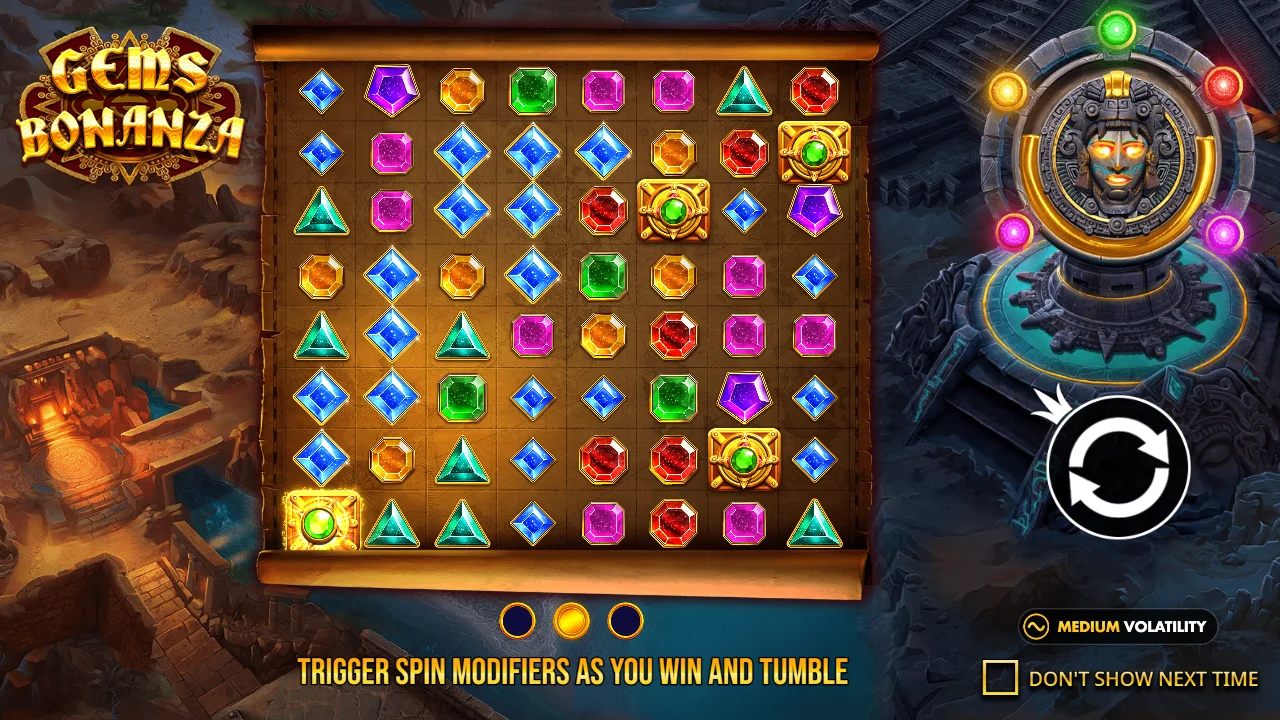
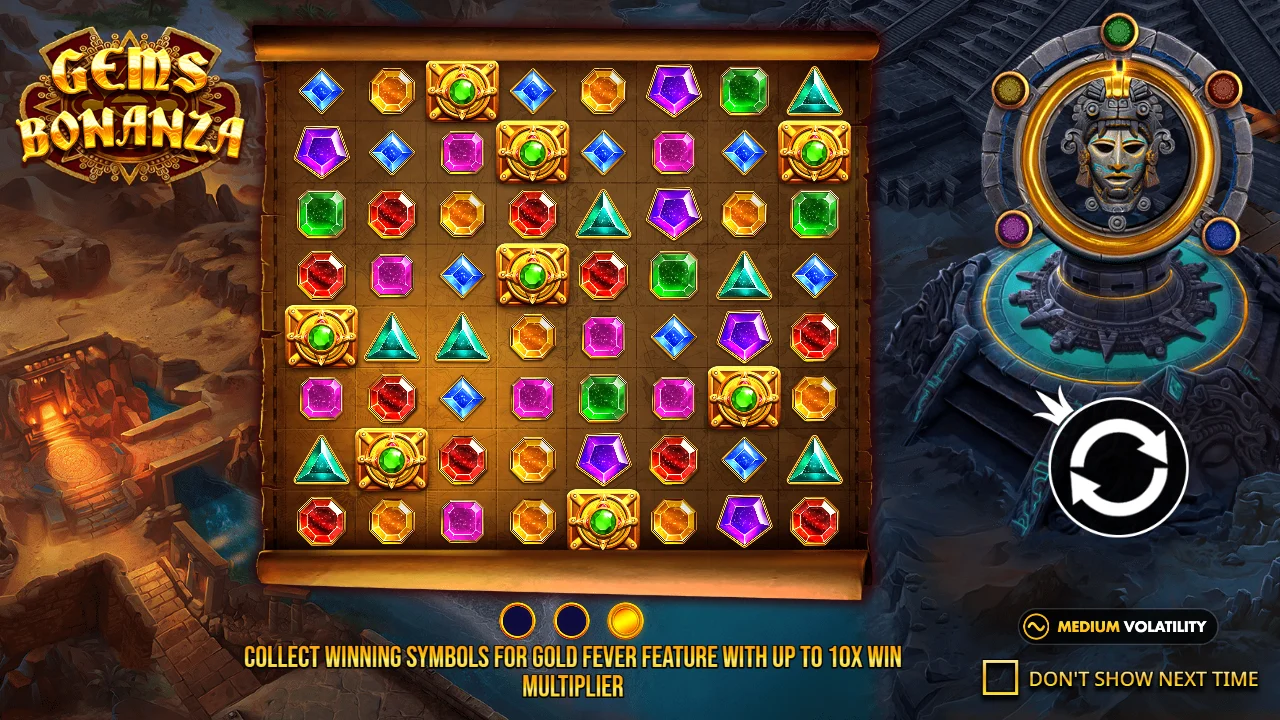
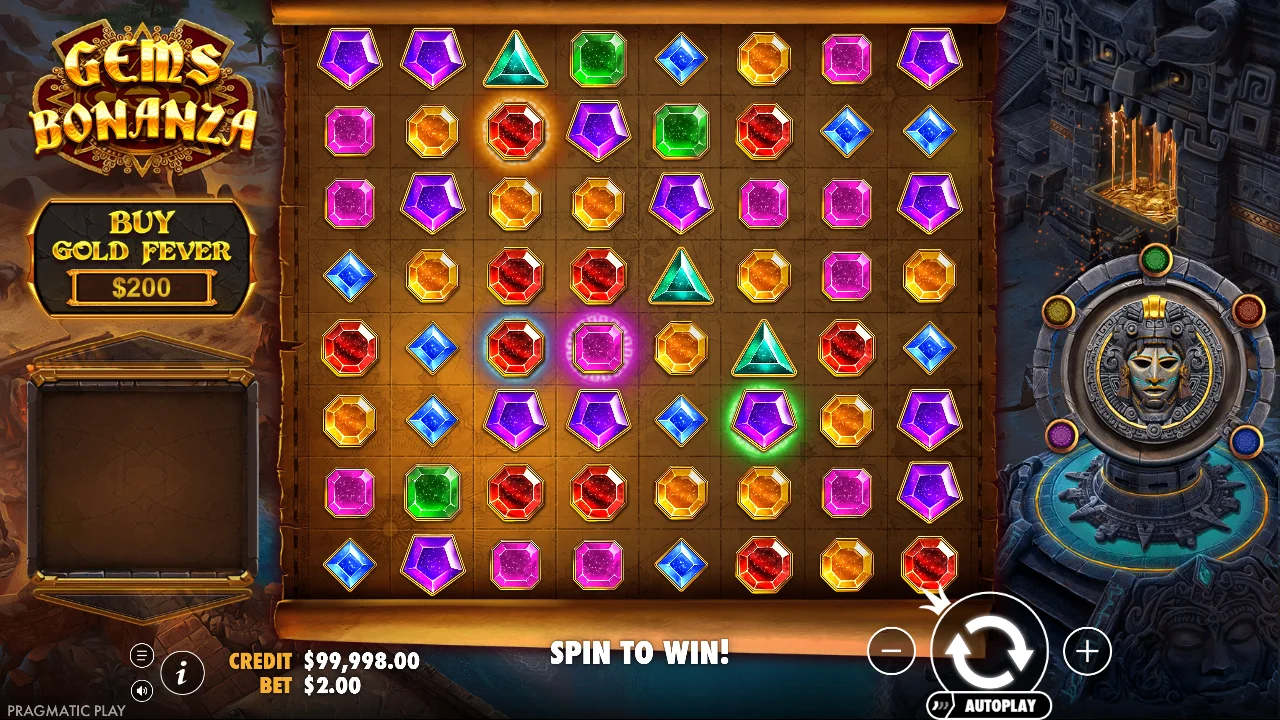
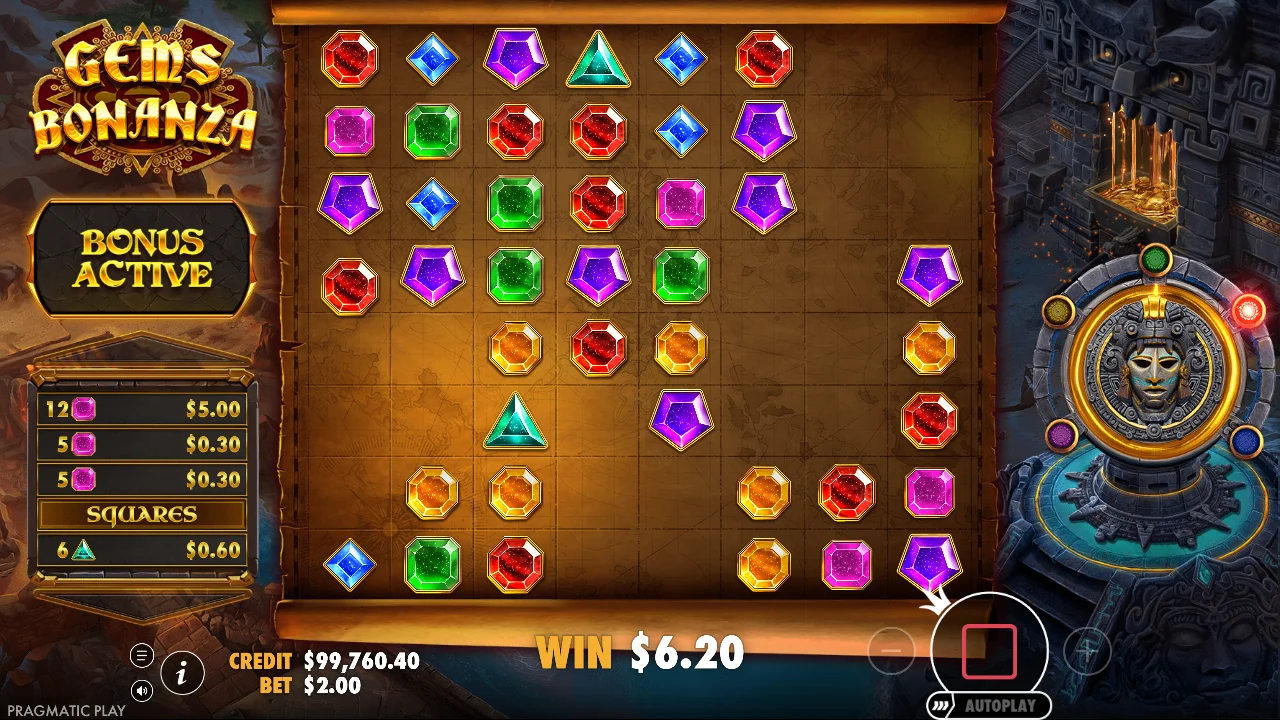
8 rules screens from the game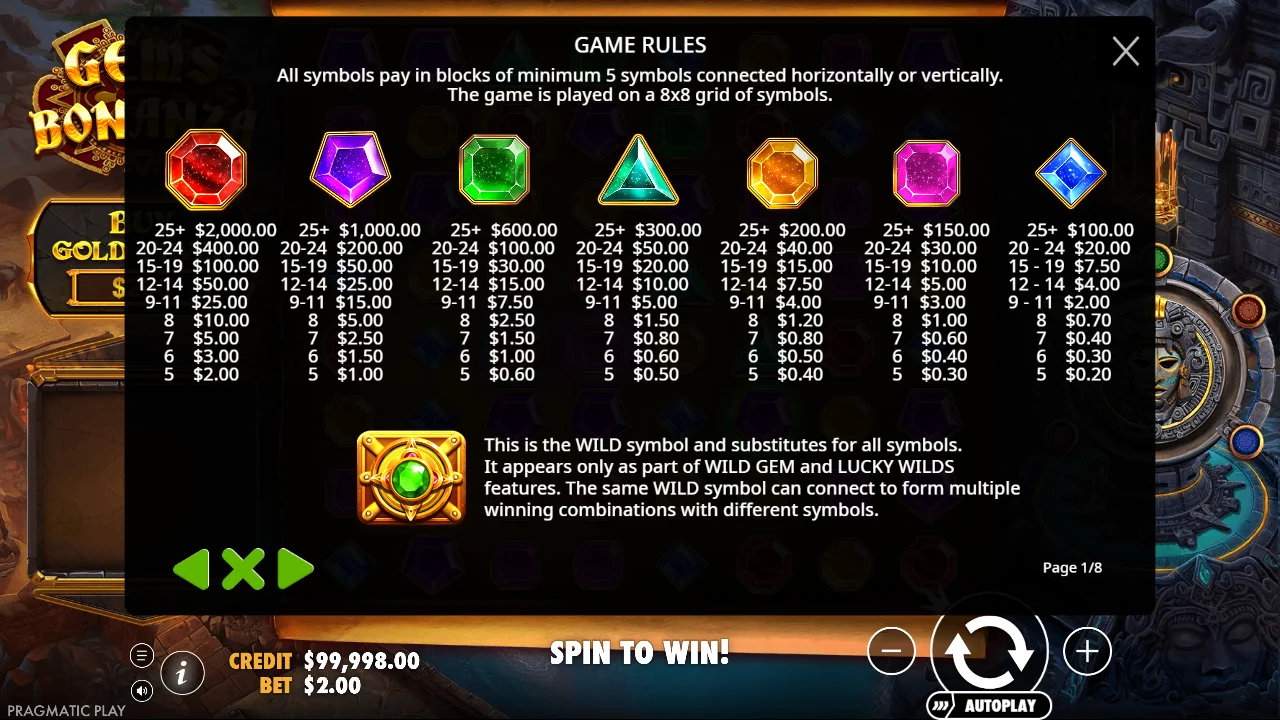
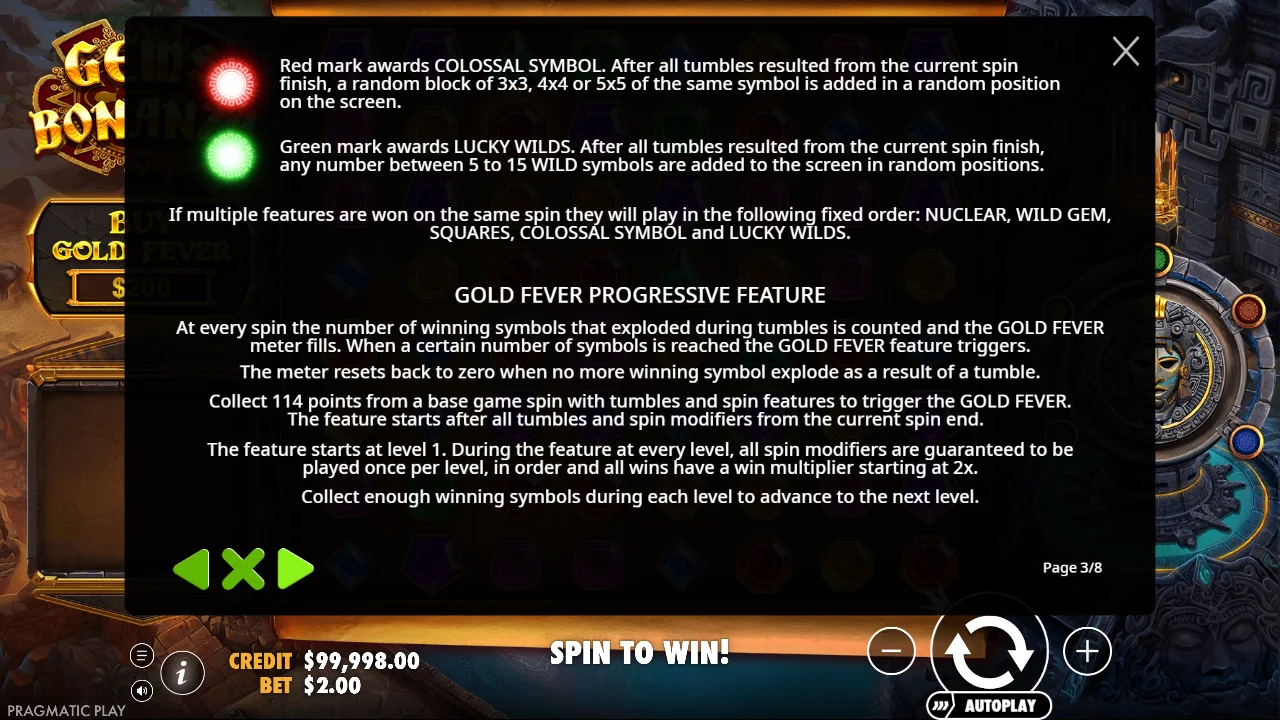
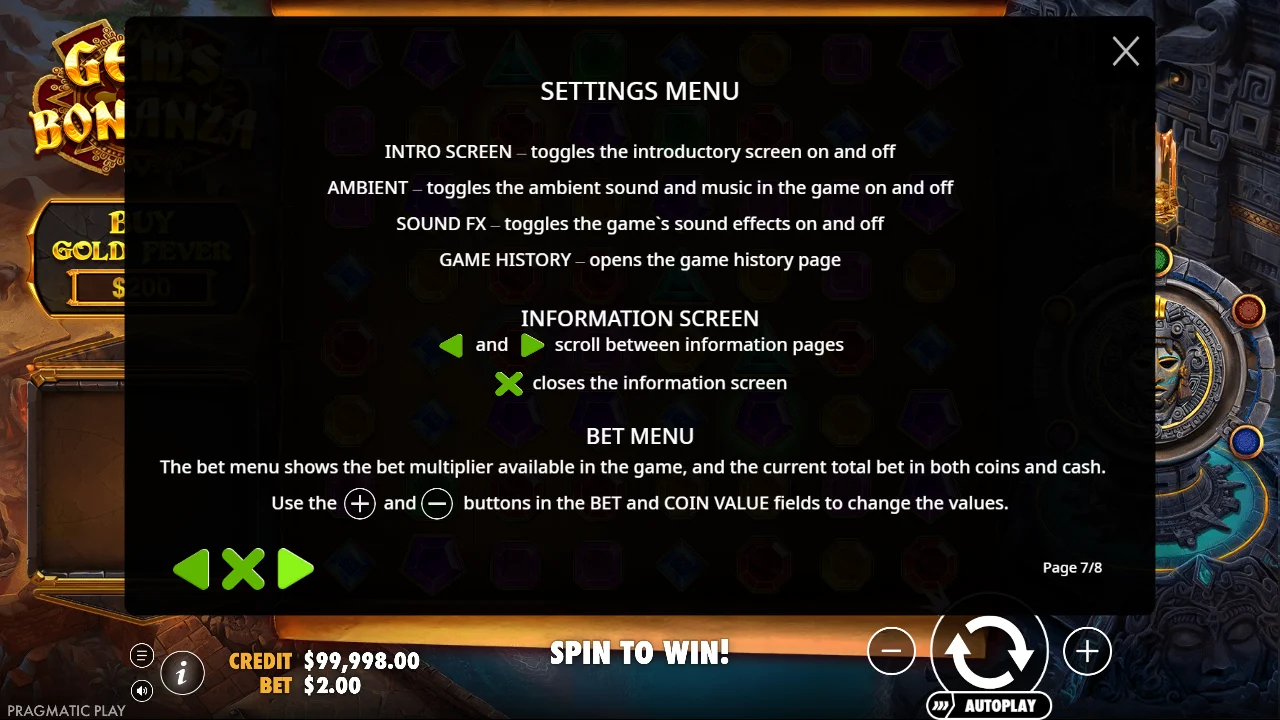
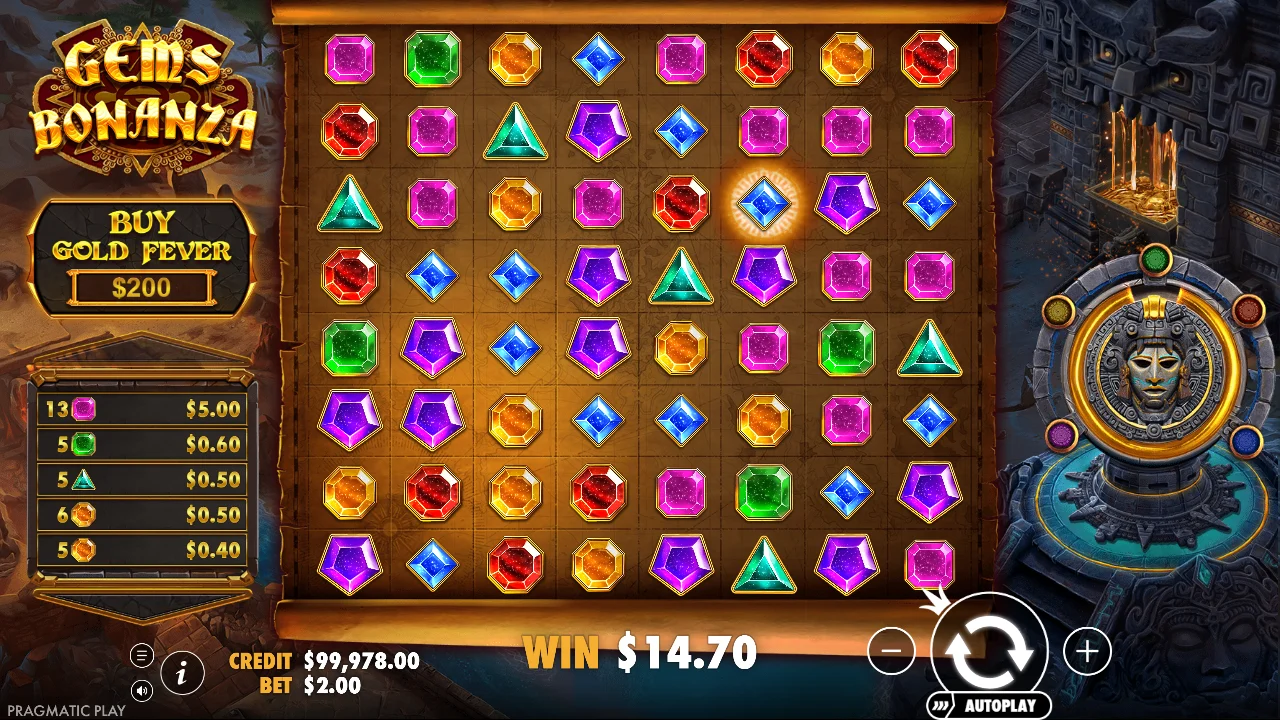
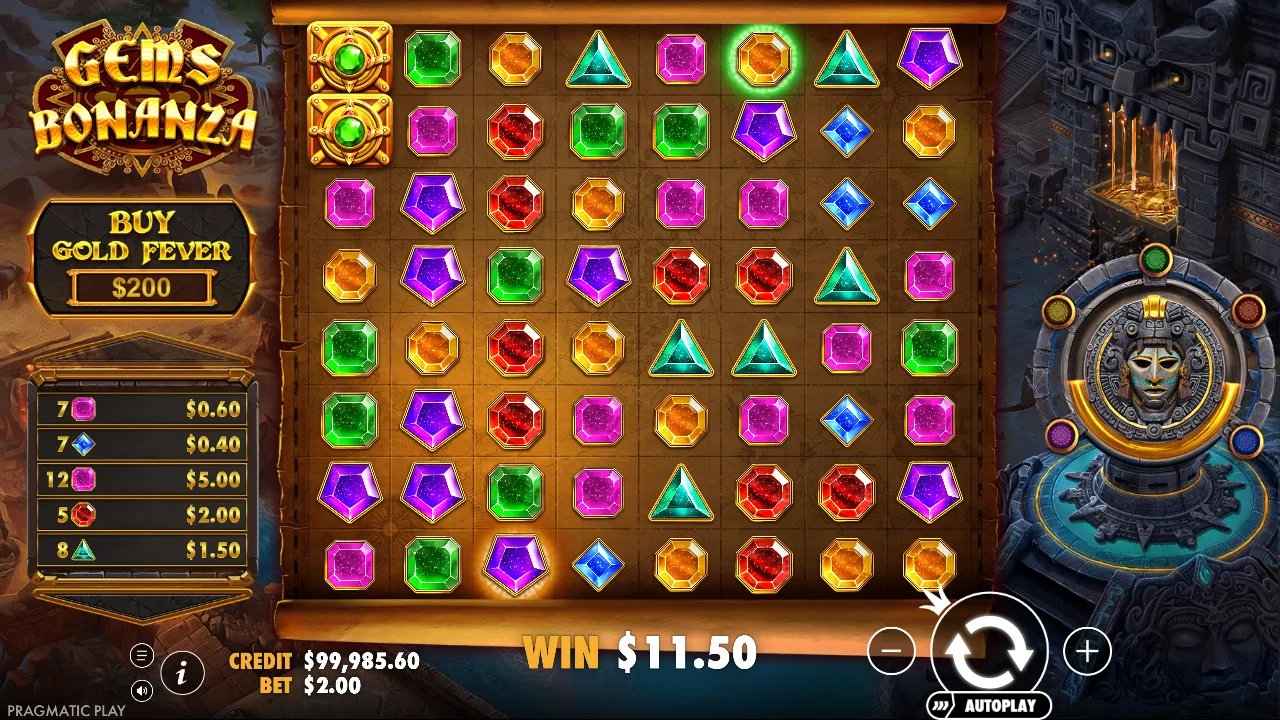
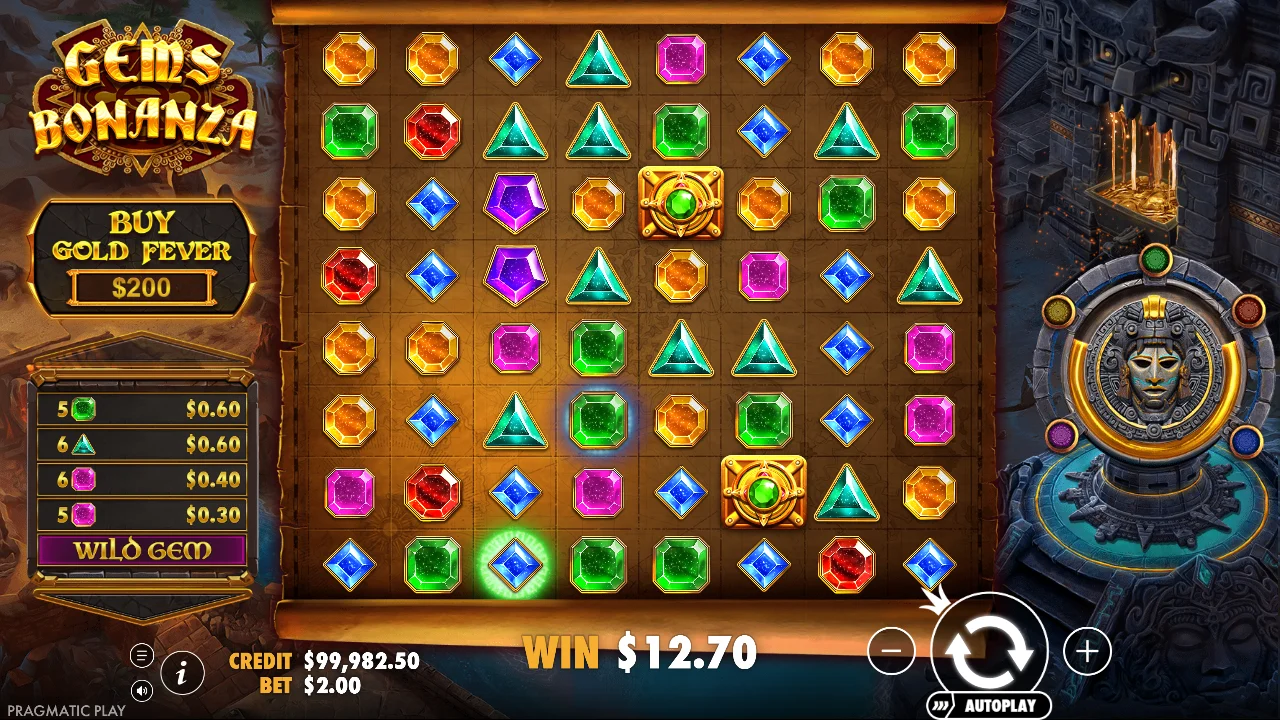
Eight columns by eight rows, paying in blocks: five or more identical gems that touch along rows or columns make a win, and bigger blocks pay steeply more, from 1x for five red gems to 1,000x for twenty-five or more. Winning gems explode, the rest fall, new ones arrive from above, and the round keeps going as long as fresh blocks appear. The wild only enters through two of the modifiers below; it is not on the reels by itself.
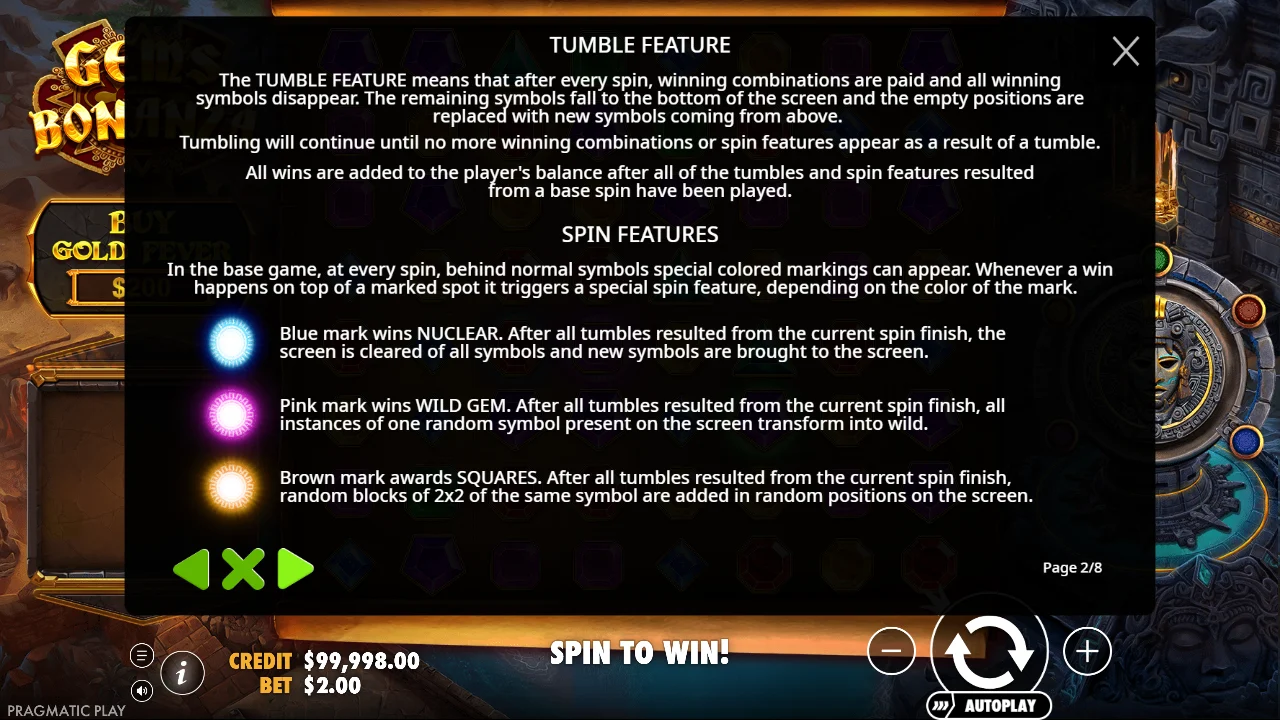
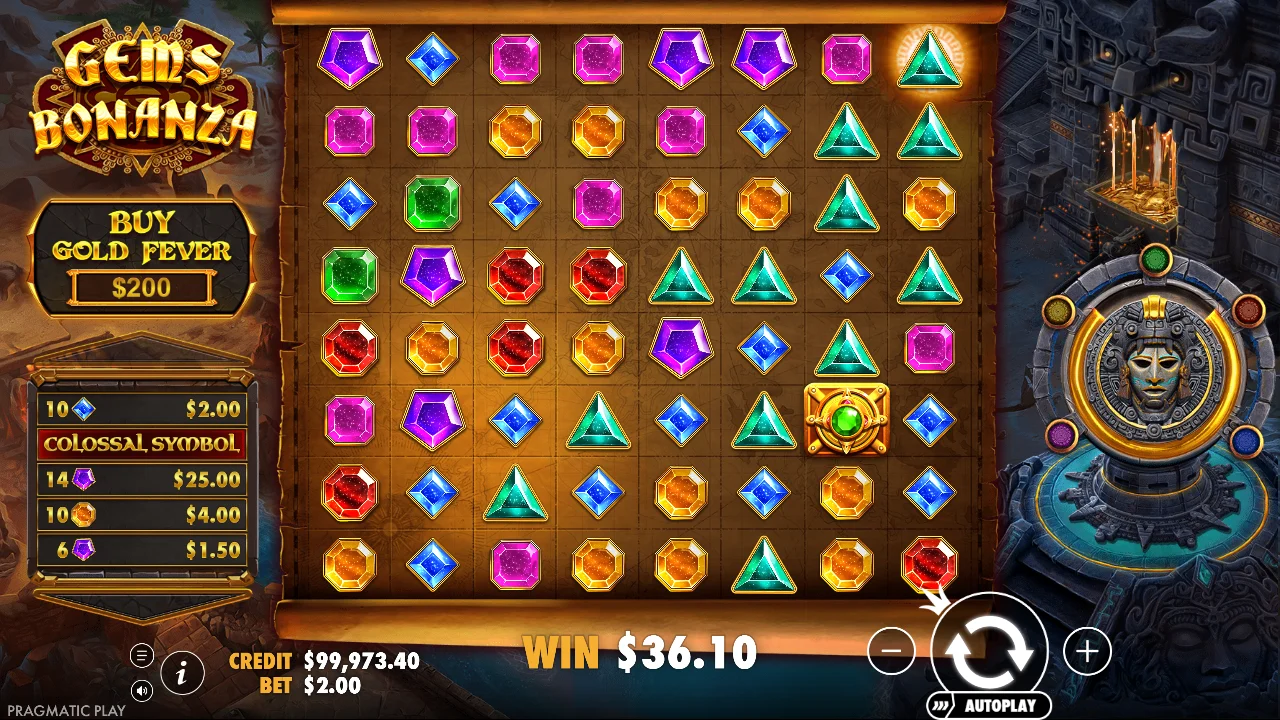
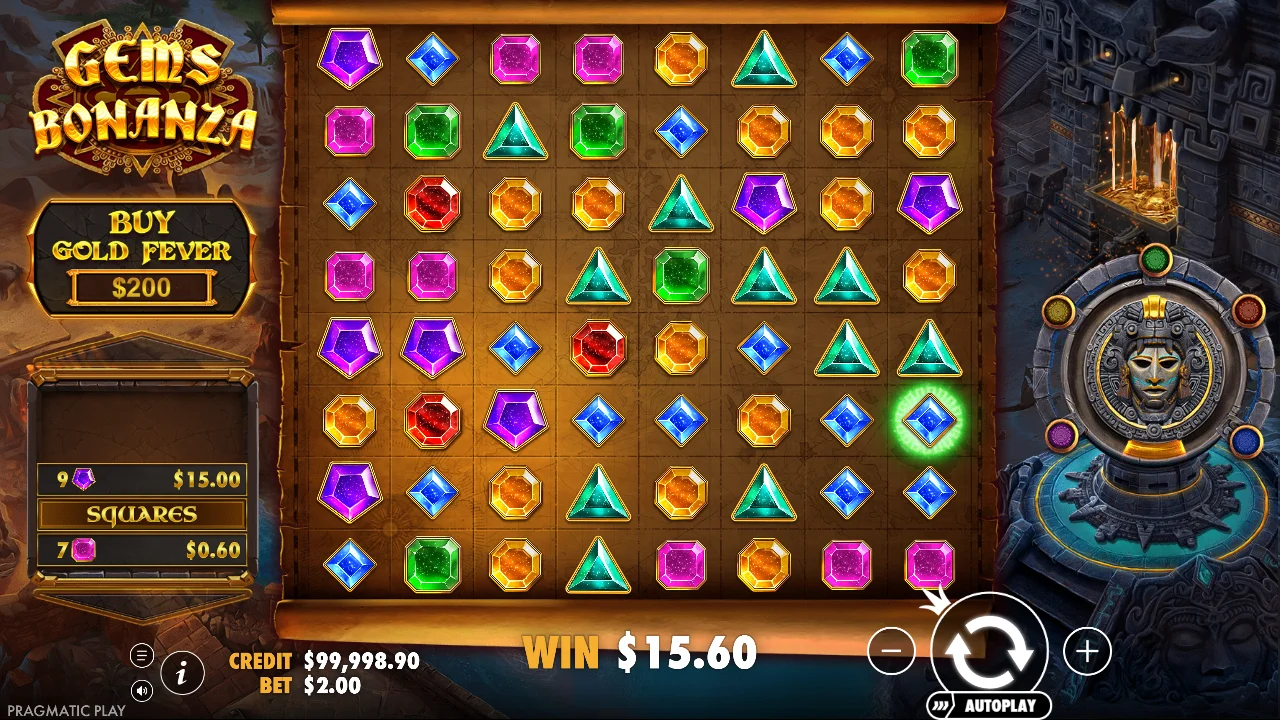
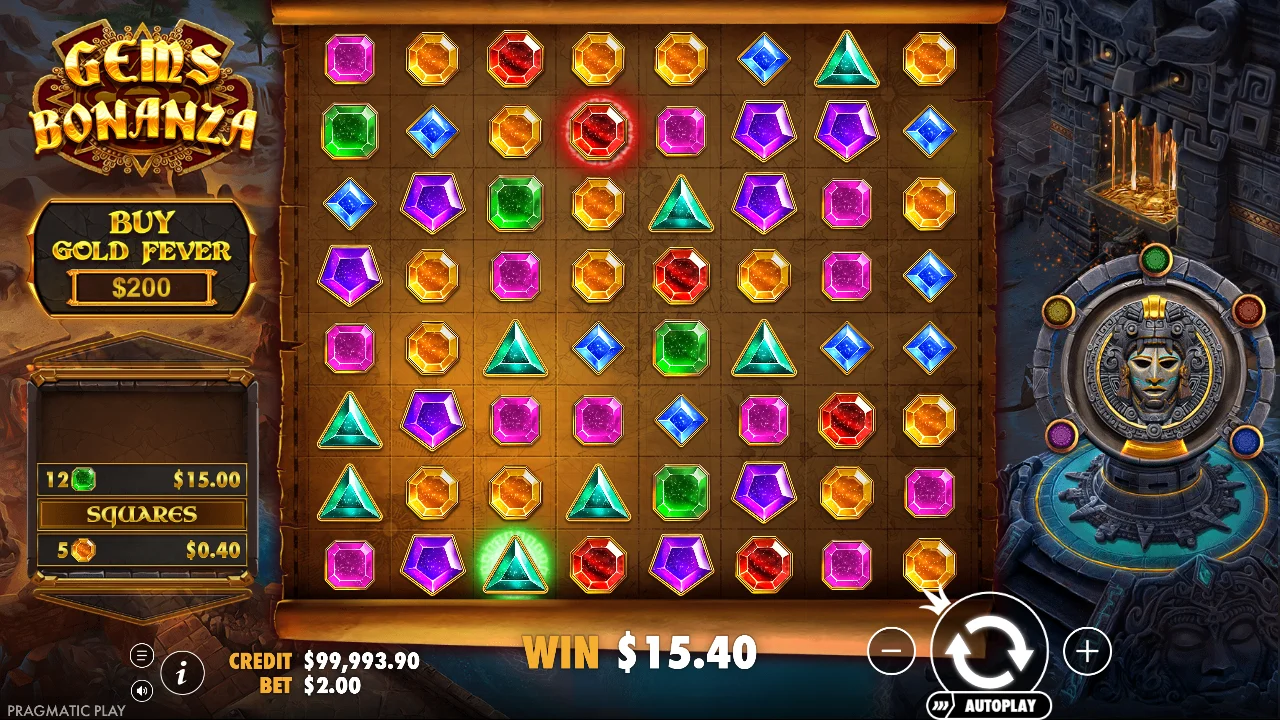
Behind the gems sit coloured marks. A win on top of a mark fires a spin feature once the tumbles are over: blue clears the whole board and refills it (Nuclear), pink turns every copy of one random symbol into wilds (Wild Gem), brown drops 2×2 blocks of one symbol (Squares), red drops a 3×3 to 5×5 block (Colossal Symbol), green scatters five to fifteen wilds (Lucky Wilds). Several marks on one spin play in that fixed order, and each feature can restart the tumbling. That is how the long chains in the first run's log happened: round 8167 tumbled 32 times for 284.1x, round 2798 26 times for 263.8x, round 4623 18 times for 238.05x including a single tumble worth 150x.
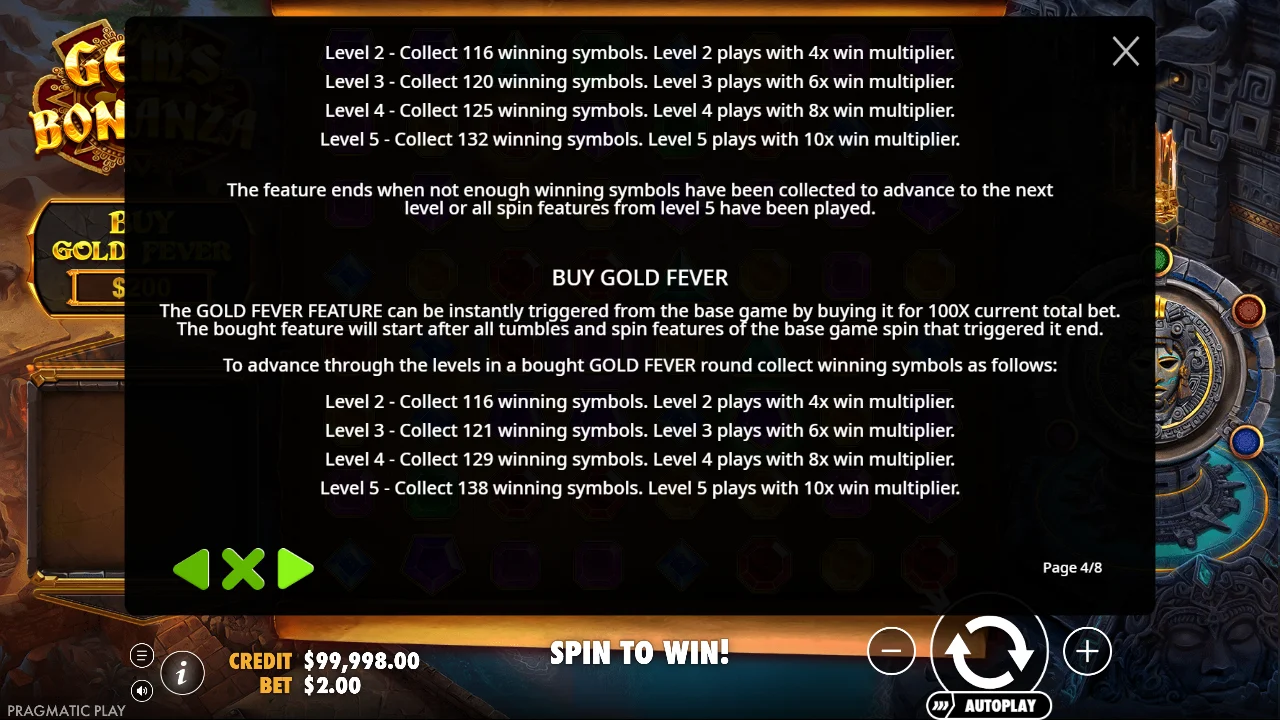
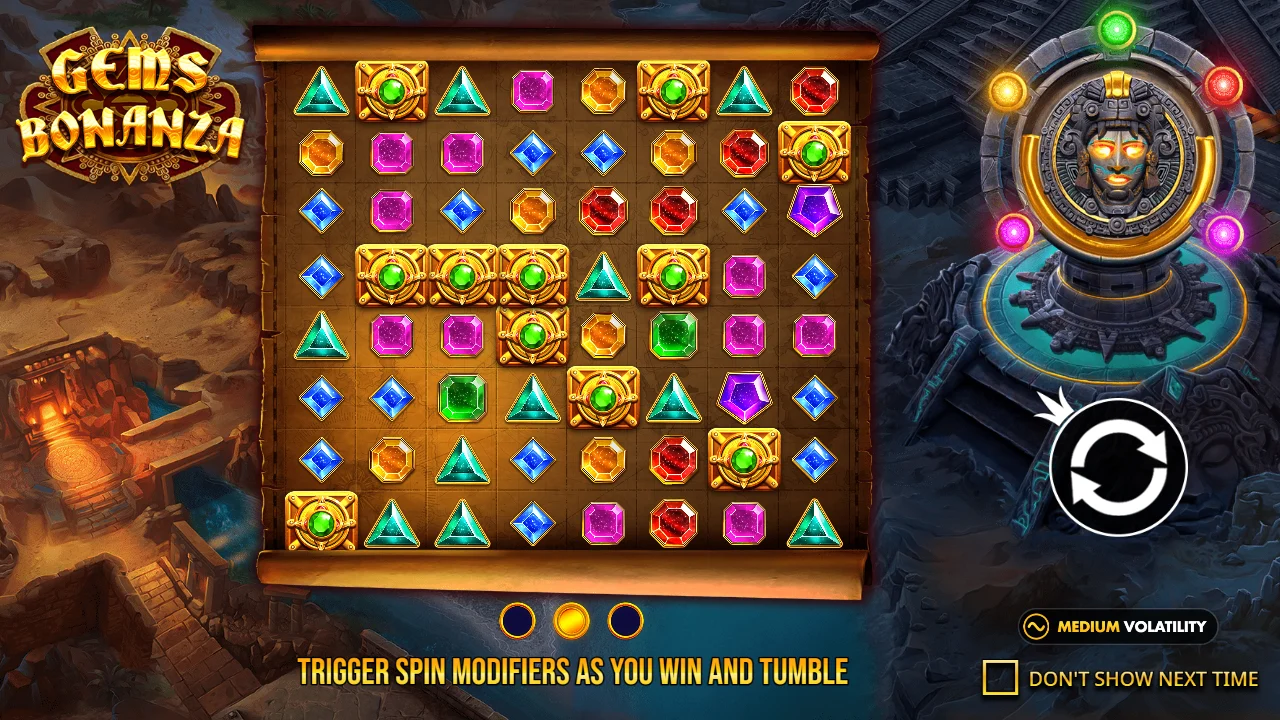
The Gold Fever meter counts the symbols that explode during one spin. Reaching 114 starts the feature after the tumbles end: level one plays every modifier once in order with all wins doubled, and collecting enough symbols during a level (116, 120, 125, 132 for levels two to five) moves to the next level at 4x, 6x, 8x and 10x. The feature ends when a level does not collect enough or level five is done. The server does not flag Gold Fever separately in its responses, so the log records each spin's tumbles and payout, not whether the meter was reached; the lab counts no free-spin rounds in this game because the game has none.
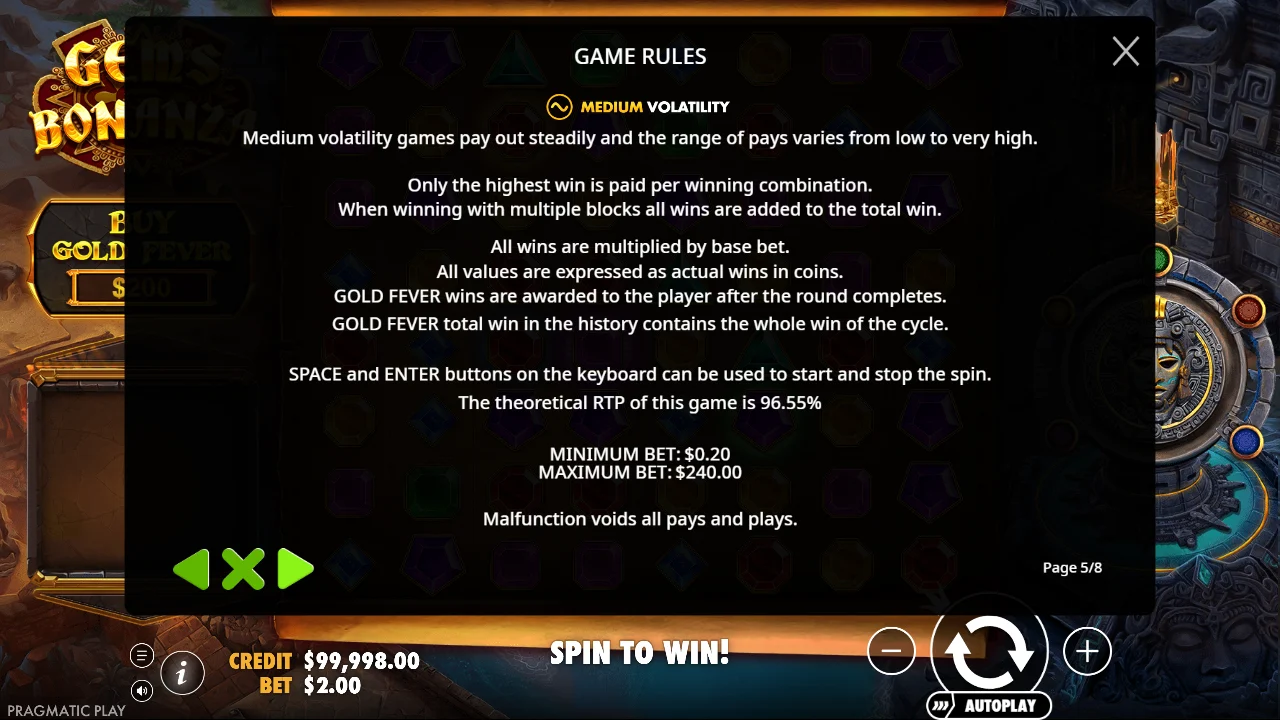
Buying Gold Fever costs 100x the bet and starts the feature at level one after the triggering spin; the bought version needs 116, 121, 129 and 138 symbols to climb. The rules state 96.55%, call the game medium volatility and set stakes from 0.20 to 240.
 Cluster pays
 Cascading reels
 Multiplier
 Wild symbol
 Bonus buy
 Bonus game
On narrow screens, swipe or use arrow keys to view all payouts.
Bet range USD 0.20 – 240 per spin · payouts read from the game's paytable at bet USD 2.00
Gallery
13 frames from the demo session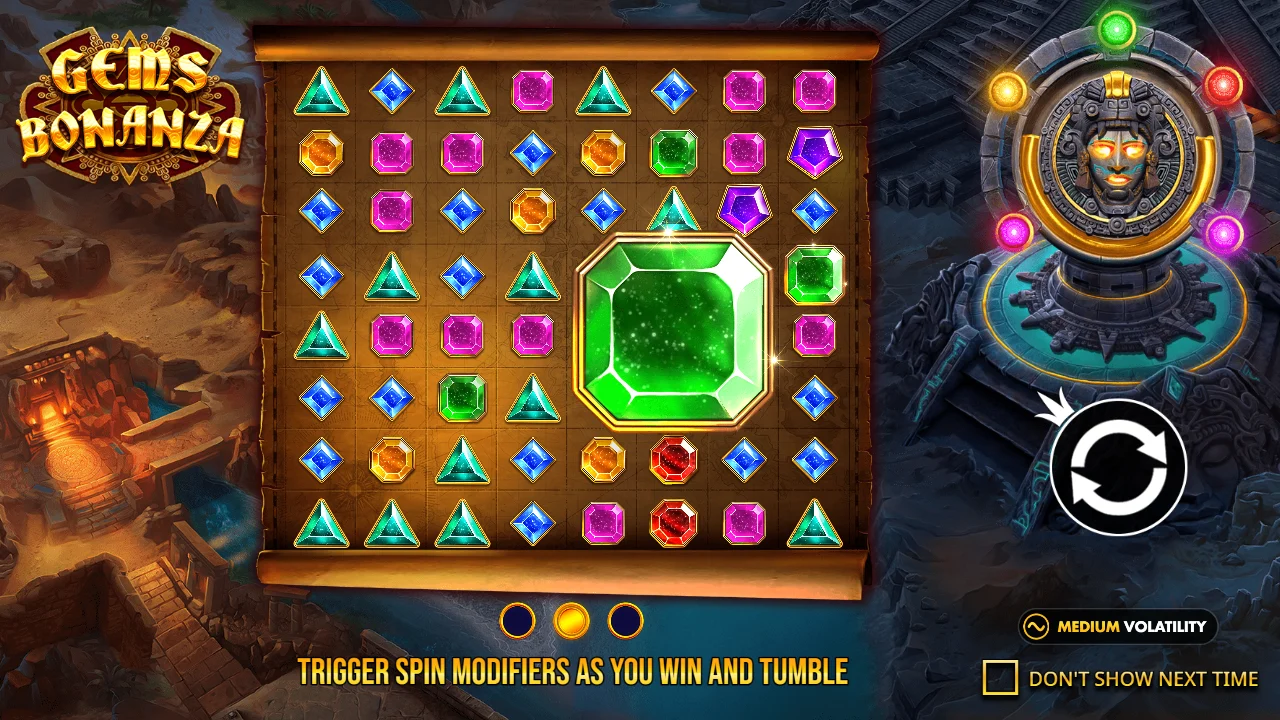
Verdict
The chain that changed the poolThree Gems Bonanza sessions of 10,000 spins have returned 92.51%, 81.14% and 121.39%, 98.34% pooled over 30,000 rounds, 1.8 points above the printed 96.55% and 496 stakes below the starting balance. The cluster grid kept its habits: a win on 31.79%, 32.3% and 32.54% of spins, a 0.35x, 0.35x and 0.3x median hit, 67.8% of rounds paying nothing and no dry stretch beyond 28 spins.
No scatter is waited for here, so the record rounds are all ordinary spins with long tumble chains, and run three rewrote the list: 2,246.35x on round 7062 over fifty tumbles, USD 4,492.70, then 680.2x on round 8348 over another fifty, ahead of 661.55x on round 3667 of run two and 284.1x on round 8167 of run one. Thirty-nine rounds cleared 100x in 30,000 spins, eleven of them 200x, and chains of ten or more tumbles came 187 times, 70, 52 and 65 by run, with 41 reaching twenty; the Gold Fever meter itself is not flagged by the server, so natural features stay uncounted in all three logs.
Gold Fever tickets, 150 of them at USD 200, returned 0.8862x of price, 88.62%, USD 26,585.20 for USD 30,000, 0.9339x, 0.9199x and 0.8048x by run, the median ticket USD 98.95: 96 lost money, 54 covered their price, 17 doubled and none reached 5x, the best still buy 7 of run one at 4.441x and the worst buy 29 of run three at 0.07x. Bought rounds ran 13.3, 12.8 and 13.7 tumbles on average, and the pooled balance, under water for nearly all of the first two runs, bottomed 3,180.4 stakes down on spin 5501 of run three before the 2,246x chain and its neighbours pulled it back to within 496 stakes.
- A 2,246.35x chain of fifty tumbles on round 7062 of run three, USD 4,492.70 on a USD 2 stake, with no feature involved
- Thirty-nine ordinary rounds past 100x across the three runs, eleven of them past 200x, and 187 chains of ten or more tumbles
- Roughly one spin in three paid in every run, and no dry stretch passed 28
- Run three returned 121.39% and lifted the pooled figure from 86.82% to 98.34%
- Spin 5501 of run three found the pooled balance 3,180.4 stakes under its start
- Ninety-six of 150 Gold Fever buys lost money, and run three's batch returned 0.8048x of price
- Natural Gold Fever triggers still cannot be counted, because the server does not flag the feature
- The top five rounds of run three carried 31.7% of its return, against 12.2% and 17.1% in the first two runs
Run 01·2026-09-07·92.51%
This was a slow bleed with a few spikes. The balance never rose more than 50 bets above the start (round 656, after a 154.5x tumble), sat 321 bets down at spin 2,000, 657 down at 4,000, and reached its low of 957 bets down at spin 7142. Round 8167, the 284.1x chain, pulled it back to 492 down; the close was 98,501.60, 749 bets short of the start. A 50-bet stake was gone after 310 spins, 100 bets after 652, 200 bets after 999.
The game hits often and small. A win came every 3.15 spins with a median of 0.35x, 68% of spins paid nothing, and the only dead run past 20 was 22 spins (rounds 7164 to 7185). The size lives in the chains: 70 rounds tumbled ten times or more, the longest 34 steps, and 14 rounds passed 100x. The top five rounds together were 12.2% of everything returned, a smaller concentration than in the lab's free-spin games, because the big results here come from many mid-sized tumbles stacking up rather than one multiplied screen.
With no natural feature to count, the purchase is the only bonus the lab could measure directly. Fifty Gold Fever buys at 200 returned 9,339: 0.934x on average, a median of 0.456x, 32 rounds below price, 27 below half of it, one below a tenth (buy 29, 0.076x). Six purchases passed 2x, led by buy 7 at 4.44x, a 28-step round with single tumbles of 409.60 and 167.40 inside it; strip that round out and the other 49 average 0.862x. A bought round ran 13 tumble steps on average, from 6 to 31.
Gems Bonanza rewards patience with the base game rather than a bonus wait: the return came from ordinary spins that kept tumbling, and the buy adds level multipliers to that same machinery for a price that, over fifty tries, it did not earn back.
Run 02·2026-09-27·81.14%
Second series, 10,000 spins at USD 2: 81.14% of stake returned, approximate 95% CI 64.1 to 98.18%, a band that stops short of the printed 96.55%, and the balance closed 1,886 stakes down after standing above its start for only five spins, the last of them spin 96. The blocks of 2,000 spins returned 65.1%, 115.5%, 83.7%, 71.8% and 69.8%; fifty, a hundred and two hundred stakes were gone by spins 197, 276 and 817, and the low of 1,892 stakes down arrived on spin 9972, 28 spins from the end. A hit landed on 32.3% of spins at a 0.35x median, 6,770 rounds paid nothing, and the longest dry stretch ran 23 spins from round 5481.
Round 3667 is the biggest round on this page: 52 tumbles, the last three worth USD 7, USD 250 and USD 40 as the modifiers kept restarting the chain, USD 1,323.10 in all, 661.55x, which cut the deficit from 970 stakes to 310 in one spin. Round 4697 added 270.7x over twenty tumbles with a single USD 400 drop inside it, rounds 528 and 5383 each carried a USD 300 tumble to 159.6x and 152.85x, and ten rounds cleared 100x against fourteen in the first run; chains of ten or more tumbles came 52 times, eleven of them twenty or more.
Fifty Gold Fever tickets at USD 200 returned 0.9199x of price, 91.99%, with a 0.5565x median, USD 111.30: 31 lost money, 22 returned under half, 19 covered their price and six doubled, the best buy 32 at 4.25x, USD 850, over 28 tumbles. The worst, buy 23, paid 0.111x, and without buy 32 the other 49 averaged 0.8519x.
Run 03·2026-09-30·121.39%
Round 7062 tumbled fifty times for USD 4,492.70, 2,246.35x, and no Gems Bonanza session on this page had produced a larger round, this one more than three times the previous record of 661.55x; round 8348 ran another fifty tumbles for 680.2x, and rounds 6282, 3951, 998 and 3065 added 383x, 304.6x, 238.7x and 216.05x, six rounds past 200x in one session after five across the first two. Fifteen rounds cleared 100x, 65 chains ran to ten tumbles or more and fifteen of them reached twenty, and the top five rounds together were 31.7% of everything returned, against 12.2% in run one and 17.1% in run two.
Hits landed on 32.54% of spins at a 0.3x median, 6,746 rounds paid nothing; the longest dry stretch, 28 spins from round 1579, was the first on this page to pass 25. The balance spent 4,264 spins above its start, bottomed 545.2 stakes down on spin 5501, then rode the fourth 2,000-round block, 195.7%, to a peak of 2,517.6 stakes up on spin 8542 and closed at USD 104,277.40, 2,138.7 stakes ahead, 121.39% of USD 20,000; the blocks read 88.3%, 113.6%, 79.5%, 195.7% and 129.8%, and fifty stakes lasted 841 spins, a hundred 919 and two hundred 1,733.
The Gold Fever counter had its weakest batch: USD 8,047.90 came back from fifty tickets at USD 200, 0.8048x of price, 80.48%, after 0.9339x and 0.9199x, with a USD 86.75 median; 33 tickets lost money, 26 returned under half the price, 17 covered it, five doubled, none got to 5x, and the best, buy 32 at 3.221x, USD 644.20, over 26 tumbles, then buy 34 at 3.0515x, and the worst buy 29 at USD 14. Bought rounds ran 13.7 tumbles on average, from six to 28.
Test record
3 runs · 30,000 rounds · 150 buys · open data · closed rigThis game has been through 3 separate test runs on the official demo server, each a fresh session of 10,000 rounds at a fixed bet. Every figure on this page combines the runs into one sample, as if they were one long session; the record below keeps each run apart, with its own numbers and its own downloadable log.
- 30,000rounds, all runs
- 32%rounds that paid
- 2,246xbiggest round
- —natural bonus rate
- 0.89xmean of 150 buys
- 28longest dry streak
01run Run 012026-09-07 measured return92.51%-4.0 pts vs declared
- 95% band
- 77.7–107.3%
- rounds that paid
- 32%
- biggest round
- 284x · round 8,167
- longest dry streak
- 22
- natural bonuses
- 0
- bonus buys
- mean 0.93x · median 0.456x · 64% below price
- balance start → end
- 100,000 → 98,502
- deepest drawdown
- 1,007x
02run Run 022026-09-27 lab note measured return81.14%-15.4 pts vs declared
- 95% band
- 64.1–98.2%
- rounds that paid
- 32%
- biggest round
- 662x · round 3,667
- longest dry streak
- 23
- natural bonuses
- 0
- bonus buys
- mean 0.92x · median 0.557x · 62% below price
- balance start → end
- 100,000 → 96,228
- deepest drawdown
- 1,894x
Three weeks after the first series, the second came in at 81.14% against 92.51%, and the pooled 86.82% now sits with its whole band below the printed 96.55%. The base game still found the series record, 661.55x on round 3667 over 52 tumbles, but only ten rounds cleared 100x against fourteen and chains of ten or more tumbles fell from 70 to 52; the fifty Gold Fever buys held at 0.9199x against 0.9339x.
03run Run 032026-09-30 lab note measured return121.39%+24.8 pts vs declared
- 95% band
- 72.7–170.1%
- rounds that paid
- 33%
- biggest round
- 2,246x · round 7,062
- longest dry streak
- 28
- natural bonuses
- 0
- bonus buys
- mean 0.80x · median 0.434x · 66% below price
- balance start → end
- 100,000 → 104,277
- deepest drawdown
- 683x
September 30's third run returned 121.39% after 92.51% on 7 September and 81.14% on 27 September, the first Gems Bonanza session on this page above the printed 96.55%, and the pooled figure climbed from 86.82% to 98.34% over 30,000 rounds. Round 7062's 2,246.35x chain set the record by a factor of three, six rounds passed 200x against five in the first two runs together, and the fifty Gold Fever tickets fell to 0.8048x of price after 0.9339x and 0.9199x.
3 test runs combined into one sample (2026-09-07, 2026-09-27, 2026-09-30): 30000 ordinary paid rounds, including naturally triggered features, at a fixed USD 2.0 bet; 150 bonus buys at 200.0 each (100.0x) on the official Pragmatic Play demo server (jurisdiction 99, RTP profile 96.55%); every request and response logged.
The test rig plays the official demo build over the network and records every server round: bet, win, intermediate steps (cascades, respins), free spins, collect. Screenshots and video were captured in a separate browser session and are not part of the statistical samples. The text was read against the log by an editor before publication. How we test →
FAQ
5 questions · answered from the logWhy 121.39% in the third run?
Six rounds over 200x where the first two runs had five between them: 2,246.35x on round 7062, 680.2x on 8348, 383x on 6282, 304.6x on 3951, 238.7x on 998 and 216.05x on 3065. The run returned 88.3%, 113.6%, 79.5%, 195.7% and 129.8% by 2,000-spin block and ended 2,138.7 stakes up after a low of 545.2 down on spin 5501.
What made round 7062 pay 2,246x with no bonus?
The third run's round 7062: fifty tumbles, the coloured marks firing modifiers that kept restarting the chain, USD 4,492.70 for the round on a USD 2 stake. It beat the second run's 661.55x record on round 3667, itself a 53-tumble chain, and round 8348 of the same third run ran fifty tumbles again for 680.2x.
Has the 100x Gold Fever buy paid back yet?
No. Gold Fever buys returned USD 26,585.20 on 150 tickets at USD 200 each, 0.8862x of price, 0.9339x, 0.9199x and 0.8048x by run. The median ticket paid USD 98.95, 96 lost money, 54 covered the price, 17 doubled and none reached 5x, the best being buy 7 of the first run at 4.441x and run three's best buy 32 at 3.221x.
Is the natural Gold Fever count known?
No, not in any of the three runs: the server's responses do not flag the feature, so the log records tumbles and payouts spin by spin without marking when the meter reached 114 symbols. What can be counted is the shape of the rounds, 187 chains of ten or more tumbles in 30,000 spins and 39 rounds above 100x, all of them ordinary spins.
Deepest point of the three runs?
Joined together, the runs bottomed 3,180.4 stakes below the start on spin 5501 of the third, after run one's low of 957 stakes down at spin 7142 and run two's 1,892 at spin 9972; run three then climbed 3,062.8 stakes from that low to its peak on spin 8542 and closed 2,138.7 up. The three test bankrolls lasted 310, 652 and 999 spins in run one, 197, 276 and 817 in run two and 841, 919 and 1,733 in run three.
Also tested
4 more slots on the same rig-
 Book of Dead
Play'n GO · 10,000 spins
2026-10-12
RTP
99.3% 96.2%
hit31%
max201x
buy—
Book of Dead
Play'n GO · 10,000 spins
2026-10-12
RTP
99.3% 96.2%
hit31%
max201x
buy—
-
 Gravity Bonanza
Pragmatic Play · 20,000 spins
2026-09-20
2026-10-15
RTP
104.8% 96.1%
hit38%
max602x
buy0.89x
Gravity Bonanza
Pragmatic Play · 20,000 spins
2026-09-20
2026-10-15
RTP
104.8% 96.1%
hit38%
max602x
buy0.89x
-
 Release the Kraken 2
Pragmatic Play · 10,000 spins
2026-09-07
RTP
86.0% 96.0%
hit27%
max122x
buy0.78x
Release the Kraken 2
Pragmatic Play · 10,000 spins
2026-09-07
RTP
86.0% 96.0%
hit27%
max122x
buy0.78x
-
 Fire Strike 2
Pragmatic Play · 20,000 spins
2026-09-07
2026-10-15
RTP
90.0% 96.5%
hit18%
max150x
buy—
Fire Strike 2
Pragmatic Play · 20,000 spins
2026-09-07
2026-10-15
RTP
90.0% 96.5%
hit18%
max150x
buy—
Field notes
0 notes