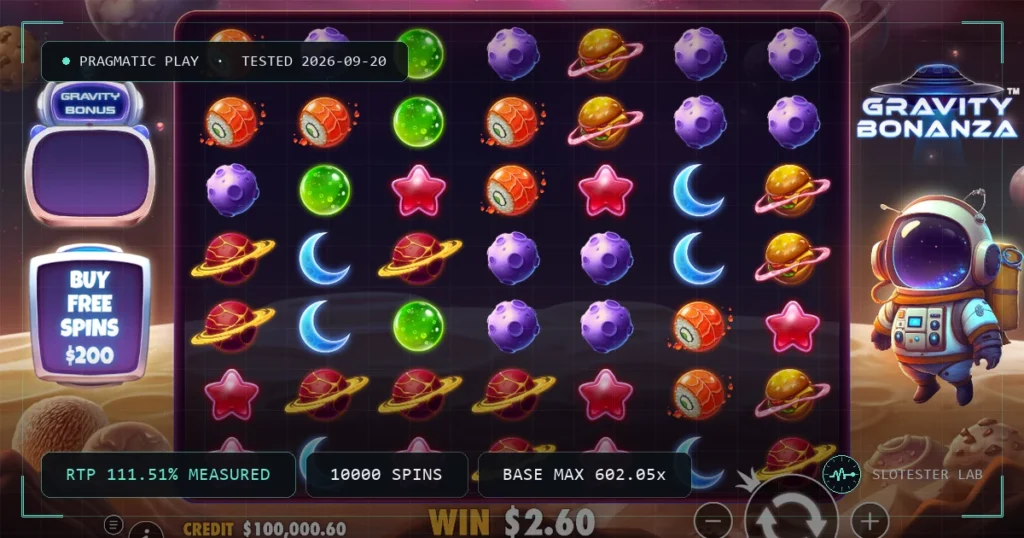
Pragmatic Play · 2023 · tested 2026-09-20
Gravity Bonanza
Black holes, not blocks, carried 64.3% of what the Gravity Bonanza demo paid back, and this review closed at 111.51% RTP after one free spin pulled 23 purple planets into a x3 meter for 1,500x.
Test card
10,000 spins · USD 2.00 bet · every request logged| Spins | 10,000 |
| Bet | USD 2.00 |
| RTP declared | 96.09% |
| RTP measured | 111.51% (approximate 95% CI 68.7–154.3) |
| Hit frequency | 37% · every 2.67 |
| Dead streak max / avg | 17 / 2.67 |
| Median hit | 0.75x |
| Max win (base game) | 602.1x · spin 1027 |
| Free spins, natural | 33 · every 303 spins · mean FS-only payout 130.8x stake |
| Balance start → end | 100,000 → 102,303 |
each run keeps its own spin log, CSV and raw server journal with checksums; the figures on this card combine all runs
Play Gravity Bonanza demo
same math as real play · demo balance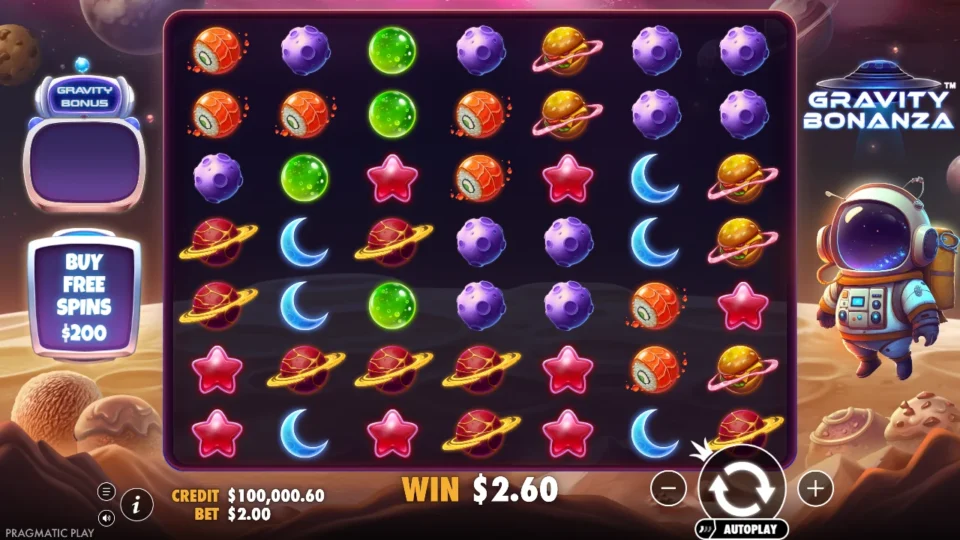
Bonus buy lab
50 buys × 100x · USD 200 eachmean 0.97x · median 0.2175× price (USD 43.50) · 32 of 50 below price · best 6.36x · worst 0.03x
| Spins per bonus (avg / min–max) | 11.5 / 10–25 |
| Retriggered | 12% |
| Bonuses that paid nothing | 0% |
The share counts tickets that landed three or more UFOs during the feature, ten extra spins each: six of the 50 did. Tickets that opened with 15 spins from four UFOs on the buying spin are not retriggers.
- Spent
- USD 10,00050 × USD 200
- Returned
- USD 9,65996.59% · approximate 95% CI 60–134%
- Net
- −USD 341−1.7 buys
- Break-even or better
- 18 / 5036%
- Paid 2× price or more
- 9 / 5018%
- Price in base spins
- 100natural trigger every ~303 spins
One ticket equals 100 ordinary stakes. Natural bonuses occurred once per 303 paid rounds in this sample. Stakes multiplied by this interval measure gross wagering, not the net cost of obtaining a bonus. Purchase returns above include the complete purchased round and are divided by the ticket price.
Risk profile
how much bankroll this run needed| 50 bets | bust at spin 184 |
| 100 bets | bust at spin 280 |
| 200 bets | survived all 10000 spins |
One run, one bet size. A different session can bust earlier or never; treat this as a measured example, not a rule.
How it plays
7 rules screens from the game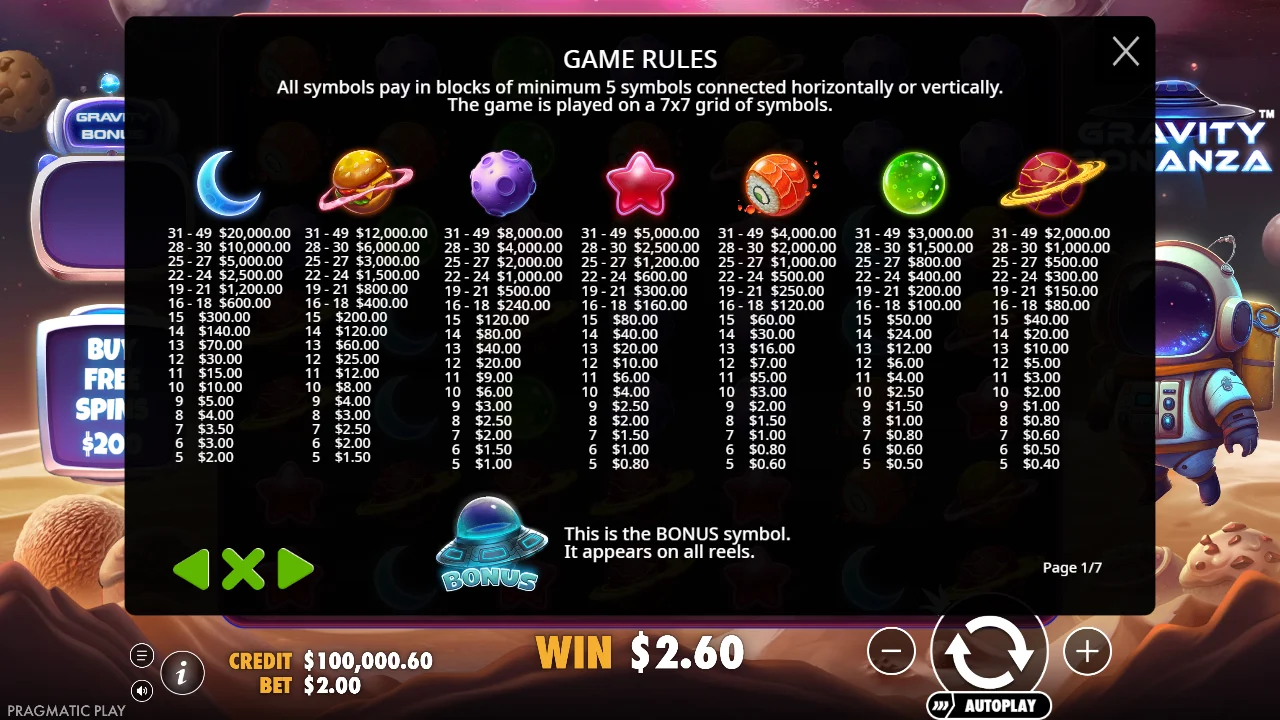
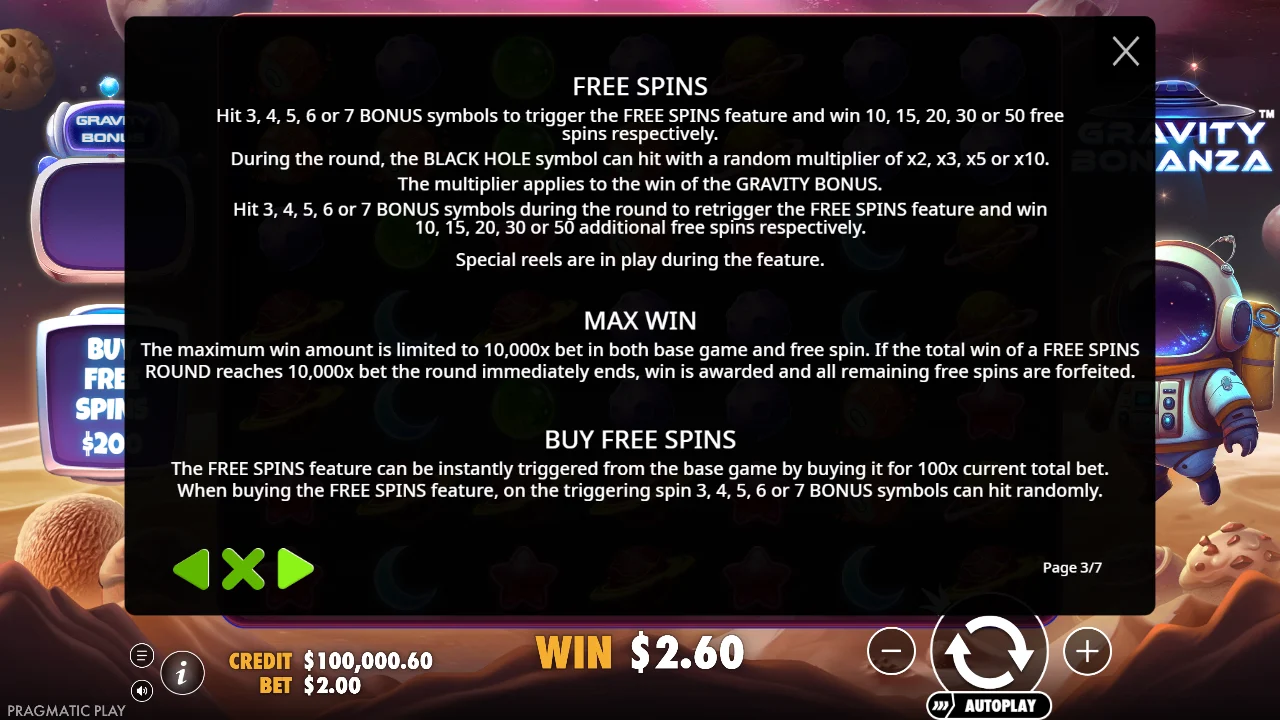
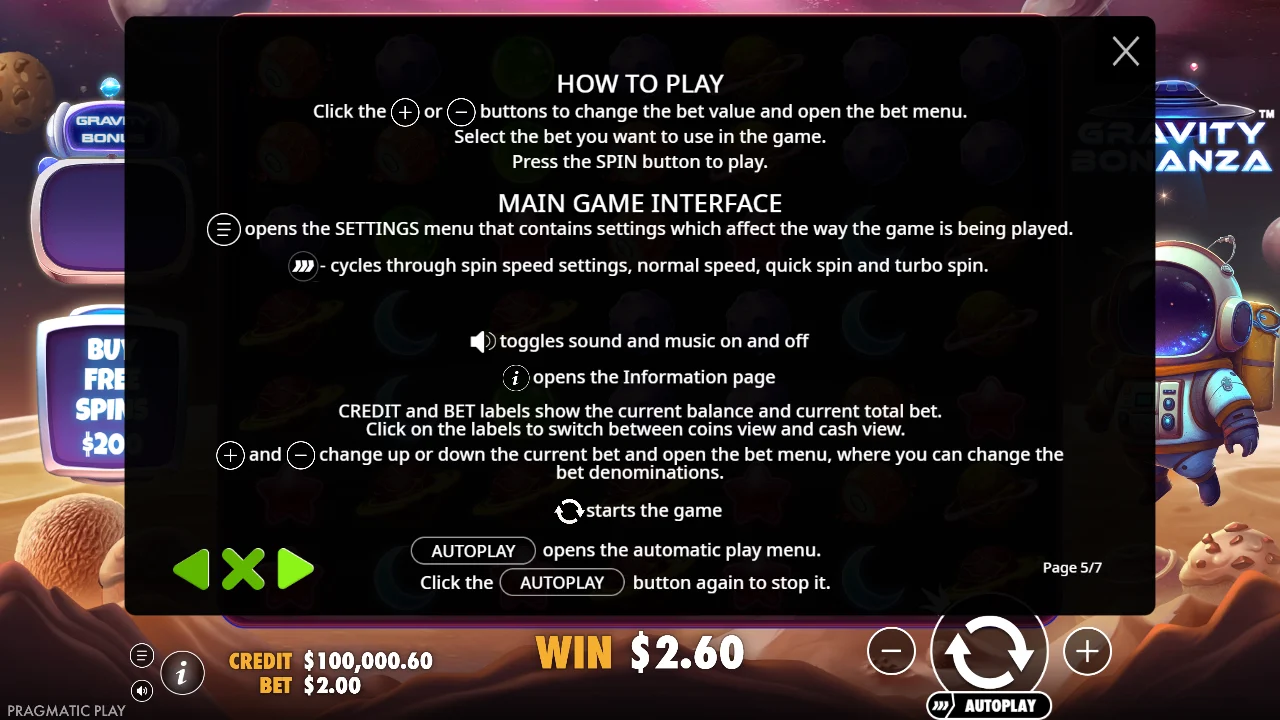
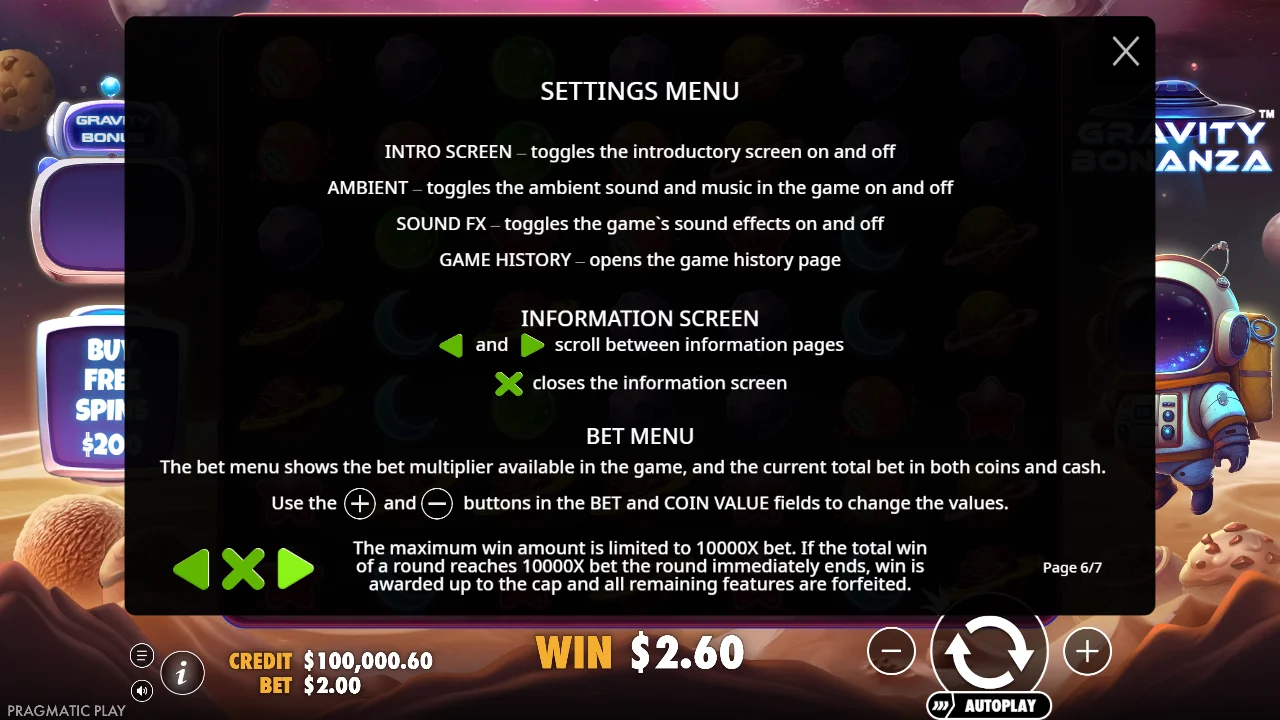
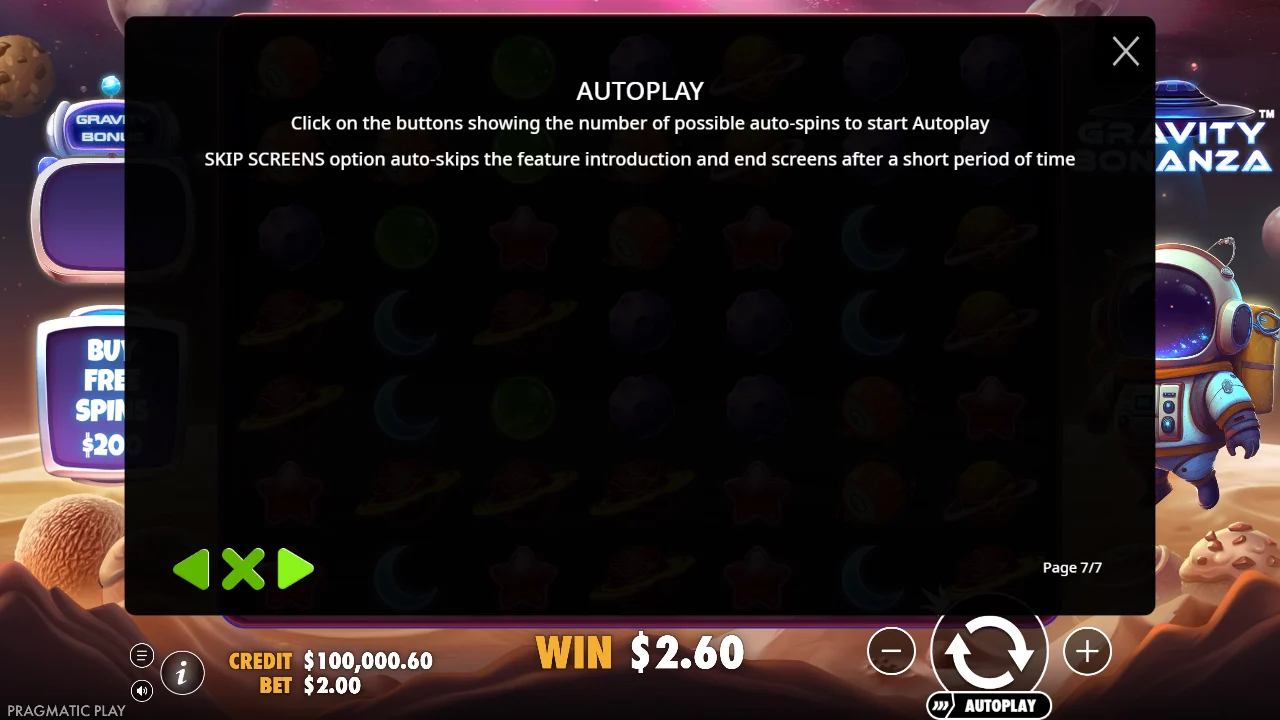
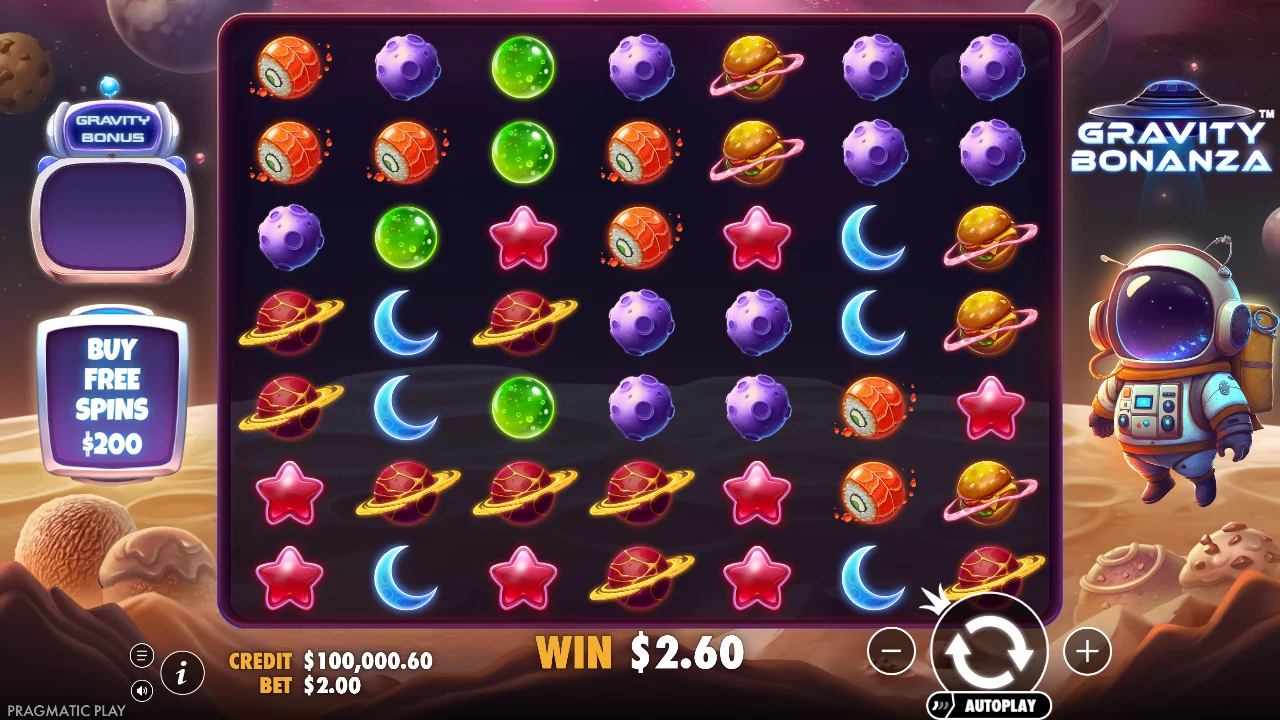
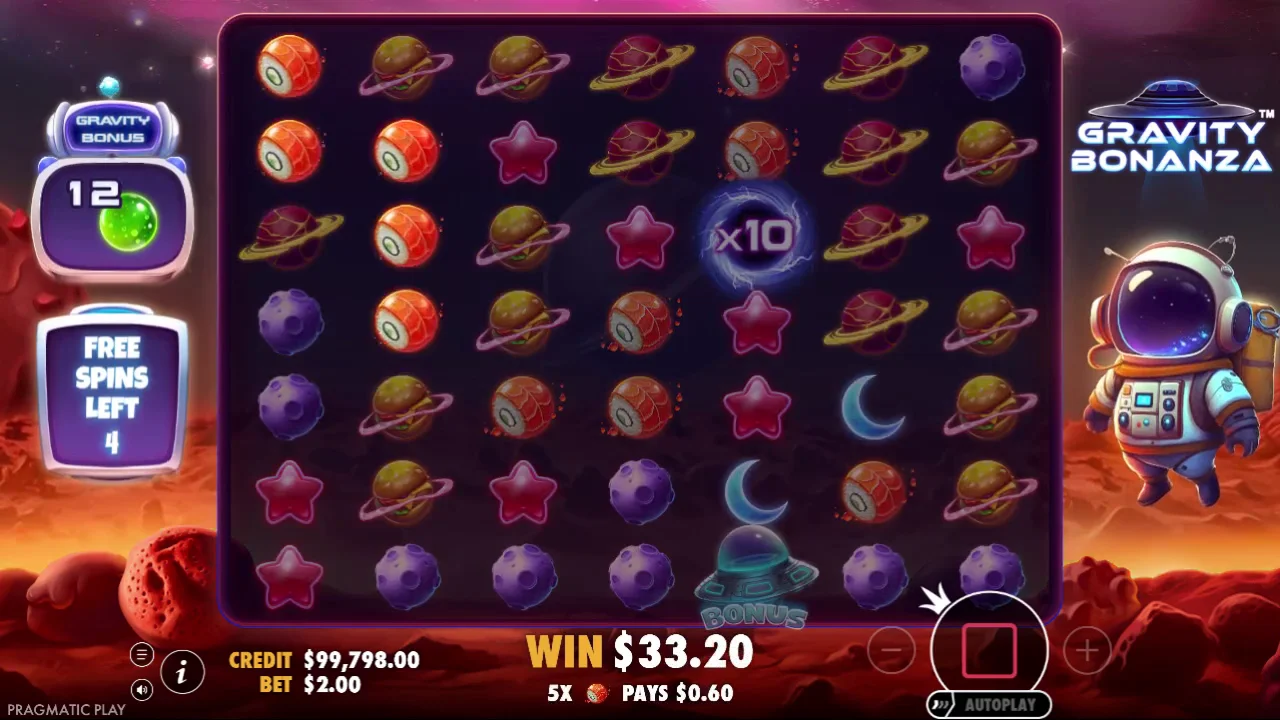
Gravity Bonanza plays on a seven-by-seven grid set above a candy-coloured moonscape, and a win needs a connected group of at least five matching symbols, joined side by side or one above another, anywhere on the screen. The blue Moon leads the paytable: a group of five Moons is worth 1x the stake, fifteen are worth 150x and 31 or more hit the 10,000x cap; behind it come the burger planet, purple planet, pink star, sushi roll, green orb and red ringed planet, five red planets being worth 0.2x. After a win the paid symbols vanish, the survivors slide down, fresh symbols top up the grid from above, and the cycle continues as long as new groups keep forming.
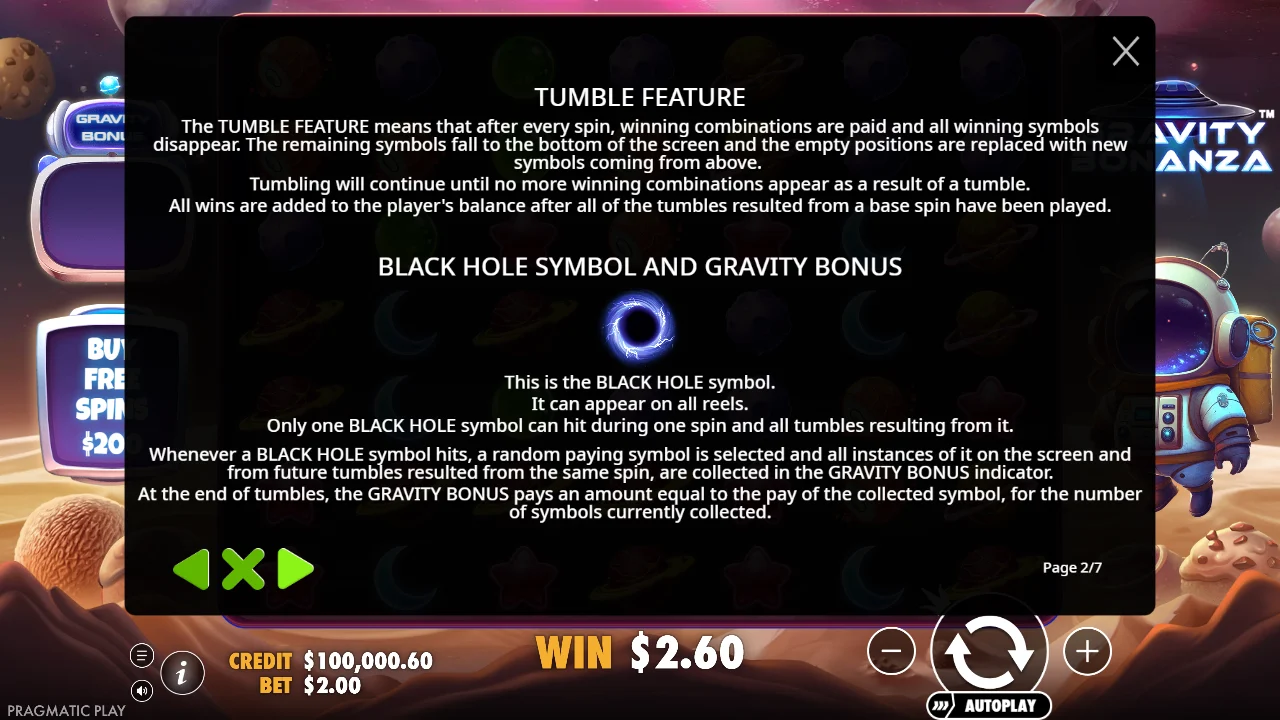
The Black Hole is the game's own device. Only one can appear per spin and its tumbles; when it lands, the game picks a random paying symbol, and every copy of that symbol on the screen and in the tumbles that follow is pulled into the Gravity Bonus meter. When the tumbles stop, the meter pays the block price of the collected symbol for the number collected, so 19 Moons gathered in round 1027 paid 600x, exactly what a 19-symbol block would have.
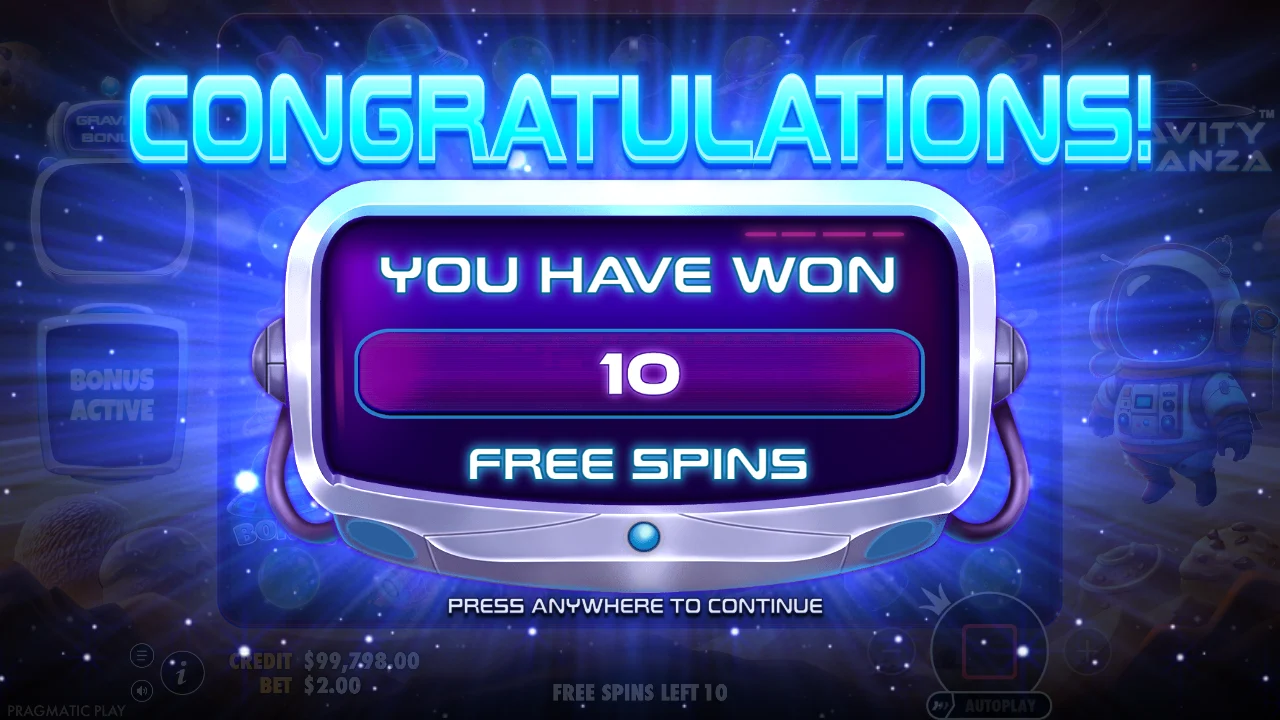
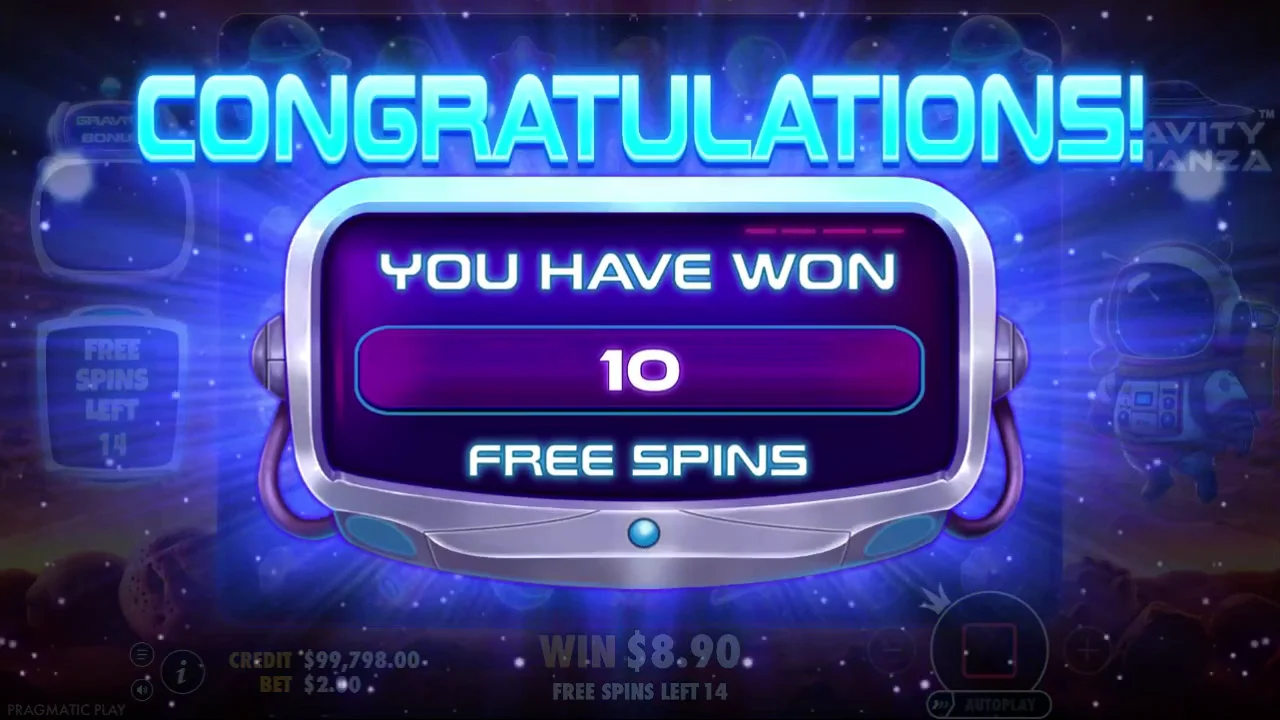
Bonus UFOs open the feature: 3 of them anywhere pay 10 free spins, 4 pay 15, 5 pay 20, 6 pay 30 and 7 pay 50, and the same counts landing inside the feature add the same numbers again. During free spins the Black Hole arrives with a random x2, x3, x5 or x10 multiplier that applies to the Gravity Bonus alone, and the rules note that special reels are in play. A round that reaches 10,000x the stake ends on the spot and forfeits the remaining spins.
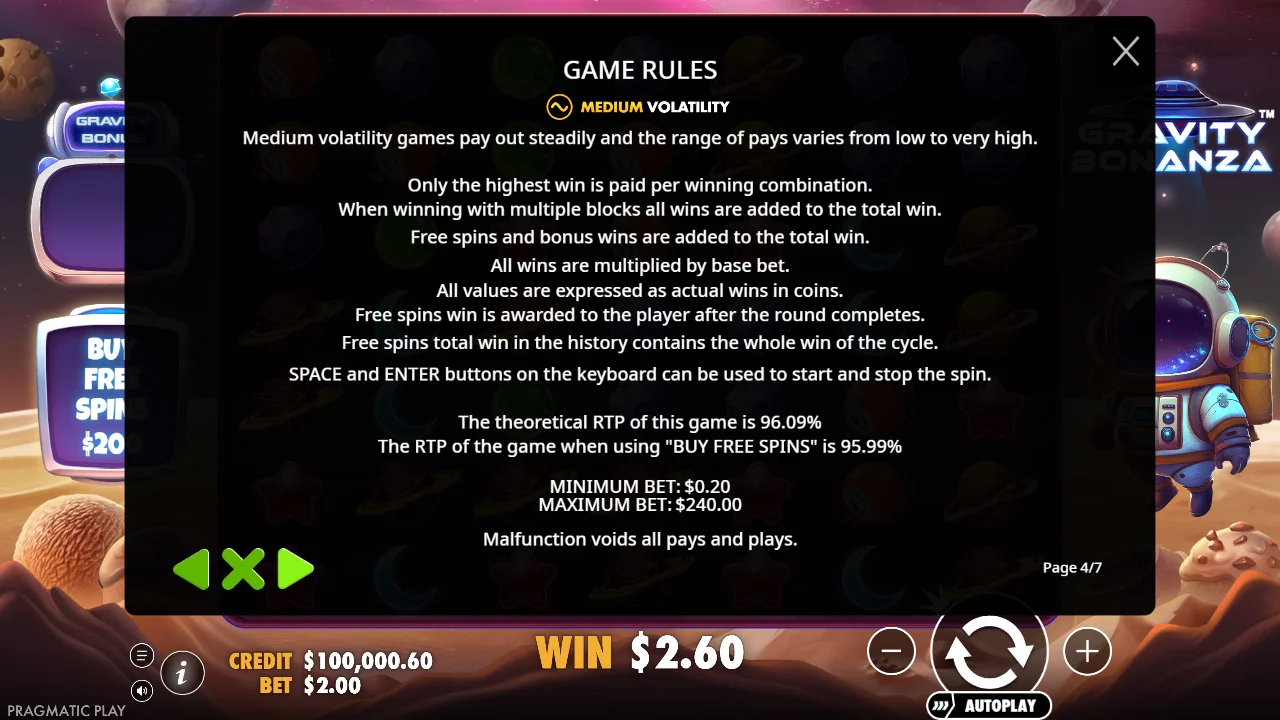
Buy Free Spins is priced at 100 stakes, which at the USD 2 bet means a USD 200 ticket, and the buying spin may land three to seven UFOs at random. The rules page calls the game medium volatility and prints 96.09% RTP for ordinary play and 95.99% for the purchase; stakes start at USD 0.20 and stop at USD 240.
 Cluster pays
 Cascading reels
 Scatter symbol
 Free spins
 Retrigger
 Multiplier
 Bonus buy
Bet range USD 0.20 – 240 per spin · payouts read from the game's paytable at bet USD 2.00
Gallery
10 frames from the test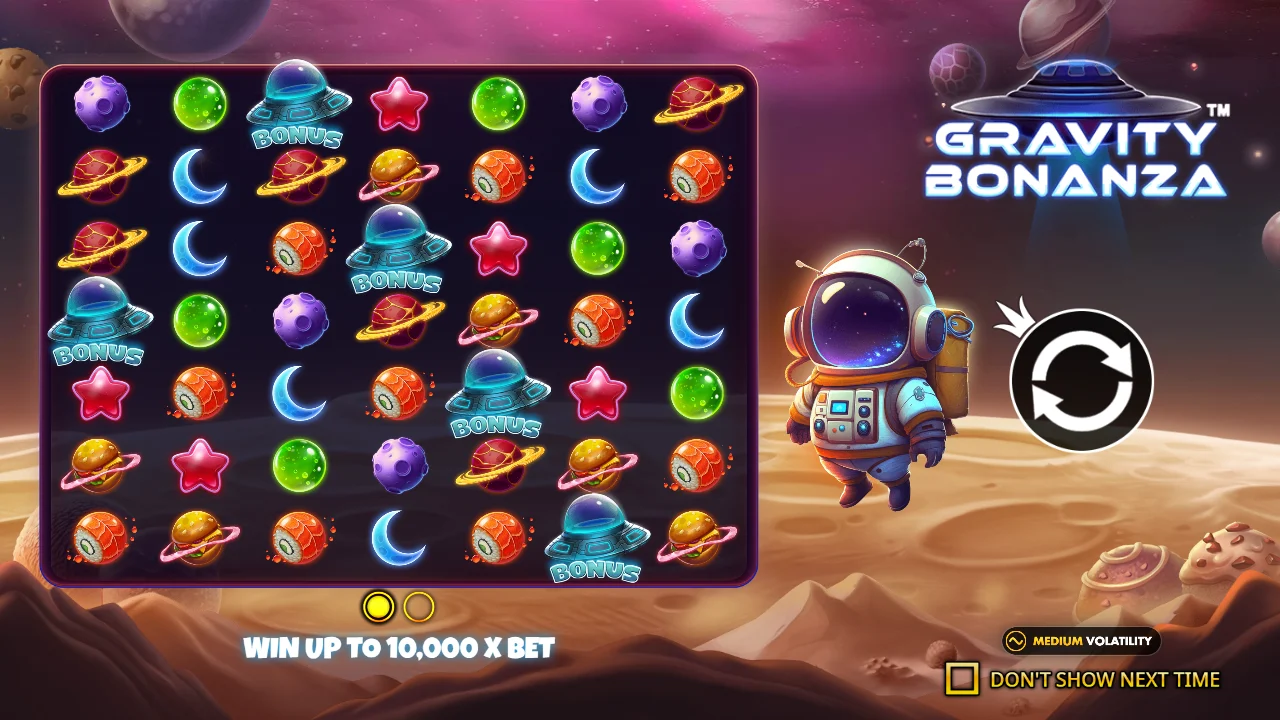
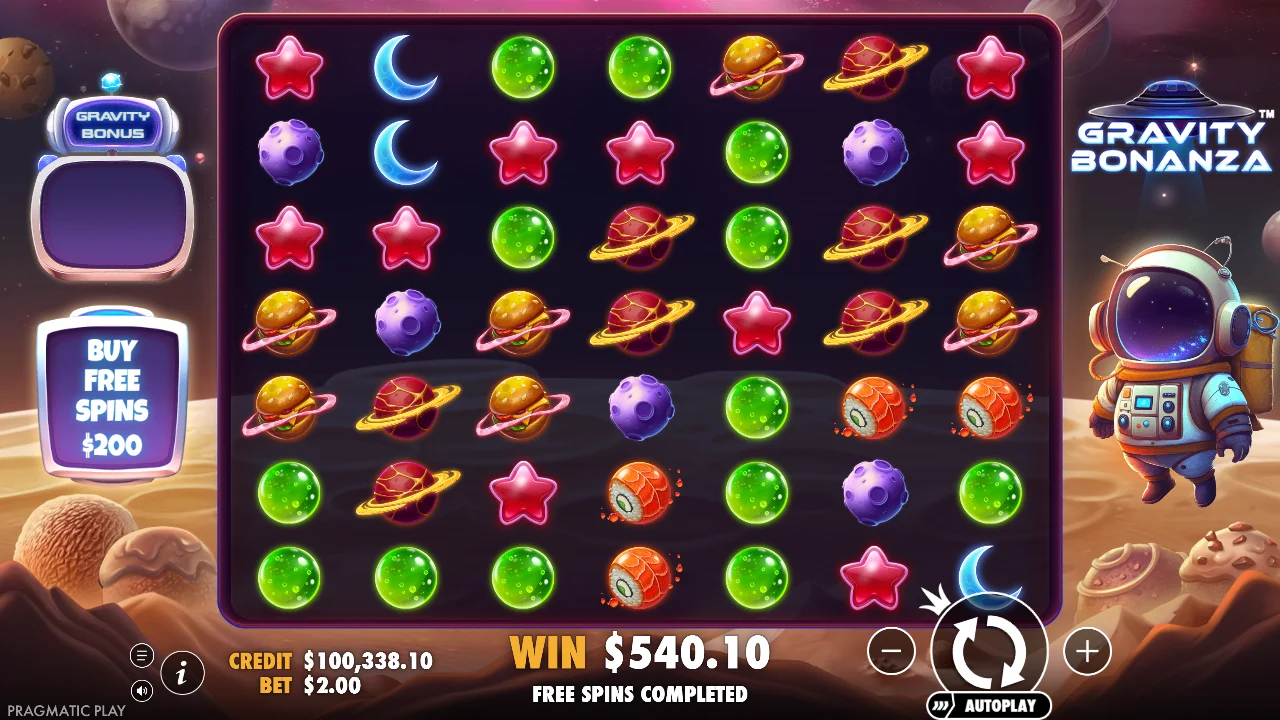
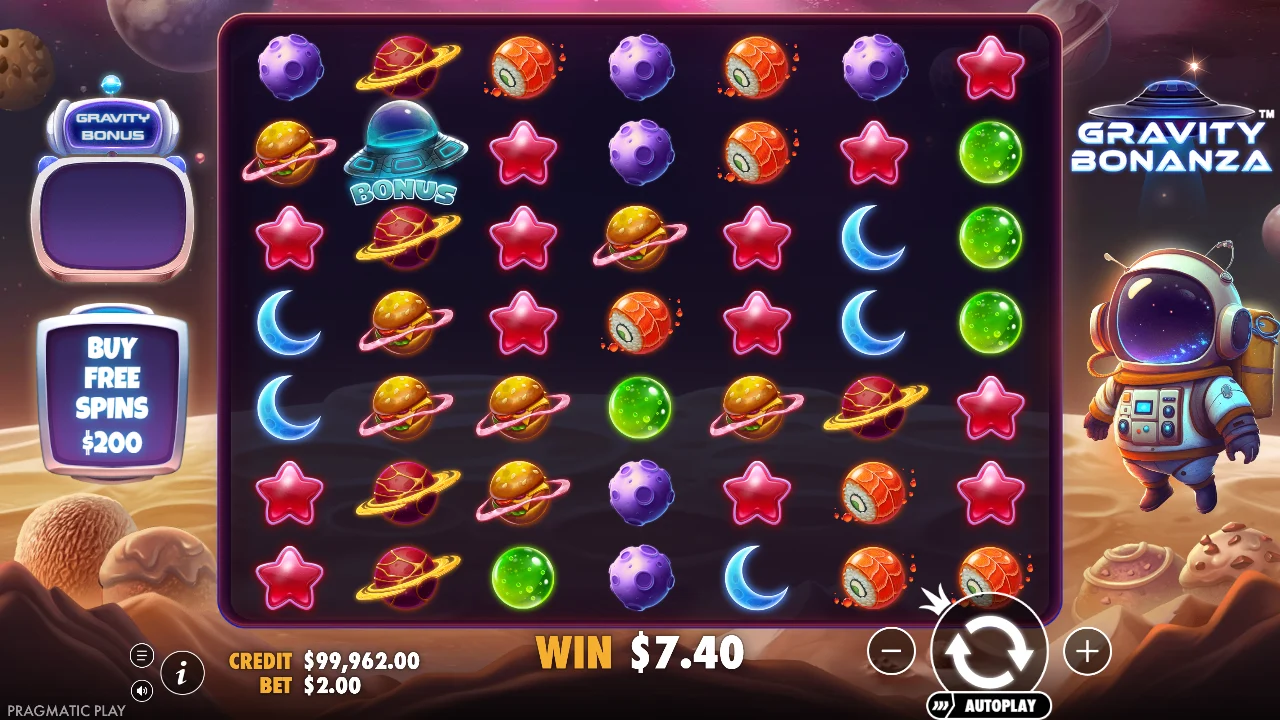
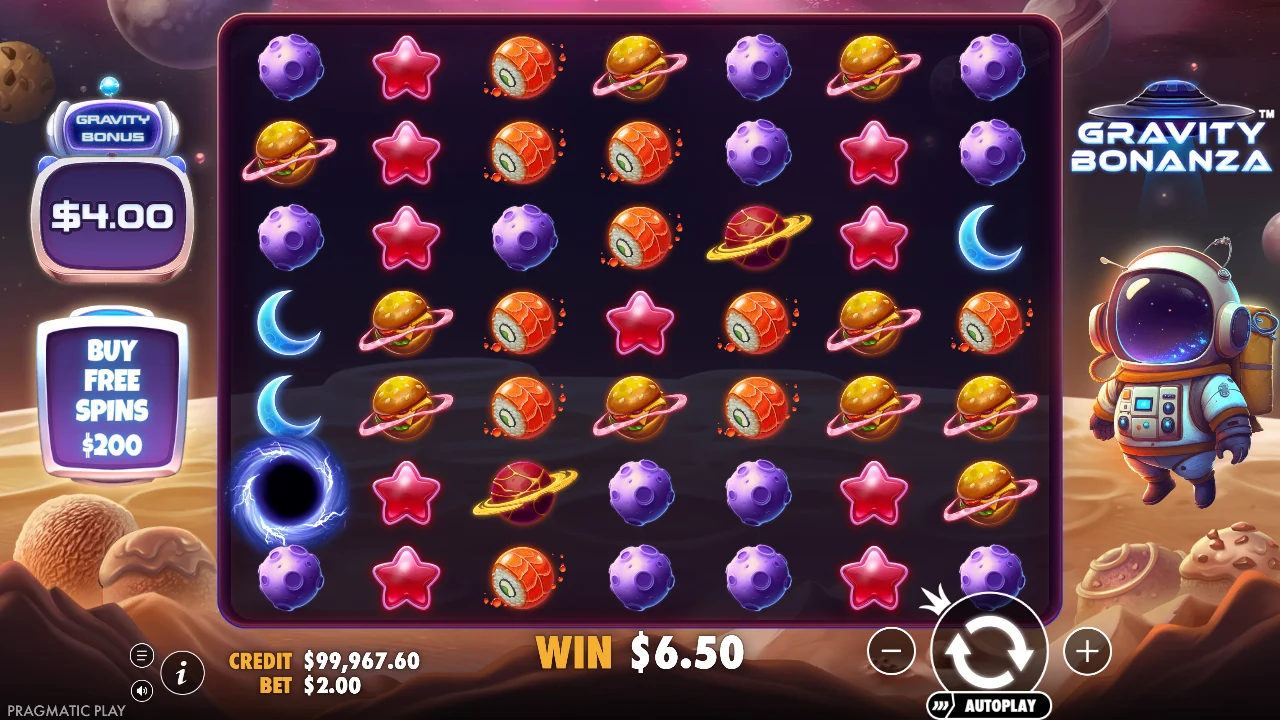
Verdict
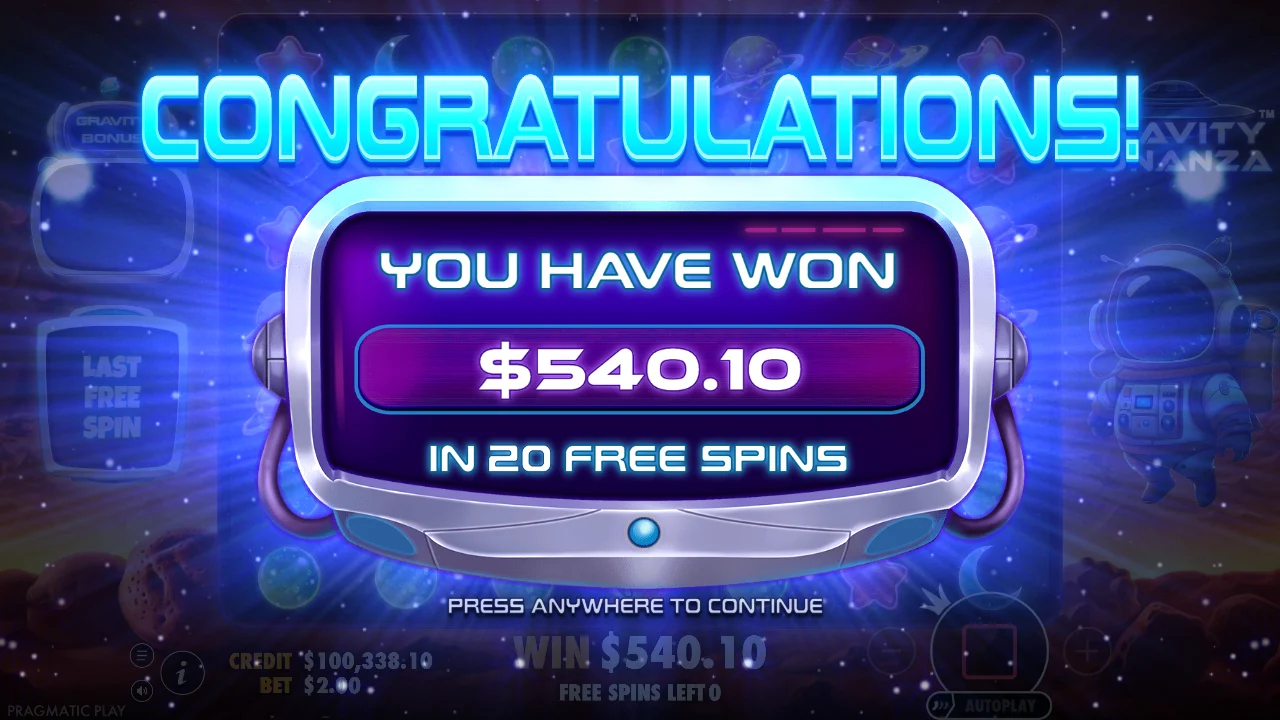
The meter pays, the blocks waitTen thousand ordinary spins returned 111.51% of stake against the 96.09% in the rules, and the approximate 95% band, 68.7 to 154.3%, is that wide because one round did most of the work. Round 5105 paid USD 3,701.20, 1,850.6x the stake, across 30 free spins; without it the other 9,999 rounds returned 93.02%. The balance closed at USD 102,302.80, 1,151 stakes up, but fifty stakes lasted only 184 spins on the way and a hundred lasted 280.
Black holes did the paying. In ordinary play one landed every 13.5 rounds, 741 times in all, and their awards made 46.7% of everything the reels returned outside the feature; across the whole series, natural free spins included, 64.3% of the return came through the Gravity Bonus meter and 35.7% through ordinary blocks. The base record, 602.05x on round 1027, was one black hole that gathered 19 Moons for USD 1,200 after three blocks worth USD 4.10 together.
Purchases fared worse: fifty tickets at USD 200 came back at 0.9659x of price on average, 96.59% against the 95.99% printed for the buy, yet the median ticket returned 0.2175x, USD 43.50, and 32 of the 50 lost money. Ticket 47 carried the sample: on its tenth spin a x3 black hole collected 17 burger planets for USD 1,200 of its USD 1,272.70, and without that ticket the other 49 returned 0.8557x. Six tickets retriggered, ten extra spins apiece, and three opened with 15 spins from four UFOs.
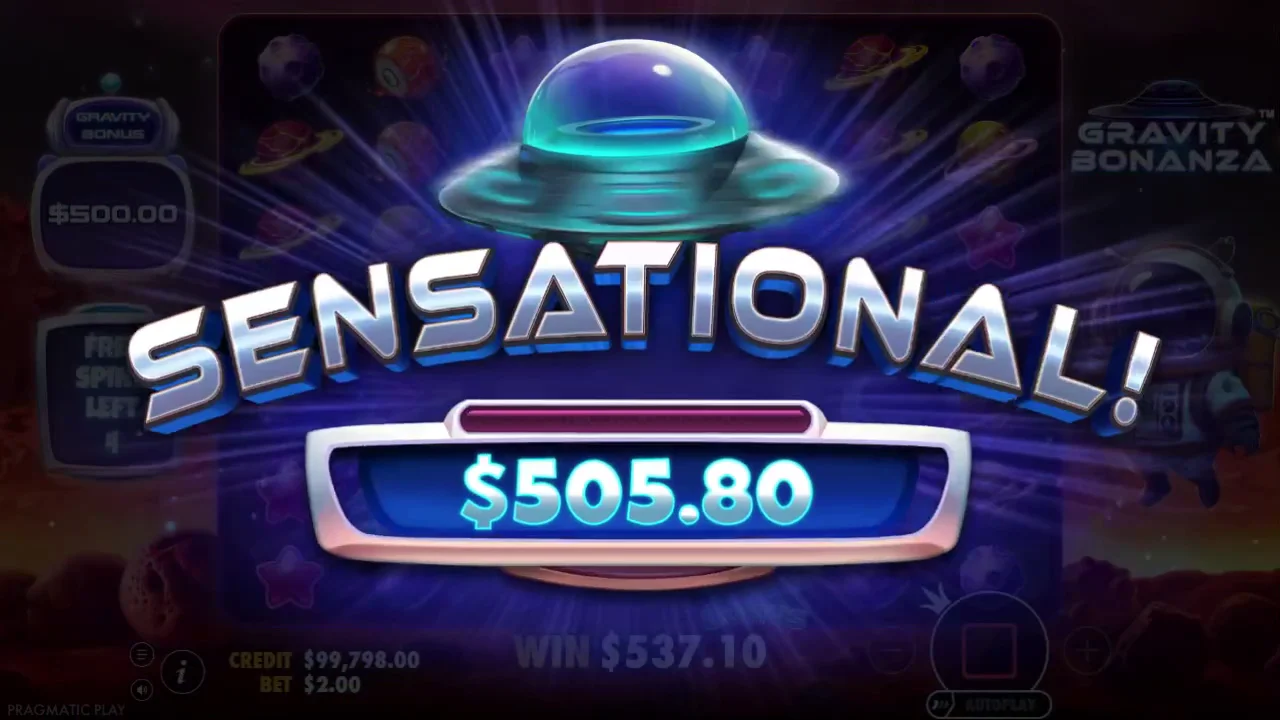
One collection can be the whole feature. Round 5105 started with ten spins, added ten on its fourth spin and ten again on its eleventh, and in between took USD 500 from 20 purple planets on spin ten and USD 3,000 from 23 of them under a x3 multiplier on spin eleven. Those two awards were 94.6% of the USD 3,698.70 the feature paid; everything else in the round, 28 other spins and the blocks beside those two collections, came to USD 198.70.
- A black hole landed in one ordinary round out of 13.5 and its awards made 46.7% of the base-game return
- Every 2.67 spins brought a hit, the median one worth 0.75x, and the longest run of empty screens was 17
- Round 5105 turned 23 purple planets under a x3 multiplier into USD 3,000 on a single free spin, 1,500x the stake
- The downloadable log holds every collection, multiplier and tumble of the 83 recorded features
- Strip out round 5105 and the remaining 9,999 spins returned 93.02%, with fifty stakes lasting 184 spins
- Thirty-two of 50 tickets lost, and the median one returned USD 43.50, 0.2175x of its USD 200 price
- The median natural feature paid 18.0x the stake FS-only, and the longest wait between two triggers was 829 spins
- 208 of the 741 ordinary black holes gathered fewer than five symbols and paid nothing
Test record
10,000 rounds · 50 buys · open data · closed rigOne test run so far: a single session of the base game plus a separate series of bonus purchases on the official demo server, every request and response logged. When the game is tested again, the new run is added here and the figures on this page combine all runs into one sample.
- 10,000rounds logged
- 37%rounds that paid
- 1,851xbiggest round
- 1 / 303natural bonus rate
- 0.97xmean of 50 buys
- 17longest dry streak
01run
Run 012026-09-20
10,000 rounds at USD 2.00 · 50 buys · rig 0.6.0 · RTP profile 96.09%
measured return111.51%+15.4 pts vs declared
Run 012026-09-20
10,000 rounds at USD 2.00 · 50 buys · rig 0.6.0 · RTP profile 96.09%
- 95% band
- 68.7–154.3%
- rounds that paid
- 37%
- biggest round
- 1,851x · round 5,105
- longest dry streak
- 17
- natural bonuses
- 33 · one per 303 rounds
- bonus buys
- mean 0.97x · median 0.22x · 64% below price
- balance start → end
- 100,000 → 102,303
- deepest drawdown
- 1,367x
10000 ordinary paid rounds, including naturally triggered features, at a fixed USD 2.0 bet; 50 bonus buys at 200.0 each (100.0x) on the official Pragmatic Play demo server (jurisdiction 99, RTP profile 96.09%); every request and response logged; test run 2026-09-20.
The test rig recorded every round on the official demo server. Screenshots and video were captured in a separate browser session and are not part of the statistical samples. This release has completed automated data, content and page checks; human editorial review is pending. How we test →
FAQ
5 questions · answered from the logGravity Bonanza RTP: why 111.51% when the rules print 96.09%?
Because round 5105 alone returned USD 3,701.20, 1,850.6x the stake; the other 9,999 rounds paid 93.02%, and the approximate 95% range around that average, 68.7 to 154.3%, is wide for the same reason. Hits came every 2.67 spins at a 0.75x median, and the balance finished USD 2,302.80 above its start.
What is a black hole worth?
The block price of the collected symbol for the number collected, multiplied only inside free spins. In ordinary play it landed 741 times, once per 13.5 rounds; 533 of those collections reached the five-symbol minimum and paid 5.99x the stake on average with a 1.0x median, 208 gathered fewer than five and paid nothing, and the biggest, 19 Moons on round 1027, paid USD 1,200.
Bought free spins: did the USD 200 tickets pay?
The 50 tickets, USD 200 each, returned 96.59% of their price, 0.9659x on average against the 95.99% the rules quote for the buy, but the median ticket came back at 0.2175x, USD 43.50, and 32 of 50 lost. Black holes made 85.1% of the purchased payout; ticket 47 turned 17 burger planets at x3 into USD 1,200, and without it the other 49 returned 0.8557x.
Free spins by nature: how far apart, how big?
Thirty-three natural triggers, spaced 303 spins apart on average, with the longest wait 829 spins between rounds 419 and 1249; at USD 2 that interval is USD 606.06 of turnover per trigger, not the net cost of one. FS-only the rounds paid 130.75x the stake on average and 18.0x in the middle; without round 5105 the other 32 averaged 77.04x at a 17.925x median.
Do the x2 to x10 multipliers turn up often?
In the 33 natural rounds the black hole landed 134 times: 56 at x1, 36 at x2, 30 at x3, seven at x5 and five at x10, and 26 of the 33 rounds collected at least one multiplied award. The best x10 was 14 green orbs on round 406 for USD 240, 120x, while purchases saw six x10 events, the largest 16 red planets on ticket 37 for USD 800.
Also tested
4 more slots on the same rig-
 Beast Mode
Relax Gaming · 2026-09-20 · 10,000 spins
RTP
96.3 → 78.1%
hit33%
max201x
buy0.88x
Beast Mode
Relax Gaming · 2026-09-20 · 10,000 spins
RTP
96.3 → 78.1%
hit33%
max201x
buy0.88x
-
 Snake Arena
Relax Gaming · 2026-09-13 · 10,000 spins
RTP
96.3 → 87.4%
hit22%
max90x
buy1.08x
Snake Arena
Relax Gaming · 2026-09-13 · 10,000 spins
RTP
96.3 → 87.4%
hit22%
max90x
buy1.08x
-
 Bigger Bass Splash
Pragmatic Play · 2026-09-08 · 10,000 spins
RTP
96.5 → 98.5%
hit16%
max50x
buy1.07x
Bigger Bass Splash
Pragmatic Play · 2026-09-08 · 10,000 spins
RTP
96.5 → 98.5%
hit16%
max50x
buy1.07x
-
 Gates of Olympus
Pragmatic Play · 2026-09-18 · 40,000 spins
RTP
96.5 → 91.3%
hit29%
max323x
buy1.03x
Gates of Olympus
Pragmatic Play · 2026-09-18 · 40,000 spins
RTP
96.5 → 91.3%
hit29%
max323x
buy1.03x
Field notes
0 notes