Are Online Slots Rigged? The Same Slot Tested Twice, Run Against Run
The lab runs some slots more than once: same game, same demo server, same stake, a fresh session weeks later. If a game were tuned to pay less after a generous session, or to drift away from its declared RTP, the second run is where it would show. This article compares every re-tested slot run against run, checks whether the gaps are bigger than chance allows, and looks at what happens in the hundred spins after a big win.
Are online slots rigged? What a second run can show
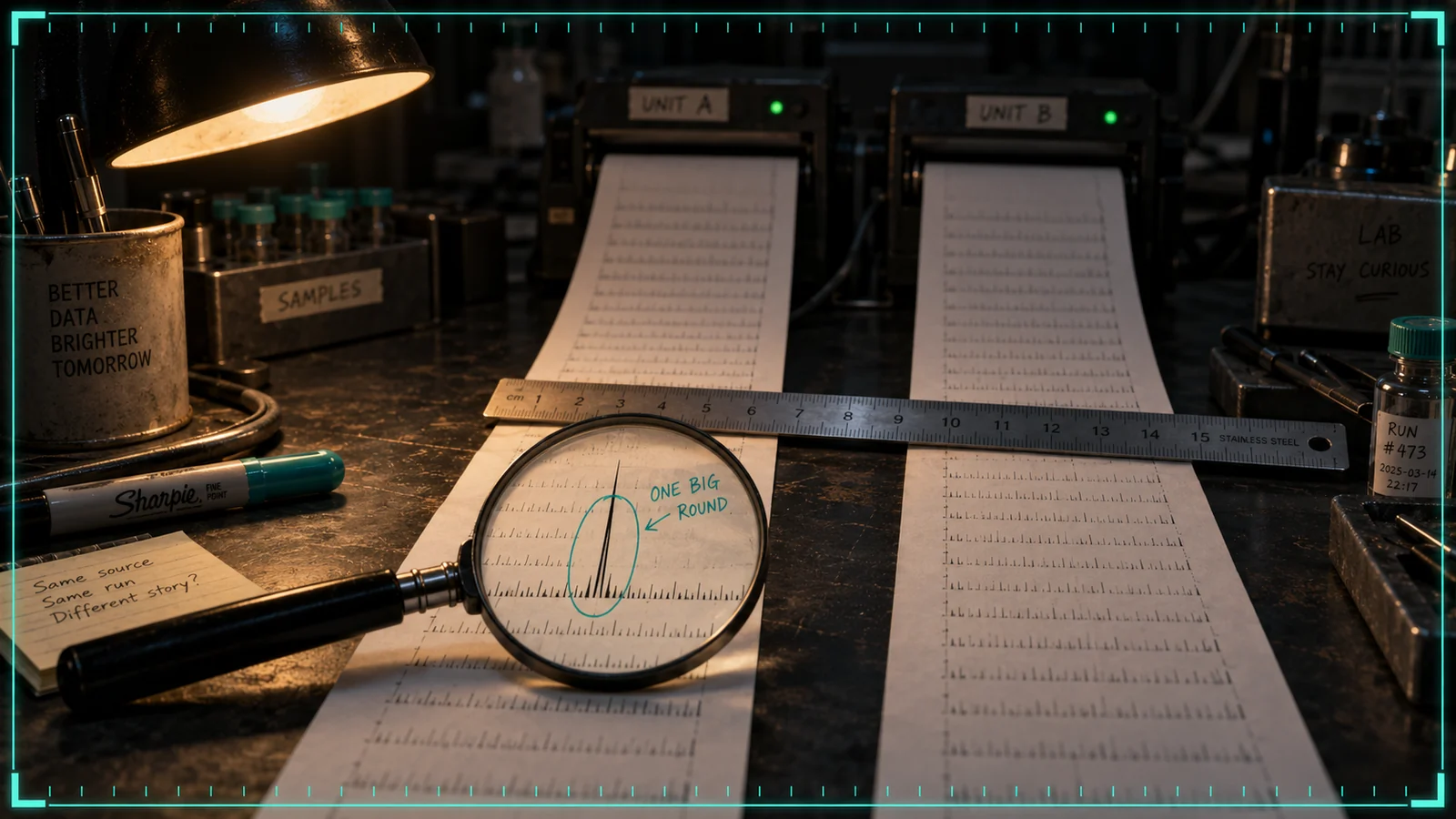
Every slot review here starts with one long series on the studio’s official demo server. A single series cannot answer the question players actually ask on forums, because one result fits both stories: a session far below the declared RTP is what bad luck looks like, and it is also what a game set to pay less would look like. Running the same game again is the simplest way to separate the two. A fair game with fixed maths should produce runs that disagree by roughly the amount the statistics predict, no more, and should show no sign of remembering what the previous run paid.
So far 112 slots have been tested more than once, 295 runs and 2,950,000 rounds in total; 49 of them have three runs or more, and the longest series, 7 runs, belongs to Top Dawg$. That is enough to ask three precise questions instead of one vague one. Do runs of the same game differ more than chance allows? Does the second run lean against the first, paying less after a good session? And does a big win change the spins that follow it?
How a slot is re-tested here
A re-test repeats the original run on the same terms: the same game build on the studio’s own demo server, the same stake, the same number of ordinary rounds and, where the game sells its bonus, the same number of purchases. Only the session is new, opened days or weeks later with a fresh demo balance. Each run gets its own log with a checksum, and the review page then shows every run separately and all of them pooled into one longer sample, the way the walk-through of one test describes for Gates of Olympus.
Nothing about the runs is chosen after the fact. The lab decides which games to re-test before seeing the new result, a run is never discarded for its result, and the pooled figure on each review simply adds the new rounds to the old ones. That matters for the question in the title: a re-test that could be dropped when it looked odd would prove nothing either way.
How much does RTP change between two runs of the same slot?
A lot, and far more than the hit rate or the bonus rhythm. Across the re-tested games the gap between the highest and the lowest run has a median of 14.1 percentage points of RTP, and 34 games show a gap of 20 points or more. At the extremes, Big Bass Bonanza Reel Action repeated itself within 0.4 points, while Top Dawg$ spread over 188.7.
The wide rows all have the same anatomy. In the runs logged by 3 October 2026, Top Dawg$ returned 274.3% in its first run because of one round worth 18,146 bets, then 85.5%, 93.9% and 97.3% in three runs without such a round. Tombstone R.I.P went the other way, 66.7% and then 140.9% once a 4,283x feature landed in the second series; Wild Beach Party fell from 144.9% to 74.6% when its 3,013x base spin did not come back. Remove the single largest round and these pairs stop looking dramatic. A run’s RTP is mostly a record of whether the tail showed up, which is why the max win study finds so little connection between a game’s ceiling and a session’s result.
Is the difference between runs bigger than chance?
Every run carries a 95% band, the range its RTP would fall in if the same game were played again and again. Two runs of a fair game should disagree by about the width of those bands, and the lab tests each game for exactly that: a weighted check of all its runs against one common RTP, which flags a game when its runs are further apart than chance produces 19 times in 20. For a set of fair games the expected number of flags is one in twenty, about 5.6 here.
The number of re-tested games flagged is 2: Fire in the Hole 2, Madame Destiny Megaways. In the runs logged by 3 October 2026 the only flag came from Fire in the Hole 2, moving from 74.8% to 100.3% over two consecutive days, a gap just past the line; by 14 October 2026 Madame Destiny Megaways had joined it, a third run of 82.52% after 98.3% and 99.61%. A flag or two in a set this size is what fair maths predicts rather than a warning. The games with the widest gaps are not flagged at all: Top Dawg$’s first band ran from below zero to over 600%, because one enormous round makes a run’s uncertainty enormous too.
| game | runs | RTP by run, % | spread, pts | pooled | declared | within chance |
|---|---|---|---|---|---|---|
| Top Dawg$ | 7 | 274.3 · 85.5 · 93.9 · 97.3 · 101.7 · 90.5 · 90.9 | 188.7 | 119.2% | 96.10% | yes (p 0.50) |
| Zeus vs Hades - Gods of War | 6 | 107.1 · 190.5 · 80.0 · 67.7 · 78.6 · 90.2 | 122.9 | 102.3% | 96.05% | yes (p 0.47) |
| Folsom Prison | 6 | 181.2 · 125.7 · 93.7 · 75.6 · 119.4 · 75.5 | 105.7 | 111.9% | 96.07% | yes (p 0.10) |
| Tombstone R.I.P | 4 | 66.7 · 140.9 · 90.2 · 75.3 | 74.2 | 93.3% | 96.08% | yes (p 0.22) |
| Wild Beach Party | 2 | 144.9 · 74.6 | 70.3 | 109.7% | 96.53% | yes (p 0.06) |
| Dog House Megaways | 4 | 95.4 · 92.3 · 135.9 · 79.7 | 56.3 | 100.8% | 96.55% | yes (p 0.06) |
| Book of 99 | 3 | 137.2 · 89.4 · 95.3 | 47.8 | 107.3% | 99.00% | yes (p 0.61) |
| Danger High Voltage | 2 | 87.1 · 130.6 | 43.6 | 108.8% | 96.22% | yes (p 0.06) |
| Elvis Frog TRUEWAYS | 3 | 138.5 · 100.1 · 97.9 | 40.6 | 112.2% | 96.70% | yes (p 0.13) |
| Gems Bonanza | 3 | 92.5 · 81.1 · 121.4 | 40.3 | 98.3% | 96.55% | yes (p 0.26) |
| Chilli Heat Megaways | 3 | 104.9 · 126.3 · 86.2 | 40.2 | 105.8% | 96.50% | yes (p 0.06) |
| Might of Ra | 4 | 78.7 · 79.5 · 89.2 · 117.9 | 39.2 | 91.3% | 96.49% | yes (p 0.35) |
The bottom of the same table shows the games whose runs agreed most closely. A small cap is not what they share: on 3 October 2026 several advertised 100,000x or more. What they share is that neither run caught an outsized round, so both series measured the same middle of the game. Money Train 4’s two runs, 92.7% and 93.2%, were the closest pair in the logs to 3 October 2026; the current closest is Big Bass Bonanza Reel Action, within 0.4 points.
| game | runs | RTP by run, % | spread, pts | pooled | declared | within chance |
|---|---|---|---|---|---|---|
| Big Bass Bonanza Reel Action | 2 | 93.1 · 92.7 | 0.4 | 92.9% | 96.50% | yes (p 0.97) |
| Fruit Party 2 | 2 | 88.5 · 89.0 | 0.4 | 88.7% | 96.53% | yes (p 0.97) |
| Money Train 4 | 2 | 92.7 · 93.2 | 0.5 | 92.9% | 96.10% | yes (p 0.97) |
| Cash Patrol | 2 | 99.2 · 99.9 | 0.8 | 99.6% | 96.50% | yes (p 0.93) |
| Book of the Fallen | 2 | 81.7 · 82.6 | 0.9 | 82.1% | 96.50% | yes (p 0.95) |
| Big Bad Wolf MEGAWAYS | 2 | 87.6 · 88.7 | 1.1 | 88.1% | 96.05% | yes (p 0.89) |
What stays the same from run to run
The rhythm of a slot barely moves. The share of rounds that pay anything differs between runs of the same game by a median of 0.55 percentage points, and the largest gap in the lab is 2.0 points, in Evil Bet: Cursed Spin. The number of natural bonuses varies more, a median ratio of 1.20 between the busiest and the quietest run, because bonuses are rare events counted in dozens rather than thousands. The largest round is the least repeatable figure of all: a median ratio of 1.9 between the biggest and the smallest best round, up to ×118 in Top Dawg$.
| figure | games | typical gap | largest gap | games beyond chance |
|---|---|---|---|---|
| measured RTP | 112 | 14.1 pts | 188.7 pts | 2 / 112 (chance alone: about 5.6) |
| hit rate | 112 | 0.55 pts | 1.99 pts | 7 / 112 (chance alone: about 5.6) |
| natural bonuses, most / fewest | 110 | ×1.20 | ×3.40 | 4 / 110 (chance alone: about 5.5) |
| bought-bonus return | 84 | 22.7 pts | 197.7 pts | 3 / 84 (chance alone: about 4.2) |
| largest round, biggest / smallest | 112 | ×1.9 | ×118.2 | — |
The last column is the useful one. For each figure it counts the games whose runs differ by more than chance allows, next to the number a set of fair games would produce on its own. Hit rate, bonus counts and bought-bonus returns all sit close to that baseline: 7 games on hit rate, 4 on bonus frequency and 3 of 84 on purchases. The bonus outlier, Gates of Olympus 1000, logged 34, 23, 24 and then only 10 bonuses in its four runs to 3 October 2026, and its fourth run was also its weakest at 77.9%; a dry series of that length is rare, and in a lab running dozens of series a rare series is expected somewhere.
Do slots pay less after a big win?
This is the most common version of the rigging question, and the logs answer it directly. Each round of 100x or more in every run, re-tested or not, was taken as a starting point, skipping any that fell inside an earlier window, and the next 100 ordinary rounds were compared with what the same run produced on average. If games tightened after paying out, those windows would pay less often, trigger fewer bonuses and return less money.
| measure | in the 100 rounds after | expected from the same runs | difference, standard errors |
|---|---|---|---|
| rounds that paid anything | 46,137 | 46,188 | −0.3 |
| natural bonus triggers | 907 | 953 | −1.5 |
| money returned, as RTP of the window | 96.8% | 100.3% | −0.8 |
They do not. After 1,755 big wins the next hundred rounds paid something almost exactly as often as the runs’ own averages predict, 46,137 times against 46,188. Bonuses came slightly less often and the money returned was slightly lower, but both differences are inside the noise: chance alone produces a gap of one standard error about one time in three, and of one and a half about one time in seven. A slot that had just paid 100 bets went on paying the way it always paid.
Does a slot tighten up after a generous run?
The same question at the scale of a whole session: if the first run paid above the declared RTP, does the second pay below it? In 48 re-tested games the first run finished above the declared figure; their second runs finished above it again in 58% of cases. After a first run at or below the declared figure the share was 48%. A game that compensated would push those two numbers apart; here they are almost the same.
| first run | games | first run vs declared, median pts | second run vs declared, median pts | second run above declared |
|---|---|---|---|---|
| first run above the declared RTP | 48 | +7.9 | +3.2 | 28 / 48 (58%) |
| first run at or below it | 64 | −9.1 | −0.5 | 31 / 64 (48%) |
| all re-tested games | 112 | −1.6 | +0.9 | 59 / 112 (53%) |
The correlation between how far the first and the second run landed from the declared RTP is 0.01, small and not a pattern a player could use: a generous first run says nothing about the second. Nor did second runs come in lower as a rule. They finished above the first run in 70 of 112 games and below it in 42, with an average of 98.9% against 97.5% for first runs, and the largest round of a game’s runs came in a later run 70 times and in the first 42 times.
Why more rounds bring the number closer to the declared RTP
Pooling the runs does what statistics says it should. Measured against the declared RTP, the first run of a re-tested game missed by a median of 8.6 points; all of its runs pooled together miss by a median of 4.4, and the pooled figure is closer than the first run in 72 of 112 games. Where it is not, the first run had usually landed within a few points of the declared figure already, so a second run could only add noise, or a later run caught a big round that pulls the pooled figure up until more rounds pull it back.
The bands deserve one honest caveat. Of the 295 individual runs, 260 contain the declared RTP, 88% rather than the 95% the band nominally promises. The band is built from the spread of the logged rounds, and a run that happens to miss the tail looks both lower and more certain than it really is, so heavy-tailed games fall outside slightly more often than a textbook band would. That is a limit of a 10,000-round series, not a sign of a game drifting, and it is the reason the reviews show every run instead of trusting any single one.

Every re-tested slot
The register lists every game with two or more runs, using the pooled figures; each review’s Test record shows the runs one by one, with their logs and checksums. Sort by measured RTP to see that the pooled numbers cluster far more tightly than the first runs did, and by largest round to see which games owe their result to one spin.
- slot · tested /
-
 Esqueleto Explosivo 3
Thunderkick · 30,000 spins
2026-11-07
RTP
97.2% 94.2%
hit28%
max102x
buy1.15x
bonus3.6 bHz
-
 Tombstone Begins
Nolimit City · 30,000 spins
2026-11-07
RTP
89.5% 96.0%
hit20%
max328x
buy1.08x
bonus4.3 bHz
-
 Big Bad Wolf Christmas Special
Quickspin · 30,000 spins
2026-11-07
RTP
105.9% 97.3%
hit31%
max76x
buy—
bonus7.7 bHz
-
 Big Bass Christmas Bash
Pragmatic Play · 30,000 spins
2026-11-07
RTP
103.2% 96.7%
hit14%
max140x
buy0.77x
bonus9.3 bHz
-
 Elvis Frog TRUEWAYS
BGaming · 30,000 spins
2026-11-07
RTP
112.2% 96.7%
hit23%
max1,275x
buy0.95x
bonus3.4 bHz
-
 Big Catch Even Bigger Bass
Blueprint Gaming · 30,000 spins
2026-11-06
2026-11-07
RTP
96.3% 95.0%
hit22%
max360x
buy—
bonus5.2 bHz
-
 Gluttony
Nolimit City · 30,000 spins
2026-11-06
2026-11-07
RTP
92.1% 96.1%
hit26%
max416x
buy0.92x
bonus3.2 bHz
-
 Gemhalla
BGaming · 30,000 spins
2026-11-06
2026-11-07
RTP
102.8% 97.2%
hit31%
max750x
buy0.87x
bonus6.4 bHz
-
 Bigger Bass Blizzard Christmas Catch
Pragmatic Play · 30,000 spins
2026-11-06
2026-11-07
RTP
104.2% 96.1%
hit12%
max72x
buy0.95x
bonus9.1 bHz
-
 Star Clusters Megapays
Big Time Gaming · 30,000 spins
2026-11-06
2026-11-07
RTP
90.3% 96.3%
hit27%
max99x
buy—
bonus10.8 bHz
-
 Fishin' Frenzy Even Bigger Catch
Blueprint Gaming · 20,000 spins
2026-11-06
RTP
84.9% 95.0%
hit18%
max87x
buy1.18x
bonus7.3 bHz
-
 Danger! High Voltage Megapays
Big Time Gaming · 20,000 spins
2026-11-06
RTP
100.8% 96.4%
hit41%
max377x
buy—
bonus5.4 bHz
What a re-test cannot prove
A re-test shows that a game behaves consistently on its official demo server: same rhythm, the same spread of results, no memory of the last session and no reaction to the last big win. It cannot see inside a real-money casino. Regulated studios certify each RTP version of a game and serve the same builds to demo and real-money play; which version a casino runs is stated in the help screen of that casino’s copy. The practical check for a player is therefore the RTP printed in the game’s own rules at the casino, compared with the figure on the review.
It also cannot make a short session predictable. The same games that agree within a few points of hit rate disagree by tens of points of RTP over 10,000 rounds, and an evening is a few hundred rounds. The declared-versus-measured report and the volatility report show what that spread means per game; this article only shows that the spread is the same on the second pass as on the first.
What changes as runs are added
Every table, figure and number above recomputes from the current set of runs whenever one is published; the after-a-big-win table is the one static piece, counted on 3 October 2026 from the round logs. Two things should hold as the set grows. The number of games flagged as beyond chance should keep tracking one in twenty of the re-tested games, sometimes a little above, sometimes below. And the second-run share above the declared RTP should stay the same after a generous first run as after a poor one. If either drifts away and stays away, that will be worth its own section here.